
Silver has had a run that caught most investors off guard. After years of playing second fiddle to gold, it tore through 2025 with gains that left equities, bonds and most other commodities in the dust. Now trading above US$90/oz, the question on every ASX investor’s mind is whether the rally has legs or whether we’re buying at the top.
For Australian investors, silver sits in an unusual spot. It behaves partly like gold, with safe-haven flows pushing prices higher when markets get nervous. But it also behaves like an industrial metal, with demand tied to solar panels, EVs, electronics and more. That split personality makes it more volatile than gold when it goes both up and down, and it means the pathway from a higher silver price to a higher share price can get complicated.
Let’s dive in.
What’s the Impact of Silver Prices on the ASX?
Silver is trading at all-time highs after one of its strongest years on record. Bloomberg called out silver alongside gold, copper and tin as metals hitting fresh highs – a sign that money is flowing back into commodities after years on the sidelines.
The Silver Institute’s latest data has the global market heading for its fifth straight year in deficit. Demand has exceeded mine supply every year since 2021, with cumulative shortfalls now approaching 800 million ounces.
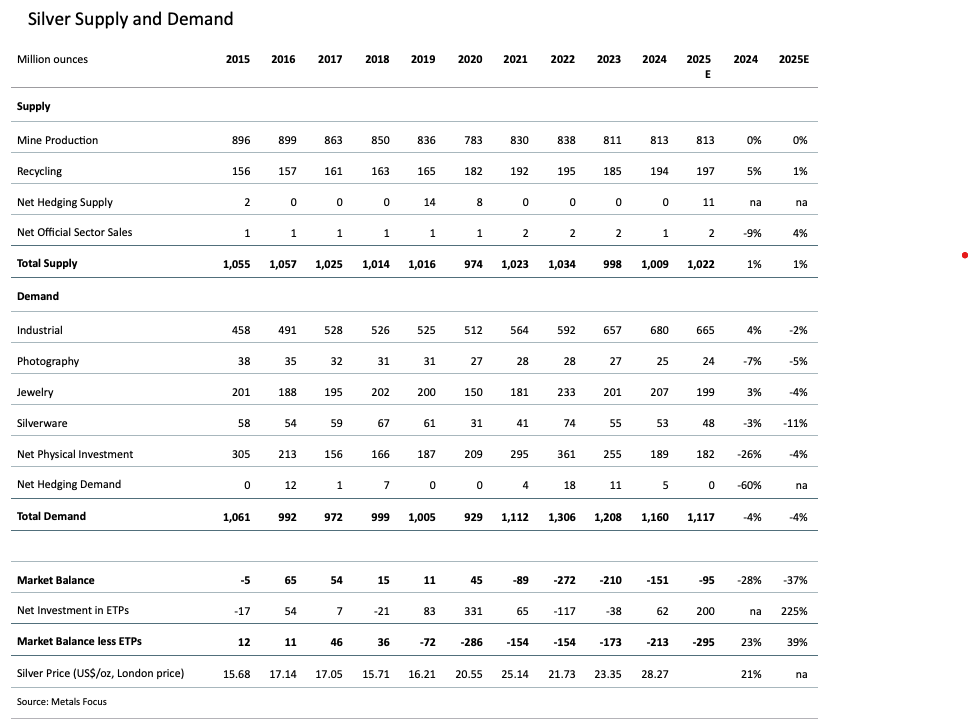
Industrial uses are driving the bus. Sprott estimates around 59% of silver demand now comes from sectors like solar, EVs and electronics, tying the metal’s fortunes to the energy transition rather than just safe-haven flows. That’s a meaningful shift from a decade ago, and it changes how you should think about silver in a portfolio.
At the start of 2025, silver was trading around US$29-31/oz. By late December, prices had surged to the low 70s, with intraday highs pushing into the low 80s in the final week. That’s a move of well over 100% for the year, far outpacing most equity indices and even beating gold’s very strong performance.
The macro tailwinds that pushed gold higher did the same for silver. Expectations of looser US monetary policy and a weaker dollar pushed investors toward precious metals as a hedge. Persistent inflation concerns added to the bid. Once gold started printing new all-time highs near US$4,400/oz, silver became the “high-beta” alternative for anyone who wanted more torque on the trade.
Supply kept falling short too. The Silver Institute flagged a fifth consecutive structural deficit, reinforcing the narrative of tightening physical availability. When demand exceeds mine supply for five years running, inventories draw down and the market eventually notices.
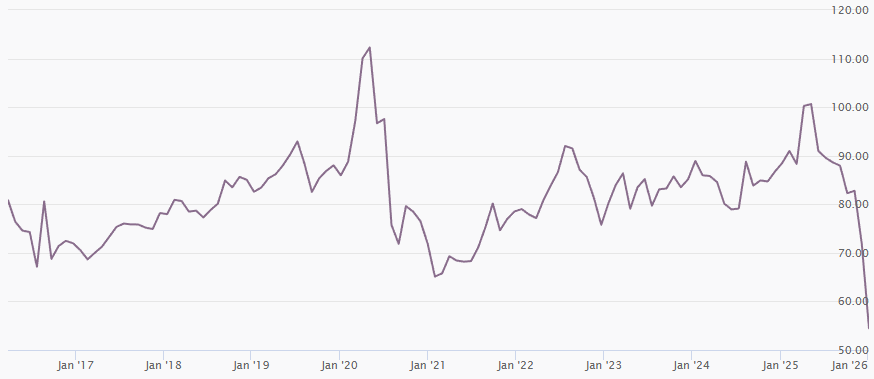
The gold-silver ratio also compressed hard. At the start of 2025, it sat above 100:1. By year-end, it had dropped toward the 60s. For traders who watch that ratio as a mean-reversion signal, the compression attracted momentum buying that fed on itself.
For ASX silver producers and developers, every sustained step up in the silver price can translate into serious operating leverage. Costs tend to move slowly while revenue per ounce moves quickly. A project that looked marginal at US$25/oz can start to make sense at US$90/oz, which is why developers often rally harder than producers when the price spikes.
The pathway is not always linear though. Index rebalancing in early 2026 is forcing large sales of silver futures, which can create sharp pullbacks that hit ASX silver equities harder than the metal itself. For investors, that means volatility around rebalancing dates and macro headlines, but also opportunities to buy quality names when futures-driven selling overshoots the fundamentals.
The key is separating the signal from the noise. A 5% pullback because of index mechanics is different from a fundamental shift in the silver story. Both might look the same on a daily chart.
What Are the Pricing Predictions and Forecasts for Silver?
After a historic breakout, the debate for 2026 is less about whether prices stay elevated and more about how far they can realistically run before momentum cools. Forecasts range from the conservative to the wildly bullish, and the gap tells you something about how uncertain the outlook is.
The World Bank sits on the cautious end, projecting silver to average about US$41/oz in 2026 before easing toward US$37/oz in 2027. That view implies a meaningful step down from today’s spot price and assumes most of the easy money from safe-haven buying and rate-cut speculation has already been made.
The big global banks sit noticeably higher. JP Morgan is targeting around US$58/oz, with UBS in the mid-50s near US$55/oz. Both see silver benefiting from lower real rates and ongoing supply tightness, but neither expects the 2025 rally to extend in a straight line. Citigroup stands out as one of the more optimistic houses, flagging potential for silver to push toward US$70/oz in a strong-demand, weak-dollar scenario.
Bank of America’s commodities team is also bullish. They describe silver as highly leveraged to both monetary and industrial themes, with scope for prices to top out around the mid-60s in their base case. In more aggressive scenarios, they see room for triple digits if the gold-silver ratio compresses sharply and deficits deepen.
Specialist precious metals managers add further nuance. Sprott’s 2026 outlook emphasises multi-year structural deficits, de-dollarisation dynamics and lower real yields as forces likely to keep silver structurally stronger than in the prior decade, though they avoid a single number and point to a high but volatile trading range. Industry commentary from GoldSilver sketches upside scenarios toward US$100-175/oz as tail events dependent on faster rate cuts, a weaker dollar and stronger energy-transition demand.
Today’s US$90/oz print sits above where most economists expect the annual average to land. Conservative institutions cluster near the low 40s, major bank forecasts coalesce in a US$50-65 band, and only a small group of ultra-bulls argue for sustained triple-digit silver.
Should I Invest in Silver or Gold?
The choice between silver and gold comes down to how much volatility you can stomach and what you want the metal to do in your portfolio.
Gold suits capital preservation and portfolio ballast. Central bank buying and safe-haven flows can support prices even in weaker growth environments. If your primary goal is to hedge against chaos, gold does that job more reliably.
Silver suits investors seeking higher beta exposure to both monetary conditions and industrial demand, accepting the sharper drawdowns that come with that. If you think 2026 will feature lower real rates, ongoing geopolitical tension and a continued push into renewables and electrification, silver gives you more leverage to that view.
An allocation to both can make sense, with gold as the stabiliser and silver as the higher-octane complement. The split depends on how much volatility you can stomach.
Silver vs Gold
Silver and gold get mentioned in the same breath, but they behave very differently once you dig in.
Gold remains the dominant monetary and central bank reserve asset. Real yields and currency moves drive prices, with geopolitical risk adding to the bid when tensions flare. Central banks buy gold. They do not buy silver.
Silver now sees most of its demand from industry, tying it closely to growth, electrification and green-energy capex. That mix means silver tends to be more volatile than gold in both directions. It often outperforms in strong bull phases but underperforms sharply when growth expectations or risk appetite fade.
Compared with other commodities like copper or lithium, silver offers a blend. It has partial safe-haven qualities plus structural industrial demand from similar end markets like solar, EVs and electronics. Lithium has been hammered by oversupply and shifting battery chemistries. Copper’s case rests more squarely on infrastructure and electrification without the safe-haven bid.
Silver’s edge in 2026 is that both macro factors (rates, FX, risk-off flows) and micro factors (multi-year deficits) are pulling in the same direction. That alignment is unusual and worth paying attention to.
Best ASX Silver Stocks to Watch in 2026
With silver trading near all-time highs, here’s a couple that have caught our eye:
Argent Minerals Limited
ASX: ARD
Share price: 6c
Market cap: 76.98m
Argent Minerals is one of those companies most people have never heard of, but once you look under the hood, it gets interesting very quickly. The company owns the Kempfield project in New South Wales, which is Australia’s second largest undeveloped silver deposit, hosting 142.8 million ounces of silver equivalent, including nearly 66 million ounces of silver. The deposit sits in proven mining country near Cadia and the numbers are deliberately conservative, using long term metal prices and realistic recoveries rather than today’s spot prices. With the resource still open at depth and multiple nearby targets yet to be drilled, Argent offers leverage to silver if exploration and development plans continue to move forward.
Broken Hill Mines Limited
ASX: BHM
Share price: $1.15
Market cap: $187.4m
Broken Hill Mines is building a fairly straightforward two project story in one of Australia’s best known mining districts. Its core asset is the Rasp Mine near Broken Hill, a fully developed operation with a 750ktpa processing plant, established underground workings, mobile fleet, rail siding and port access. Rasp has already been mined for over a decade and carries a sizeable lead zinc silver resource, supported by proven metallurgy, concentrate sales history and existing permits. Importantly, the infrastructure is in place and maintained, meaning any restart does not begin from zero.
Alongside this sits the Pinnacles Mine, located roughly 15km south west of Broken Hill. Pinnacles hosts a JORC 2012 Mineral Resource of around 6.0Mt at 10.9% ZnEq, including strong silver grades, with gold not yet included in the equivalent calculation. The deposit is shallow, high grade by global standards, and has seen over 55,000 metres of drilling, with limited historical mining focused only on the richest galena zones. The development logic is simple: grow the Pinnacles resource and feed it into the existing Rasp processing plant, lifting throughput and mine life without needing to build new infrastructure. Together, the two projects position BHM as a genuine restart and expansion play rather than a greenfields story.
Patriot Resources Ltd
ASX: PAT
Share price: 6c
Market cap: $12.9m
Patriot Resources is a small cap silver explorer worth keeping an eye on, mainly because of its Tassa Silver Gold Project in Peru. Tassa already has 26 historical drill holes, with reported silver grades running as high as 383 g/t, which is a strong starting point for a company sitting on a $12 million market cap. That amount of historical drilling shortens the path to something meaningful, because Patriot is not starting from scratch. The project sits in a proven Peruvian mining region and remains open for further drilling, which is where the upside comes from. For silver investors, Tassa is clearly the core asset, with the company also holding copper and lithium exposure as longer dated optionality rather than the main story.
How Do I Invest in Silver?
For an Australian-based investor, there are three primary pathways to investing in silver on the ASX.
First, physical and bullion-backed products. Physically backed ETFs like ETFS Physical Silver (ASX: ETPMAG), plus coins and bars, provide direct exposure to the silver price with minimal company-specific risk. They track the metal but offer no operational leverage. If silver goes up 20%, your ETF goes up roughly 20%. Simple.
Second, ASX-listed miners and developers. These can offer amplified upside to sustained price strength, but introduce project, jurisdiction and execution risks. At the small-cap end of the market, those risks are real. A 20% move in silver might translate to a 50% move in a well-positioned developer, or it might not move the stock at all if management stumbles or permitting drags.
Third, diversified precious metal or resources funds that allocate to silver alongside gold and base metals. These can smooth some of silver’s inherent volatility by spreading exposure across multiple commodities and companies.
Whatever route you take, think about position sizing and whether silver is a hedge, a growth bet on electrification, or a trading vehicle. It will probably remain headline-sensitive through 2026.
In Summary
Silver’s run to around US$90/oz has pushed it well above historical norms. Most credible forecasts for 2026 point to elevated yet volatile prices rather than an endless rally. Conservative institutions like the World Bank sit near the low 40s, the bulk of major banks cluster in a US$50-65 band, and only a small group of ultra-bulls argue for sustained triple-digit silver.
For ASX investors, that backdrop suggests using today’s price as a stress test rather than a base case. Focus on projects and producers that still work on more conservative assumptions. Treat any scenario where silver stays near or breaks decisively above current levels as upside optionality rather than something to bank on.
Silver has run hard and the fundamentals support a structurally stronger price than we saw in the 2010s. But buying at all-time highs requires discipline around position sizing and a clear view on what you’re trying to achieve.
Want More Insights Like This?
Silver’s had a hell of a run, but the hard part is figuring out what happens next. At Equities Club, we cover ASX small caps and the companies exposed to moves like this every week.

General advice, disclosure and confidentiality
General advice warning
The contents of this document are intended to provide general securities advice only and have been prepared without taking account of your objectives, financial situation or needs. Because of that you should, before taking any action to acquire or deal in, or follow a recommendation (if any) in respect of any of the financial products or information mentioned in this document, consulting your own investment advisor to consider whether that is appropriate having regard to your own objectives, financial situation and needs. If applicable, you should obtain the Product Disclosure Statement relating to the relevant financial product mentioned in this document (which contains full details of the terms and conditions of the relevant financial product) and consider it before making any decision about whether to acquire the financial product. Whilst the Equities Club Pty Ltd (“Equities Club”) believes information contained in this document is based on information which is believed to be reliable, its accuracy and completeness are not guaranteed and no warranty of accuracy or reliability is given or implied and no responsibility for any loss or damage arising in any way for any representation, act or omission is accepted by Equities Club or any officer, agent or employee of Equities Club or any related company.
Neither Equities Club, nor any of its directors, authorised representatives, employees, or agents, makes any representation or warranty as to the reliability, accuracy, or completeness, of this document or any advice. Nor do they accept any liability or responsibility arising in any way (including negligence) for errors in, or omissions from, this document or advice.
Disclosure
The directors, authorised representatives, employees and associated persons of Equities Club may have an interest in the financial products discussed in this document and they may earn brokerage, commissions, fees and advantages, pecuniary or otherwise, in connection with the making of a recommendation or dealing by a client in such financial products.
Confidentiality notice
The information contained in and accompanying this communication is strictly confidential and intended solely for the use of the intended recipient/s. The copyright in this communication belongs to Equities Club. If you are not the intended recipient of this communication please delete and destroy all copies immediately.
Equities Club Ltd (CAR No. 001308139) is a corporate authorised representative of ShareX Pty Ltd, Australian Financial Services License (AFSL) No. 519872.