

It was one of those weeks where the market gave you plenty to think about.
Every morning brought something new. A drill hit in Chile. Rio walking away from Serbia. Directors dumping their own stock. Then the Liberal Party bins net zero just to keep things interesting.
The big end of town wasn’t much steadier either. The ASX 200 hit a four-month low on Friday, wiping out $37 billion in a single session after the Fed started talking tough on US rates and our jobs numbers killed any chance of an RBA cut.
If you live in small-cap world like us, you had your hands full keeping up.
- FMR Resources edging toward its main copper target with all the right signals
- Fortuna Metals locking in $3.5 million and gearing up for a busy run of results
- DroneShield diving after directors unload stock into weakness
- Rio pulling the pin on its Jadar lithium project after years of pushback
- Early signs lithium might be starting to wake up
- ASIC launching legal action against AVZ directors
- Big investment banks tipping higher oil demand from here
- Renewables, gas and coal all thrown into discussion as Coalition shifts its climate stance
- BHP found liable over its role in the 2015 Brazil dam disaster
FMR Resources Drilling Update: Copper Target at 1,200m
FMR Resources (ASX: FMR) delivered another strong drilling update this week, with the hole at Southern Porphyry now down to 1,200 metres and pulling up just what you’d hope to see when a company edges closer to a major copper system.
They’re now sitting in what’s called an alteration halo – basically the zone where hot fluids have cooked the rock above a porphyry. The drill’s hitting copper veins and altered rock that match their models perfectly, and when drilling and modelling tell the same story, it usually means you are heading in the right direction.
Drilling paused briefly for mechanical issues but replacement gear’s already on the way. They’ll push through to the main target at 1,600 metres over the coming weeks, and that’s where things should get properly interesting.
Cameron Peacock joined the board this week too. He helped build Nickel Industries into the world’s largest listed pure-play nickel producer, so he knows how to take a discovery story to international investors if FMR lands what it’s chasing.
The appointment further builds the credibility of an already impressive board of directors.

Fortuna Metals Raises $3.5 Million for Malawi Drilling
Fortuna Metals (ASX: FUN) topped up the tank this week raising $3.5 million, leaving them with roughly $7.4 million in cash and more than enough runway for a proper exploration program without coming back to market anytime soon.
The raise was oversubscribed, with directors also chipping in their own money, which tells you something. The board writing personal cheques ahead of a busy stretch of results usually means they like what they’re seeing.

Work’s already underway on the ground. Hand auger drilling is underway across broad grids at Mkanda and Kampini, zeroing in on the best targets while they build out scale and continuity.
Results should start flowing soon and keep coming through December into next year. Each set of results will help build the case for what FUN’s really sitting on.
FUN controls more than 650 square kilometres immediately south of Sovereign Metals’ (ASX: SVM) Kasiya deposit, the world’s largest rutile resource. FUN sits along the same geological trend but is trading at a fraction of Sovereign’s valuation.

With fresh cash, boots on the ground in-country and plenty of drilling ahead, FUN’s got what it needs to start closing that valuation gap. Now they just need the grades to cooperate.
DroneShield Share Price Dives After Director Sales
DroneShield (ASX: DRO) finished the week in damage control after directors unloaded almost all their ordinary shares on market, keeping only their options and leaving investors to wear the pain.
CEO, Oleg Vornik, set the tone by selling his entire shareholding, a cool $50 million worth. The market’s response was brutal – DRO dropped 31% for the week.

To make matters worse, directors sold right after the company had to clarify revenue timing on a major defence contract, which already had investors nervous about the near-term outlook.
Moves like this hit harder in small caps because alignment matters more than anything. When directors dump their real equity and keep only the upside, the market naturally asks whether the board has short-term confidence in the company.

The board trotted out the usual lines about planned trades and strong fundamentals, but not many were buying it. The stock’s already halved since early October, and the director selling just threw petrol on the fire.
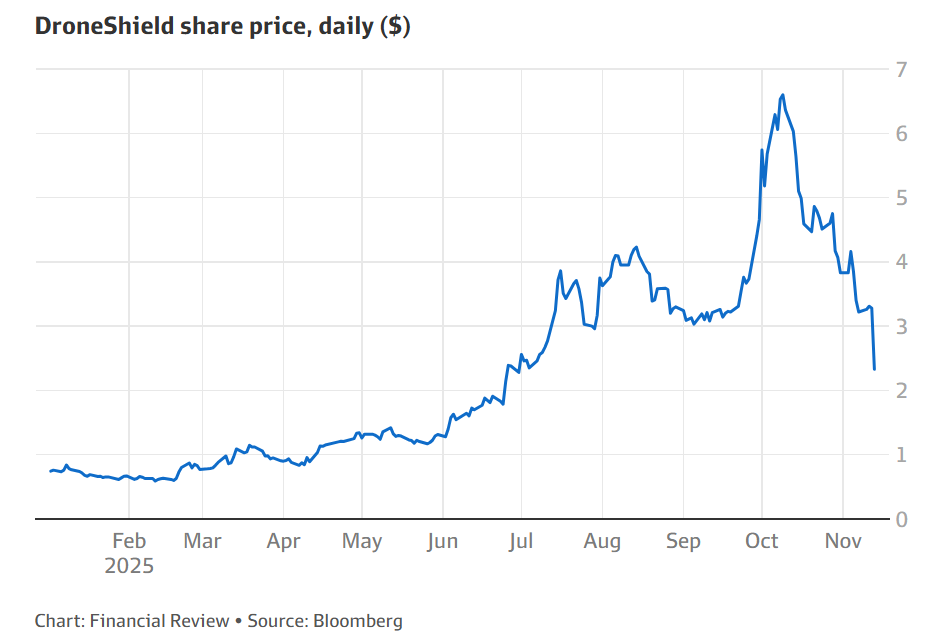
Sentiment in the small-cap world lives and dies on trust, and whatever trust DRO’s board had with shareholders took a heavy blow this week.
From here the company has to deliver, and deliver quickly. Investors will want to see a clear reversal in momentum, otherwise it would not be surprising to see more investors follow the directors out the door.
Rio Tinto Abandons Jadar Lithium Project Serbia
Rio Tinto quietly pulled the pin on its US$3.7 billion Jadar lithium project in Serbia this week, officially blaming cost cuts, but everyone knows the real story.

The project’s been a headache for Rio for years. Community protests, environmental campaigns, permit cancellations – even Novak Djokovic joined the pile-on at one point. Serbia couldn’t decide if it wanted to be a battery materials hub or keep its farmland pristine.
Rio’s decision sends a clear message to other mining jurisdictions: you may have all the commodities in the world, but if the locals, regulators and government aren’t on board, even the biggest miners will walk away.

Serbia was hoping Jadar could put them on the global lithium map. Instead, Rio has decided to take its money elsewhere.
Lithium Stocks Rally: Pilbara Minerals Up 27%
There’s a faint pulse in the lithium sector after years on life support. Pilbara Minerals (ASX: PLS) jumped 27% this week, leading a rally that saw lithium stocks become the best performers on the ASX 200.
We saw the first signs late last month when investment banks quietly lifted their long-term price forecasts. Then the AFR pointed out this week that battery storage is about to explode – energy storage systems will jump 45% in 2026 while EVs grow 26%.

A few shifts worth watching:
- Banks are lifting forecasts with JP Morgan taking 2026/27 spodumene back towards US$1,300 a tonne. Big banks tend to only move long-term assumptions when the tone is shifting.
- Energy-storage demand is exploding and expected to make up 30% of lithium demand by 2030, up from 20% today. This alone pushes investment bank models into deficit.
- A US House committee called out China for price manipulation claiming Beijing pushes prices down every time they start recovering.
- Western producers are sitting on their hands and refusing to restart mines until prices improve. Supply discipline is now back, but it likely won’t last forever.
None of the above guarantees a new boom, but it does feel like there are some green shoots starting to appear. Lithium has been dead a couple of years, and these are the kind of early signals you tend to see when a cycle starts to turn.

ASIC Legal Action Against AVZ Minerals Directors
AVZ Minerals was once the lithium market’s golden child, the go-to play for a massive African hard-rock deposit. At its peak the company was worth $4.6 billion.
Manono looked like the project that could reshape the global lithium supply picture. We covered the whole saga in detail here, and it’s worth reading if you want more of the story.

That feels like ancient history now. AVZ went into a trading halt in 2022, never came back, and was eventually delisted in 2024. Shareholders haven’t been able to trade a single share since.
And this week ASIC launched civil proceedings against directors over alleged continuous-disclosure failures.
The case centres on whether the company kept the market properly informed about ownership disputes and permitting dramas around Manono. Both issues have been at the heart of a messy legal fight in the DRC that’s dragged on for years.
Years of competing claims, shifting licences and political tension have already pushed development well beyond any realistic timeline. Now regulators are stepping in to pick apart the decision-making that happened during those critical periods.

For the 20,000-plus shareholders frozen since the 2022 halt, this is just another kick in the teeth. No clarity, no resolution, just more lawyers and more waiting.
The geology at Manono was never the problem. It’s a world-class deposit that could have been a company-maker. Instead it’s become the poster child for why jurisdiction matters more than grade. When ownership, governance and politics collide, even the best resource in the world can’t save you.
Oil Demand Forecast 2025: Goldman Sachs Bullish
The tone around oil shifted this week. After years of hearing about so-called peak oil, that narrative has faded and the investment banks are now leaning quietly bullish.
Goldman Sachs is telling clients that energy remains one of the most attractive corners of the market, pushing producers as the smartest way to play what they reckon is a tighter market ahead.

Demand’s holding up better than expected, while OPEC remains disciplined with production cuts and US shale isn’t growing fast enough to flood the market like it once did.
The IEA also dropped its latest World Energy Outlook this week with a message that would’ve been unthinkable not long ago. Oil and gas consumption could keep rising until 2050, hitting 113 million barrels a day under their business-as-usual scenario.

LNG is expected to surge 50 per cent by 2030, driven by power demand from data centres and AI. That is not a backdrop where oil prices quietly trend lower.
Put it all together and the picture’s fairly clear: banks see value, the IEA sees structural demand, and supply growth isn’t the given it once was.
For investors, it suggests oil’s got a sturdier floor than anyone wants to admit. While plenty are trying to distance themselves from fossil fuels, the upside is getting harder to ignore.
Liberal Party Abandons Net Zero 2050 Target
The Liberal Party has binned its net zero by 2050 commitment, a position first locked in under Scott Morrison and kept in place for a while under Peter Dutton.
After a marathon party room meeting that reportedly got heated, new leader Sussan Ley confirmed the Coalition would scrap Labor’s 43% emissions target and pivot its messaging towards gas, coal and whatever keeps energy costs down.

They’re staying in the Paris Agreement (for now), but the shift in tone is clear. This is about internal politics, winning back regional seats and reconnecting with the base, not some grand rethink on climate economics.
Labor’s still in charge, so nothing changes immediately and the legislated emissions targets and renewable build-out continue. But the next Coalition government would almost certainly lean into fossil fuels, nuclear and a much slower energy transition.
That narrative shift alone could lift coal, gas and uranium plays on the small-cap end of the ASX, though the Libs are a fair way from power at the moment.

At the same time, global capital is still rewarding decarbonisation. Copper, nickel, lithium and rare earth developers will still attract money as long as the economics stack up.
For small-cap investors, this isn’t about picking sides in the climate policy wars. Both energy systems need massive volumes of raw materials. The smart money backs whichever commodities have the strongest tailwind over the next cycle.
BHP Liable for Brazil Dam Disaster UK Court Rules
The week ended with a bit of a jolt after a UK court ruled BHP liable for its role in the 2015 Fundão dam collapse in Brazil, the disaster that killed 19 people and destroyed entire communities along the Doce River.
It’s taken nearly a decade to get here, and now comes the part everyone’s been waiting for – the fight over damages. More than 600,000 Brazilians have joined the claim and the numbers being thrown around are eye-watering.
The damages trials will drag on into the late 2020s, with BHP saying it’ll appeal and pointing to compensation already paid through Brazilian channels, but that’s not going to make this go away.

Expect this to be a slow, grinding legal process that’ll hang over them for years. Courts are getting bolder about holding resource companies accountable when things go catastrophically wrong and BHP just became the test case for that shift.
The Wrap
The market gave us plenty to chew on this week, but the common thread was momentum shifting back toward companies with real catalysts in front of them.
FMR is drilling into the section of the hole where things get very interesting, Fortuna is cashed up with results about to flow. Even lithium’s showing a pulse.
Not everything was roses though as DroneShield’s board torched investor trust with their stock dump, BHP got handed a ruling that’ll shadow them for years. Meanwhile, Rio walked away from Jadar after burning through patience and cash and AVZ is tied up in courts, again.
For small-cap investors, the next few weeks come down to one thing – delivery. We’re heading into silly season with drill results, assays and milestones stacking up across the portfolio. If even one of them hits properly, the market could hand out an early Christmas present.
Till next week.
General advice warning
The contents of this document are intended to provide general securities advice only and have been prepared without taking account of your objectives, financial situation or needs. Because of that you should, before taking any action to acquire or deal in, or follow a recommendation (if any) in respect of any of the financial products or information mentioned in this document, consulting your own investment advisor to consider whether that is appropriate having regard to your own objectives, financial situation and needs. If applicable, you should obtain the Product Disclosure Statement relating to the relevant financial product mentioned in this document (which contains full details of the terms and conditions of the relevant financial product) and consider it before making any decision about whether to acquire the financial product. Whilst the Equities Club Pty Ltd (“Equities Club”) believes information contained in this document is based on information which is believed to be reliable, its accuracy and completeness are not guaranteed and no warranty of accuracy or reliability is given or implied and no responsibility for any loss or damage arising in any way for any representation, act or omission is accepted by Equities Club or any officer, agent or employee of Equities Club or any related company.
Neither Equities Club, nor any of its directors, authorised representatives, employees, or agents, makes any representation or warranty as to the reliability, accuracy, or completeness, of this document or any advice. Nor do they accept any liability or responsibility arising in any way (including negligence) for errors in, or omissions from, this document or advice.
Disclosure
The directors, authorised representatives, employees and associated persons of Equities Club may have an interest in the financial products discussed in this document and they may earn brokerage, commissions, fees and advantages, pecuniary or otherwise, in connection with the making of a recommendation or dealing by a client in such financial products. Equities Club owns 1,504,000 FUN and 109,000 FMR shares and at the time of publishing this article. Equities Club has been engaged by FUN and FMR at the time of writing.
Confidentiality notice
The information contained in and accompanying this communication is strictly confidential and intended solely for the use of the intended recipient/s. The copyright in this communication belongs to Equities Club. If you are not the intended recipient of this communication please delete and destroy all copies immediately.
Equities Club Ltd (CAR No. 001308139) is a corporate authorised representative of ShareX Pty Ltd, Australian Financial Services License (AFSL) No 519872.