
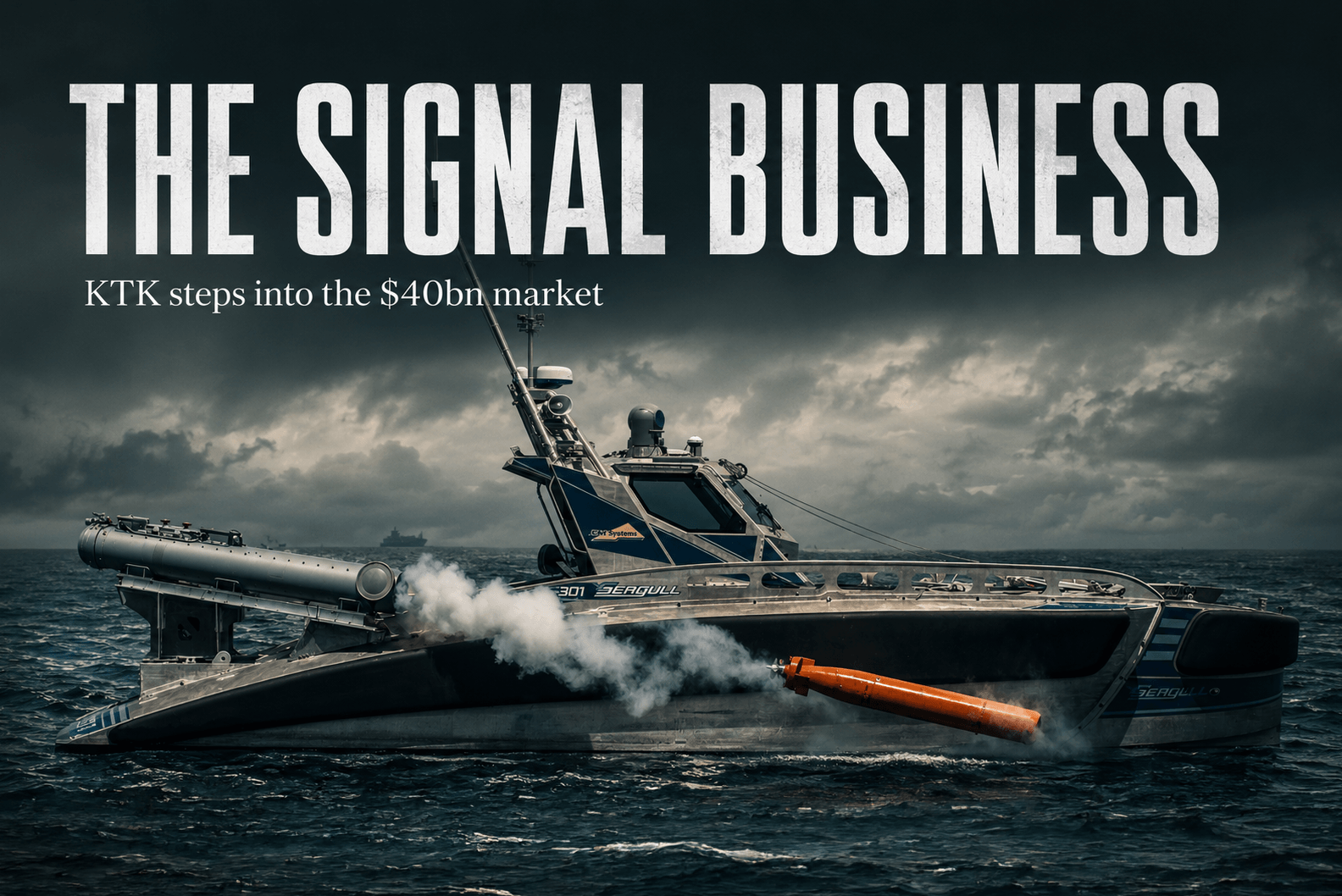
A drone flying low over the Black Sea needs to send its video feed back to someone. So does an unmanned boat, a convoy vehicle and a soldier on foot.
That link runs through a satellite, and holding it steady from a drone banking hard or a truck bouncing down a dirt road is one of the harder engineering problems in defence.
The kit that does the job is called SATCOM-on-the-Move. The White House watching the bin Laden raid live, streamed from a drone circling overhead, is the job done well.
The market for it runs at roughly US$40 billion a year (defence takes close to half of it), and analysts have it roughly tripling over the next decade as everything from drones to trucks gets a satellite link bolted on.
This morning, KTEK Aerosystems (ASX: KTK) announced it’s stepping into that market.
The company has set up a new business unit building SATCOM components and sub-assemblies, and signed its first deal to go with it.
The deal is a Letter of Intent with Over-Sat, an Israeli satellite terminal maker whose gear is already at sea with multiple navies and has been picked to supply a major European navy.
KTK last traded at 34 cents, a market cap around $48 million. Seven weeks ago it listed at 20 cents.
[INSERT ANN — ASX announcement embed/link to go here]
What KTEK Aerosystems Signed With Over-Sat
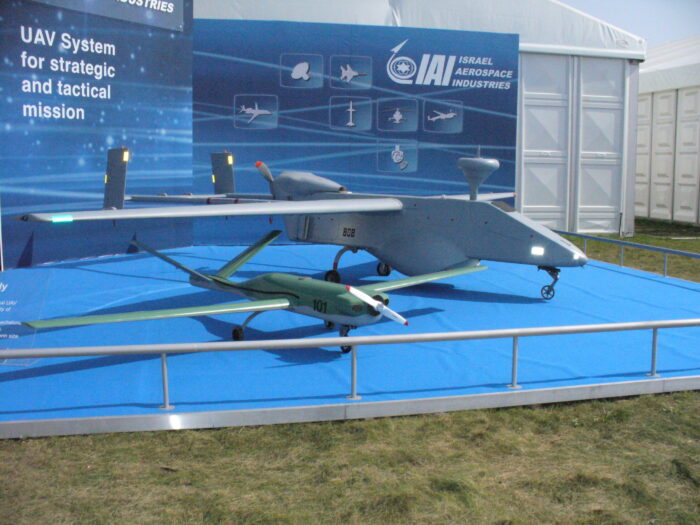
KTK builds composite parts and finished sub-assemblies for military drone makers, mainly Elbit Systems and UVision, and ships them ready to bolt straight into the aircraft.
Under the LOI, KTK will provide engineering, manufacturing and industrialisation services for selected components of Over-Sat’s MANTIS and PYTHON terminal systems, the two satellite terminals Over-Sat builds.
In practice that means the things KTK already does for drone-makers, applied to satellite terminals.

Over-Sat’s SATCOM technology maintaining connectivity across sea, land and air platforms.
RF-transparent radomes (the protective dome that sits over an antenna), lightweight antenna structures, electromechanical assemblies, composite parts, tooling, and the grind of taking a prototype through to serial production.
Work gets agreed order by order, with each work order setting its own scope, schedule, pricing and quality requirements.
Subject to commercial terms still being pinned down, Over-Sat intends to give KTK priority for manufacturing the parts and assemblies that come out of the cooperation.
SATCOM becomes KTK’s fifth product line.
It sits alongside composite airframes, electromechanical assemblies, systems integration and rugged defence systems (the hardened kit built to cop a beating in the field).
All of it runs through the same Cordless Factory model, KTK’s network of certified aerospace manufacturing partners.
Over-Sat’s Luneburg Lens SATCOM Terminals
Over-Sat builds satellite terminals around something called a Luneburg Lens, a ball of 3D-printed material that bends incoming radio waves to a single focus point, the same way a magnifying glass concentrates sunlight into one hot spot.
A conventional SATCOM terminal holds its link by physically pointing a motorised dish at the satellite, and keeping that aim from a boat crashing through swell (as one example) is a heavy, failure-prone job.
The lens does the same work sitting still. Its shape handles the focusing, and it holds its performance even when the satellite sits low on the horizon, which is where conventional antennas struggle and where a satellite usually sits when the vessel is operating at sea.
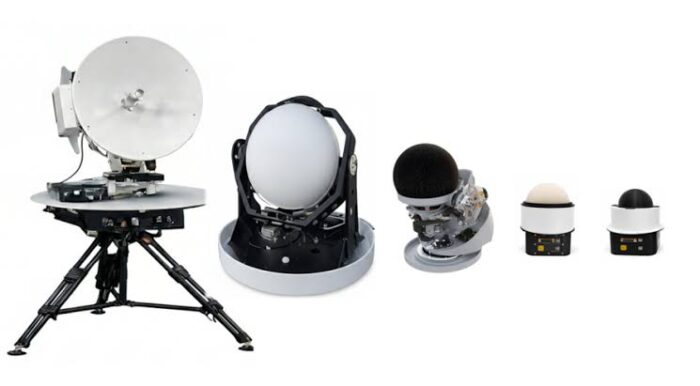
Over-Sat’s SATCOM terminals, designed to deliver connectivity on moving platforms.
The finished terminal is compact enough to fit platforms conventional SATCOM gear never could, and it keeps video, voice and data flowing across GEO, MEO and LEO satellite networks while the boat or drone it’s bolted to is being thrown around.
Over-Sat terminals are already working at sea on an unmanned naval vessel built by Elbit Systems, one of Israel’s largest defence contractors with a market cap around US$38 billion.
The vessel, named Seagull, is used by multiple navies and has run exercises with the US Navy.
Over-Sat has also been picked to supply satellite terminals to a major European navy, and it’s won an order to supply the world’s first Luneburg Lens terminals to a defence customer in Asia. (Neither gets named, which is often how defence contracts work.)
It also has a co-development agreement with Rangsons Aerospace in India, a supplier to India’s space agency, Boeing and the Indian Armed Forces.
A lot of ASX investors will be reading the name Over-Sat for the first time this morning, but the customer list says the defence world already knows it well.
The Israeli Defence Network Behind KTEK and Over-Sat
KTK and Over-Sat grew up in the same Israeli defence engineering world.
That world produced KTK’s existing relationships with Elbit and UVision, and Over-Sat’s flagship deployment sits on an Elbit platform.
KTK Managing Director Dekel Keisar spent his career inside Israel Aerospace Industries before founding KTK, and the same circle of engineers and program managers has now handed him a satellite terminal maker with a problem KTK knows how to solve.
Here’s Dekel’s read on it:
“Weight and size reduction is a non-negotiable requirement across every modern UAV and unmanned program we work in, and communications hardware is under constant engineering pressure to become lighter and more compact without sacrificing performance.”
– Dekel Keisar, Managing Director, KTEK Aerosystems
Lighter, smaller, tougher parts are the same problem KTK has spent seven years solving for drones. A terminal bolted to a boat slamming through waves cops the same vibration and the same weight limits as a part flying on a drone.
What KTK’s Over-Sat LOI Actually Commits
The LOI contains no committed order volumes and no minimum revenue. Work orders get agreed one at a time, and revenue shows up only as they’re executed. There’s no certainty on timing or value.
Treat today as a door opening. The contracts come later, order by order, and KTK has said it will update the market as material ones land.
What We’re Watching Next for KTK
- The first work order. The LOI is paperwork until an order with a dollar figure comes through under it. That order turns SATCOM into a revenue line.
- Priority manufacturing locked in. Over-Sat’s stated intent to give KTK manufacturing priority is subject to commercial terms. Watch for that converting into something binding.
- SATCOM beyond Over-Sat. KTK can sell radomes and antenna structures to any terminal maker, whether defence or commercial, and orders from a second customer would prove the product line stands on its own.
- The drone ramp. KTK is targeting 150 units a month by spring, and every shipment against the Elbit and UVision contracts is another invoice on KTK’s books.
Our View
KTK rang the bell seven weeks ago as a drone parts supplier. The first container shipped inside a fortnight. Now there’s a fifth product line, opened with a partner whose gear sails on the vessels of KTK’s biggest customer.
At the IPO we backed a model that keeps the engineering in-house and pushes the manufacturing out to the partner network, so the company grows without going back to shareholders for cash.
SATCOM extends that model into a market worth tens of billions a year, at zero capital cost, through relationships KTK already had.
If the work orders come, KTK picks up a revenue line the IPO price never included. If they take longer, the drone book keeps ramping regardless.
Either way, a $48 million company just got a bigger surface area.
General advice, disclosure and confidentiality
<p data-pm-slice=”1 1 []”>General advice warning</p>
The contents of this document are intended to provide general securities advice only and have been prepared without taking account of your objectives, financial situation or needs. Because of that you should, before taking any action to acquire or deal in, or follow a recommendation (if any) in respect of any of the financial products or information mentioned in this document, consulting your own investment advisor to consider whether that is appropriate having regard to your own objectives, financial situation and needs. If applicable, you should obtain the Product Disclosure Statement relating to the relevant financial product mentioned in this document (which contains full details of the terms and conditions of the relevant financial product) and consider it before making any decision about whether to acquire the financial product. Whilst the Equities Club Pty Ltd (”Equities Club”) believes information contained in this document is based on information which is believed to be reliable, its accuracy and completeness are not guaranteed and no warranty of accuracy or reliability is given or implied and no responsibility for any loss or damage arising in any way for any representation, act or omission is accepted by Equities Club or any officer, agent or employee of Equities Club or any related company.
Neither Equities Club, nor any of its directors, authorised representatives, employees, or agents, makes any representation or warranty as to the reliability, accuracy, or completeness, of this document or any advice. Nor do they accept any liability or responsibility arising in any way (including negligence) for errors in, or omissions from, this document or advice.
Disclosure
The directors, authorised representatives, employees and associated persons of Equities Club may have an interest in the financial products discussed in this document and they may earn brokerage, commissions, fees and advantages, pecuniary or otherwise, in connection with the making of a recommendation or dealing by a client in such financial products. Equities Club owns 500,000 KTK shares. Equities Club has been engaged by KTK at the time of writing.
Confidentiality notice
The information contained in and accompanying this communication is strictly confidential and intended solely for the use of the intended recipient/s. The copyright in this communication belongs to Equities Club. If you are not the intended recipient of this communication please delete and destroy all copies immediately.
Equities Club Ltd (CAR No. 001308139) is a corporate authorised representative of ShareX Pty Ltd, Australian Financial Services License (AFSL) No 519872.