
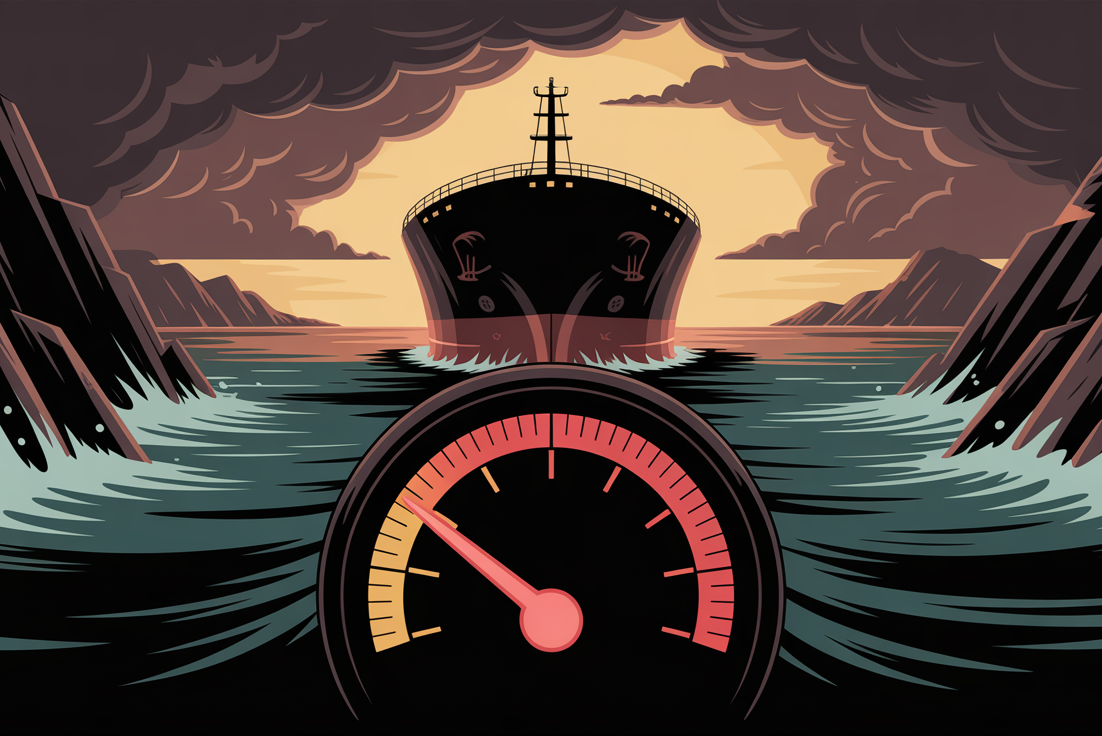
The Strait of Hormuz is the jugular of the global energy market. And right now, it’s being squeezed.
For the average ASX investor, this isn’t some distant “geopolitical risk” to be filed away. It’s an immediate, structural threat to almost every portfolio on the board. It’s because Australia operates on a “just-in-time” fuel model that is remarkably high on efficiency and dangerously low on common sense. With only a few weeks of buffer stock of refined fuels, investors are on notice (for good reason).
Here, we’ll lay down the operational mechanics, the market reaction so far and the data points retail investors tracking energy exposure should be watching.
The Vulnerability: Australia’s 35-Day Redline
Australia’s system just isn’t designed to be sealed off from global markets for any extended period. Government data confirms the brutal reality: we’re currently hovering around 30 days of diesel, 37 of petrol and a mere 29 of jet fuel.
The International Energy Agency (IEA) says nations should hold a 90-day buffer. We aren’t even halfway there. We’ve traded security for a leaner bottom line and the market is about to find out exactly what that “lean” costs.
How the Strait of Hormuz Disrupts Australia’s “Just-In-Time” Delivery Model
The global refined fuels system relies on maritime throughput and regional refining capacity. The “just-in-time” model works beautifully when the world is at peace. It’s efficient, it’s lean, and it’s currently a disaster. We’re seeing two immediate bottlenecks that should have every energy analyst in the country reaching for the Panadol:
- The insurance blackout: Despite Donald Trump urging allies to send warships to act as escorts through the strait, tanker transit through the Hormuz corridor has cratered toward zero. It’s because when insurers pull “war risk” coverage, the majors don’t sail. A $200 million hull doesn’t move an inch if it isn’t covered.
- The long way around: Trading houses are rerouting cargoes around the Cape of Good Hope. That sounds like a simple detour until you realise it adds two weeks to delivery times and sends freight costs into the stratosphere.
When a key transit lane pauses, the delivered supply of refined petrol, diesel, and jet can collapse within weeks. Wholesalers may ration or prioritise customers, while refiners may cut runs if feedstock or throughput is constrained.
Downstream production cuts
Global refiners are losing their minds trying to balance the books.
If the crude can’t get out of the Gulf, the refineries in Singapore and South Korea (where Australia gets the lion’s share of our product) start cutting runs. We are highly dependent on the sea and when the feedstock stops, domestic taps go dry.
The immediate result is that spot prices are ripping, and the “wholesale squeeze” is moving downstream fast. If you’re holding ASX companies that rely on high-volume transport or heavy machinery, you’re looking at higher costs and the very real possibility that some of their fleet simply won’t have the fuel to move by next month.
Short-Term Blip or Long-Term Disruption?
This is the only question that actually matters for your capital right now. Forget the headlines; look at the duration. We are staring down two very different paths:
- The short-term shock: A “V-shaped” panic where markets calm, tankers find a workaround, and strategic reserves blunt the blow. Prices retreat, and everyone goes back to pretending the system isn’t fragile.
- The sustained burn: Weeks turn into months. Tanker flows stay choked, refining margins explode, and the “energy tax” starts eating the lunch of every energy-intensive sector on the ASX.
The signals from last week aren’t exactly comforting. Oil absolutely ripped, with Brent eyeing the US$100 mark as Hormuz flows effectively fell off a cliff. In our books, this looks like a textbook example of repricing of global risk.
Initial market reaction
The market didn’t wait for permission to panic. Energy prices spiked instantly as the realisation hit that the taps might be jammed. But the real story is in the invisible costs – shipping rates and insurance premiums are mooning. If you’re a tanker operator, your cost of doing business just went vertical.
For ASX investors, this has manifested as gut-wrenching volatility. Share prices for commodity-linked plays are swinging wildly because the market hates one thing more than bad news: uncertainty. Expect more headline-driven whiplash in coming weeks. If you’re trading this, keep your position sizes sane.
How will this affect domestic energy projects?
A sustained shock changes the maths for domestic energy projects. Suddenly, the “boring” stuff, such as storage tanks, pipelines and local refining, looks like gold.
Having oil in the ground (upstream) is great for the soul, but it doesn’t put fuel in a truck in Dubbo. Stop obsessing over simple EBITDA linked to the oil price. Start looking at who actually owns the downstream infrastructure and the storage capacity.
The reality is this that in a crisis, the person who owns the fuel is king. The person who owns the promise of fuel is just another person waiting in line.
What This Means For the ASX
For retail investors playing in the small and mid-cap space, geopolitical chaos creates asymmetric windows. While many chase the headline oil price, the smart money is looking for the operational pivots. When the supply chain snaps, price moves usually outpace reality. If a micro-cap can prove it has fuel in a tank (metaphorically and literally), that stock stands to benefit.
Domestic vs international producers
Refiners and firms with local storage are structurally shielded when imports tighten. Winners will likely be those that can increase their throughput, secure feedstock or monetise their storage and distribution assets.
Export-facing producers (whether crude or LNG) may face more complex dynamics where higher prices don’t immediately convert into increased domestic availability. If they can’t get a tanker into a port, that “high price” is just a theoretical number on a screen.
The small-cap edge
In a supply shock, the market stops caring about five-year plans and starts caring about now. Attention shifts to the “unsexy” businesses that actually move the needle:
- The Middlemen: Specialist distributors with “bulletproof” supply contracts.
- The Landlords: Owners of the actual tanks and bulk logistics hubs.
- The Fixers: Wholesale trading desks and short-haul transport firms that keep the gears turning when the majors stall.
Because these opportunities rely on specific local operations, investors who carefully check the facts, like actual storage capacity or logistics capability, can potentially see significant gains.
In many ways, this is prime small-cap territory: high reward, brutal execution risk. If the company’s “guaranteed” supply turns out to be a legal mirage, expect a total washout on the downside.
Who stands to gain?
Start monitoring the companies that:
- Control physical storage or terminal capacity inside Australia.
- Have long-dated supply contracts that are hard to cancel.
- Provide specialist logistics or product blending in short supply.
- Look for those with low net crude exposure but high service margins.
Avoid assuming a rising global oil price will automatically benefit small upstream producers. Between shipping hikes and export bans, that “profit” can evaporate before it hits the balance sheet.
The Bottom Line
The Hormuz disruption is both a headline shock and an operational stress test that Australia wasn’t prepared to take. With our national fuel clock ticking down in weeks, here’s what investors should watch for in their ASX positions:
- Map the exposure: Are you holding “energy” or are you holding “logistics”? There’s a world of difference right now.
- Check the ledger: A supply squeeze drains working capital fast. Ensure your small-cap plays aren’t about to hit a debt covenant wall.
- Watch the vibe: Shipping and insurance flows are your lead indicators. If the tankers aren’t moving, the “recovery” is a lie.
- Kill the FOMO: Don’t chase a 20% spike on a “maybe.” Verified tank capacity beats a “bullish” tweet every single time.
Geopolitical shocks compress time. You don’t have a month to wait and see. Use the next few sessions to triage your positions. In a 35-day redline environment, execution is the only fundamental that matters.
Follow Equities Club for the straight-talking, high-conviction coverage you need to navigate the collision of defense, energy, and minerals on the ASX. Subscribe now and get our next deep dive delivered straight to your inbox.