
Somewhere north of US$50 billion has been punted on this World Cup, the biggest betting event in history. Only 11 companies on the whole ASX are worth more than what the planet has wagered on 22 blokes chasing a ball, and it’ll all come down to 90 minutes or so on Monday morning.
We’ll be up with the sparrows to watch Messi have one last crack at it. At 39, most of us are managing a mortgage and a dodgy hamstring. He’s carrying a nation. (Which can’t be good for your back)
The market spent the week doing some gambling of its own.
The US bombed Iran seven nights straight and oil marched toward US$90, our portfolio delivered on the resource front, biotech ran hard against a red week, and the chip selloff rolled on while the money behind AI and drones rolled in.
Let’s get to it.
- The Middle East reignites and oil could be heading to US$100 a barrel next
- Evion halts ahead of a make-or-break Maniry milestone
- Fortuna lands a top-six rutile resource, nine months after we backed it
- Biotech bucks a red week with three of the top small-cap movers
- US$1.3 trillion wiped off chips, and the AI money keeps pouring in
- Drone warfare rewrites the rules as defence billions pile up
- AZ9 drills nearly 12% copper, its best hole of the year
- A Chinese giant pays double the market price for a slice of Tartana
- Janus doubles on a big fortnight of US orders
- Mount Ridley grows its scandium without turning a drill
The Middle East Reignites, and Oil Prices Follow
Fill up the car this weekend and you’re paying, again, for a war half a world away. Brent closed Friday at US$88 a barrel (up 19% since the fighting restarted) and servos never need long to pass that on.
The peace deal signed in June bought the region about a month of quiet. Now the US is bombing Iran nightly again and Iran’s back peppering missiles around the Gulf. Overnight, Iranian missiles killed two American soldiers in Jordan, and the US was bombing again within hours.
Trump reimposed his naval blockade and briefly declared America “THE GUARDIAN OF THE HORMUZ STRAIT”, with a 20% toll on every cargo passing through (which lasted all of 24 hours).
For the ancient history buffs among us, it has shades of Xerxes, the Persian king who sentenced the sea to 300 lashes after a storm wrecked one of his bridges and his plans to invade Greece. His army duly flogged the water and the water took its punishment and carried on doing as it pleased.
You suspect Trump knows the feeling.1
Despite the uptick, oil at US$88 is still a market betting the ships come back, because they always have. Tankers kept sailing through the 80s while Iran and Iraq shot at them, and when this war first kicked off in March, the panic faded within weeks. A Strait running at a third of its normal traffic says this bet is still live.
If the blockade holds, Commonwealth Bank’s Vivek Dhar has oil past US$100 within 10 days, and closer to US$150 across the hardest-hit parts of Asia if real shortfalls land.
Higher oil bleeds into everything. Petrol, freight, inflation, and eventually the rate cuts a lot of us have been banking on.
The record highs the ASX 200 hit in early March feel long gone now, and a year on the index is up less than 1%. Small-caps are caught in the middle.
Money is still finding drill results and discoveries, but the market is holding its breath, and the window that’s rewarded good news all year gets a little narrower every week the Strait stays quiet.
Evion (ASX: EVG) Halts Ahead of a Maniry Graphite Milestone
Evion Group (ASX: EVG), one of our portfolio companies, went into a trading halt on Friday, pending news on its Maniry graphite tenements in southern Madagascar.
Trading is frozen until Tuesday or an announcement drops, whichever comes first.
Maniry has been years in the making. The 2022 definitive feasibility study laid out a project producing up to 60,000 tonnes of graphite concentrate a year over a 21-year mine life, with a pre-tax NPV of US$263 million and payback under four years.
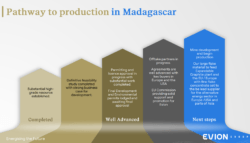
Last year Brussels handed it Strategic Project status under the EU’s Critical Raw Materials Act, making Maniry the only project in Madagascar to get the nod and the only graphite project outside Europe the EU has recognised as a preferred source of supply.
So Europe is openly shopping for graphite that doesn’t pass through Chinese hands, and of every graphite project on earth outside its own borders, it pointed at this one.
The one document still missing is the mining licence. If that lands this week, it’s the milestone EVG has been building toward for years. A granted licence is what opens up the serious conversations around financing, offtake and actually building the thing.
Add it to your watch list now.
Fortuna Metals (ASX: FUN) Lands a Top-Six Rutile Resource
Nine months ago we added Fortuna Metals (ASX: FUN) to the portfolio, right as it picked up its ground in Malawi. This week it came up for air and announced one of the six biggest rutile deposits on the planet.
The drilling behind it was done with hand augers (basically a giant corkscrew and a strong back). The holes averaged 8.4 metres, and most stopped at the water table, so the workers downed tools with rutile still running under their feet.
Explorers can spend years chasing a maiden resource, and plenty run out of money before they find one. So it’s notable FUN got there in nine months, with hand tools no less.
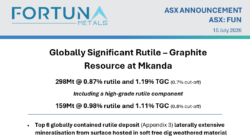
Those holes added up to a maiden resource at the Mkanda project of 298 million tonnes at 0.87% rutile, for 2.6 million tonnes of contained rutile. That, on the company’s own ranking, is top six in the world.
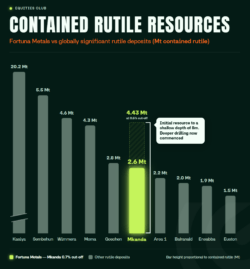
The aircore rigs that arrived last week drill more than three times deeper, so whatever’s sitting below the water table will get added to the resource, and maybe inch Mkanda closer to the podium.
Rutile is the preferred feedstock for titanium, and demand for the metal is set to climb hard as humanoid robots scale into mass production.
A bulk sample came back at 96.6% TiO2, cleaner than product the established producers have shipped for decades, so buyers can skip a refining step on the way to the finished metal.
Next door, Sovereign Metals sits on the same geology and trades near $330 million. FUN, now with its maiden resource in hand, sits at around $33 million.
A JORC resource is also the trigger that lets funds model the project properly, and lets management open offtake talks and development studies.
ASX Biotech Stocks Buck a Red Week
Every Melbourne Cup, someone backs a roughie because they like the name, and every few years the bloody thing salutes.
Biotech runs at the same odds, with a lot more riding on the win. You’re backing trial data that’s years from revenue, and the companies are having a crack at some of the hardest problems in medicine.
This week, three got up. Most of the market finished the week in the red, and the sector still landed three of the ten best moves under $100 million.
A broker in our Broker Book tipped this a few weeks back, calling ASX biotech overdue some love after a long spell out of favour.
The Americans moved first in this space (they usually do). Their small-cap biotech benchmark has run about 70% in a year on takeovers and IPO windows swinging back open, and that money tends to arrive here about a year later.
Argenica Therapeutics (ASX: AGN) ran all week, from 12.5 cents to 16 cents. Argenica is developing a drug that aims to limit brain damage after a stroke, a hard problem to crack and a huge market if the data holds up.
OncoSil Medical (ASX: OSL) moved from 1.32 cents to 1.45 cents. OncoSil makes a targeted radiation device implanted straight into pancreatic tumours, going after a cancer with grim odds and few good treatment options.
Emyria (ASX: EMD) was the pick of them, jumping from 38 cents to 49 cents. Emyria runs clinics delivering MDMA and psilocybin therapy for PTSD and depression.
Ten years ago that pill meant a strip search at the festival gates. Now it comes with a script and a follow-up appointment.
Chip Stocks Sell Off, But the AI Money Keeps Pouring In
Some nervous punters have spent the past few weeks sprinting for the casino exits. Since the end of June, something like US$1.3 trillion in semiconductor value has gone, with Intel alone down more than 20% and the big chip indices off double digits.
The worry is that AI spending has run too hot, too fast.
The house sees it differently. Hyperscaler capital spending on AI jumped 67% to around US$650 billion, and this week TSMC, the Taiwanese giant that manufactures advanced chips for just about everyone (Nvidia and Apple included), committed another US$100 billion to expand its US production.
TSMC sees every order book on the planet before the market does, and it’s still pouring concrete.
Nobody builds a bigger casino unless they’re confident the punters will return.
Every sector that runs this hard eventually stops for a breather, and to us that’s what this selloff is.

We’ve backed Adisyn (ASX: AI1) as our play on where this is all heading. Copper is the wiring inside every advanced chip, and it’s hitting its physical limits as transistors shrink below two nanometres.
AI1 is developing graphene interconnects to get past that wall, growing graphene onto chips at temperatures low enough for a factory to use.
Drone Warfare Rewrites the Rules as Defence Billions Pile Up
General Sherman once famously said war “is all hell”,2 and he’d seen the worst of the American Civil War. Even he’d struggle to comprehend what soldiers face today.
The drone has done what the machine gun did in 1914, when a century of battlefield tactics met a weapon that killed at industrial scale.
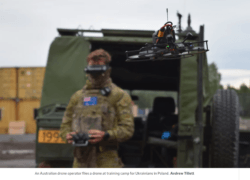
This week The AFR underlined Sherman’s bleak words from a training camp in Poland, where Australians are helping prepare Ukrainian troops for the front.
One Australian drone operator there said 85% of front-line deaths now come from drone strikes. And that around 30% of the soldiers who finish the course will be killed, or wounded too badly to fight, within months.
The men learn anyway.
Drones can now leapfrog five or six lines of defence and hit a brigade’s headquarters 100km behind the front. The golden hour, the window medics once had to get a wounded soldier off the field, is gone, because the sky is never clear.
Soldiers are taught instead to keep a wounded mate alive in a trench for days, waiting for a gap that might never come.
One Australian commander summed up the grim logic: teach them to survive so they can keep killing Russians.
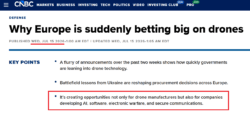
Europe is rearming. The first two weeks of July alone brought five of the continent’s largest ever defence packages, including a NATO-wide US$40 billion counter-drone push and a German order for 50,000 AI-guided attack drones.
One drone maker raised US$1.2 billion on its own.
That capital takes time to reach the companies actually building the hardware.
KTEK Aerosystems (ASX: KTK) is our picks-and-shovels way in. KTK makes the airframes and sub-assemblies bolted inside drones from Tier-1 names like Elbit and UVision.
It’s already an approved supplier pushing into the US. At just under $40 million, it’s a rare small-cap with revenue coming through the door while the sector’s spending wave is still building.
AZ9 Drills 11.94% Copper, Its Best Hole Yet
Azzuro Resources (ASX: AZ9) drilled the best copper hole of its year at the Red Hill project in Mongolia, and the grade could be mistaken for a typo.
Hole MU2605 returned 1.6 metres at 11.94% copper, with gold and silver riding alongside it. Most copper mines in the world make good money on ore grading under 1%, so a number starting with 11 turns heads. (just ask Spinal Tap)
That hit sits inside a broader copper zone, and another hole added 18 metres at just over 1% copper.
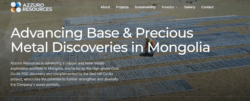
Red Hill now stretches close to 550 metres of strike and remains open to the west, east and down-dip, growing with almost every batch of assays AZ9 has reported this year.
More results land over the coming weeks, and metallurgical testwork kicks off this quarter as the company starts mapping a path toward development.
AZ9’s market cap sits under $20 million, and more than $4 million of that is cash in the bank. So the market is pricing Red Hill, and everything else the company owns, at around $15 million, while copper trades above US$13,000 a tonne off last month’s record highs.
A Chinese Giant Pays Double for Tartana (ASX: TAT)
Tartana Minerals (ASX: TAT) was trading at 2 cents last week when a Chinese group agreed to pay 5.3 cents a share for a stake. We read the announcement twice to make sure we had those numbers the right way around.
Xingye, a subsidiary of Inner Mongolia Xingye Silver and Tin, is putting in $5.18 million at two-and-a-half times the market price.
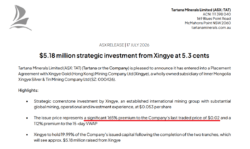
The deal takes Xingye to just under 20% across two tranches, and it comes with the right to appoint directors and send in its own geologists. This is a buyer planning to roll up its sleeves and work the ground itself.
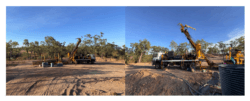
That ground sits in the Chillagoe region of Far North Queensland, prospective for copper, gold, silver, zinc and tin, with the silver projects Nightflower and Montalbion the main game.
The market nudged TAT up about 25%, to roughly half what Xingye just agreed to pay. So a silver and tin operator says the shares are worth 5.3 cents, and the screen says about half that. One of them is wrong.
Due diligence starts now, and FIRB still needs to approve the second tranche. The whole thing is due to be wrapped by mid-November.
Janus Electric (ASX: JNS) Doubles on US Orders
No company under $100 million did better on the ASX this week than Janus Electric (ASX: JNS), which doubled from 14.5 cents to 29 cents to top the board at the small end of town.
Janus converts diesel prime movers into electric trucks with a swappable battery. The driver pulls in, trades the flat battery for a charged one and gets back on the road, the same way you’d swap a gas bottle at the servo, while everyone else’s electric truck sits at a charger for hours.
A trading halt usually means a nervous couple of days for holders. Janus called two in a week, and both times came back with news worth the wait.

It came out of Monday’s halt with a first US order worth around A$10 million, went back in on Wednesday, then out again Thursday with a A$45 million order on top.
That A$45 million deal signed up four new California fleet operators for 67 truck conversions, taking the US order book from four conversions to 87 and the North American book to 112.
California is practically paying its truckers to convert, with grants worth roughly US$166,000 per truck dragging the net cost close to zero for operators who qualify.
Not a bad week at all for holders.
Mount Ridley (ASX: MRD) Grows Its Scandium Off Old Hits
Now for Mount Ridley Mines (ASX: MRD), one of our portfolio companies.
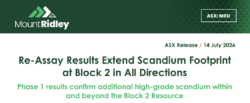
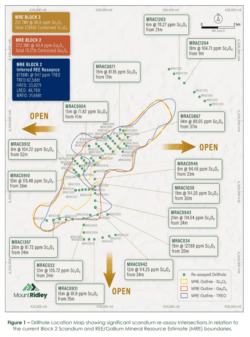
MRD ran this whole thing off historical pulps already sitting in storage. It re-assayed the old samples for scandium and the Block 2 footprint grew in every direction.
The best hits came back at 19m at 127.68 ppm and 24m at 114.54 ppm Sc₂O₃, both well above the current 86.9 ppm resource average.
Doing it that way costs a fraction of a fresh drill program, which is the part that caught our eye. For a small explorer watching its cash, stretching old samples this far is a tidy result.
A new scandium resource estimate is the next cab off the rank, and Phase 2 re-assay work is already running on the pulps still to be tested.
Worth remembering the estimate still has to be signed off, and even then it lands as an inferred resource, the softest classification going. Treat the upside as potential until the numbers are locked.
For the wider picture, Money of Mine put out a podcast on the looming scandium squeeze as the West hunts for supply outside China. Worth a listen.
What We’re Watching
Monday morning belongs to Messi, though EVG might grab the encore. The halt runs until Tuesday at the latest, and halts have a habit of ending early, so we’ll be keeping one eye on the football and one on the announcements page.
Then it’s conference season. First up is the Noosa Mining Investor Conference, July 22-24 at Peppers Noosa Resort on the Sunshine Coast, with around 74 ASX-listed companies presenting.
Noosa’s one of the better rooms for finding juniors before the crowd does, and there’s something about giving 74 small-cap MDs a stage and a room full of investors that always shakes news loose. We’ll be listening for who’s drilling and what they have to say (or not say).
On commodities, gold and uranium are still the two we keep coming back to.
Tech will probably keep wobbling from here, and we’re fine with that. The selloff hasn’t changed what the hyperscalers are spending or what TSMC is building.
And the Middle East stays at the top of the list. It escalated again overnight, and a ceasefire looks further away than it did on Friday. We’re still hoping for one.
Till next week.
1. Xerxes, for the record, went on to lose his whole navy in a narrow strait. Let’s hope the parallels stop at the flogging. ↩
2. The full line was delivered at an event in 1880: “There is many a boy here today who looks on war as all glory, but, boys, it is all hell.” General Sherman fought war about as brutally as anyone ever has, and he spent his last years making sure it wasn’t romanticised. ↩
General advice, disclosure and confidentiality
General advice warning
The contents of this document are intended to provide general securities advice only and have been prepared without taking account of your objectives, financial situation or needs. Because of that you should, before taking any action to acquire or deal in, or follow a recommendation (if any) in respect of any of the financial products or information mentioned in this document, consulting your own investment advisor to consider whether that is appropriate having regard to your own objectives, financial situation and needs. If applicable, you should obtain the Product Disclosure Statement relating to the relevant financial product mentioned in this document (which contains full details of the terms and conditions of the relevant financial product) and consider it before making any decision about whether to acquire the financial product. Whilst the Equities Club Pty Ltd (”Equities Club”) believes information contained in this document is based on information which is believed to be reliable, its accuracy and completeness are not guaranteed and no warranty of accuracy or reliability is given or implied and no responsibility for any loss or damage arising in any way for any representation, act or omission is accepted by Equities Club or any officer, agent or employee of Equities Club or any related company.
Neither Equities Club, nor any of its directors, authorised representatives, employees, or agents, makes any representation or warranty as to the reliability, accuracy, or completeness, of this document or any advice. Nor do they accept any liability or responsibility arising in any way (including negligence) for errors in, or omissions from, this document or advice.
Disclosure
The directors, authorised representatives, employees and associated persons of Equities Club may have an interest in the financial products discussed in this document and they may earn brokerage, commissions, fees and advantages, pecuniary or otherwise, in connection with the making of a recommendation or dealing by a client in such financial products. Equities Club owns 1,554,000 FUN shares, 500,000 KTK shares, 4,500,000 EVG shares, 1,150,000 AZ9 shares, 2,083,333 MRD performance rights, 900,000 performance rights of AI1 at the time of publishing this article. Equities Club has been engaged by KTK, AZ9, MRD, EVG, AI1 and FUN at the time of writing.
Confidentiality notice
The information contained in and accompanying this communication is strictly confidential and intended solely for the use of the intended recipient/s. The copyright in this communication belongs to Equities Club. If you are not the intended recipient of this communication please delete and destroy all copies immediately.
Equities Club Ltd (CAR No. 001308139) is a corporate authorised representative of ShareX Pty Ltd, Australian Financial Services License (AFSL) No 519872.