
Drive into Queenstown on Tasmania’s west coast and the hills hit you first. They’re bare and orange, stripped by a century of fumes from the furnaces that cooked copper out of the ground and built the town.
The copper came out of Mt Lyell, which opened in 1893 and went on to produce more than 1.4 million tonnes of it along with 50 tonnes of gold. Three workers died there within six weeks over the summer of 2013 and 2014, and the mine went quiet.
Copper hit an all-time high last month, and the big miners are going back through old ground like Queenstown looking for more of it. South African miner Sibanye-Stillwater paid US$10 million for Mt Lyell in 2023, and on September 2 it approved a $490 million restart with first copper due in early 2029.
About 10km from Mt Lyell, on the same belt of ancient volcanics, sits a copper-gold project called Skyline, and on Monday Bubalus Resources (ASX: BUS) signed a binding deal to buy it.
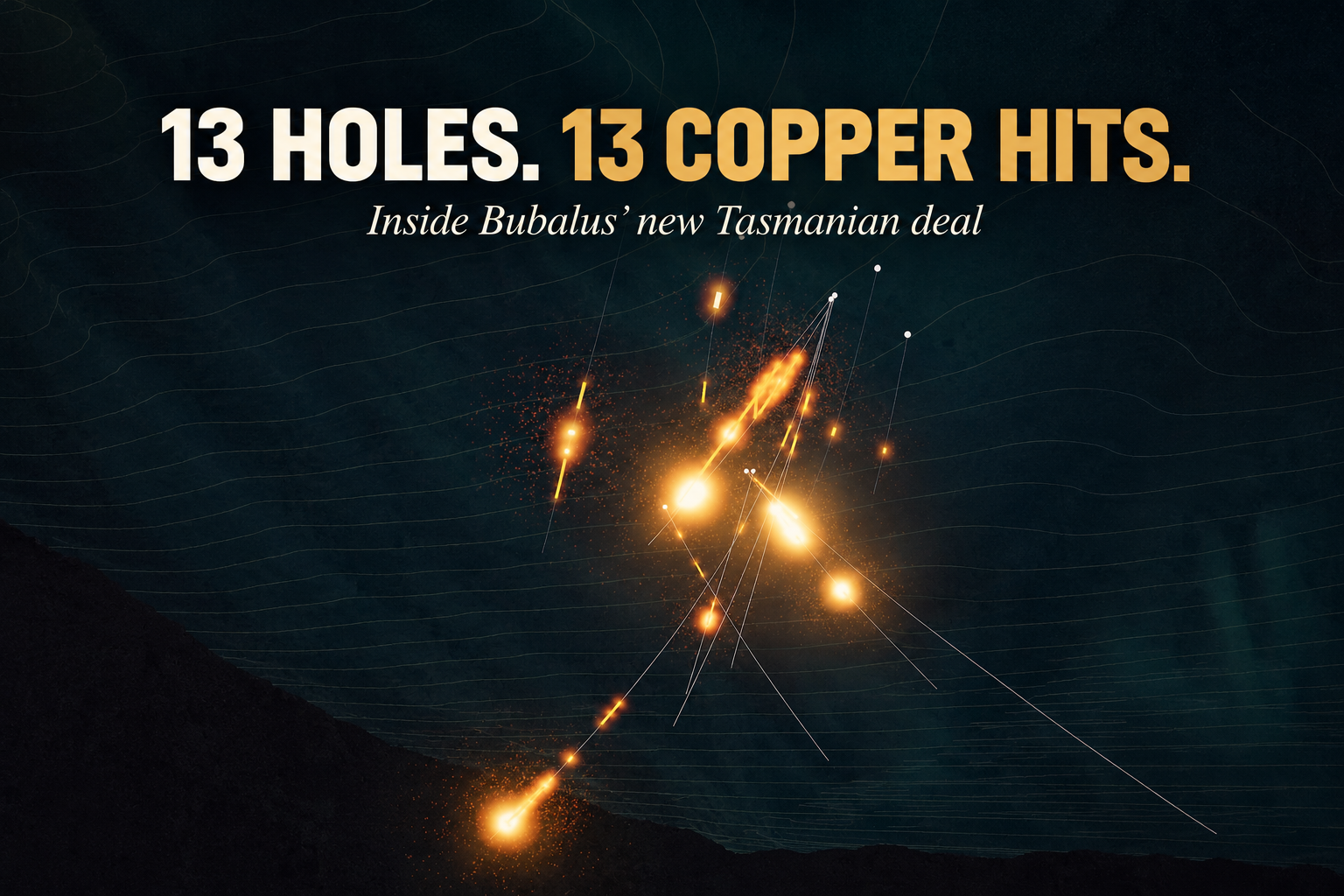
Its lead prospect is called Jukes. Every hole drilled into it has hit copper, 13 from 13, and BUS is paying $1 million in cash and $2 million in shares for the lot.
We’ve owned BUS since 2025, through a gold drilling program at Avon Plains in Victoria that came back lighter than any of us wanted. Managing director Brendan Borg spent this year scouring the globe for a better project, and we think he’s found one.
Skyline spent the past year inside a Toronto-listed company that ran short of money to drill it. Borg says a Tasmanian copper project inside a Canadian company was never ideal, and bringing it onto the ASX will get more value out of it.
We’re copper bulls, and we’ve spent months looking for a small-cap with real copper in the ground and a share price that hasn’t caught up. At 8.3c, BUS is it.
Borg has also brought geologist Nick Jolly onto the board. Jolly ran the geology at Spartan Resources while it found 2.37 million ounces of gold at Never Never and Pepper in WA. Ramelius paid $2.4 billion for Spartan last year.
Jolly had a proper look at the core and liked the ground, and he’s putting his own money into the raise alongside Borg and the rest of the board months before the first hole.
What Bubalus is Buying at the Skyline Copper Project
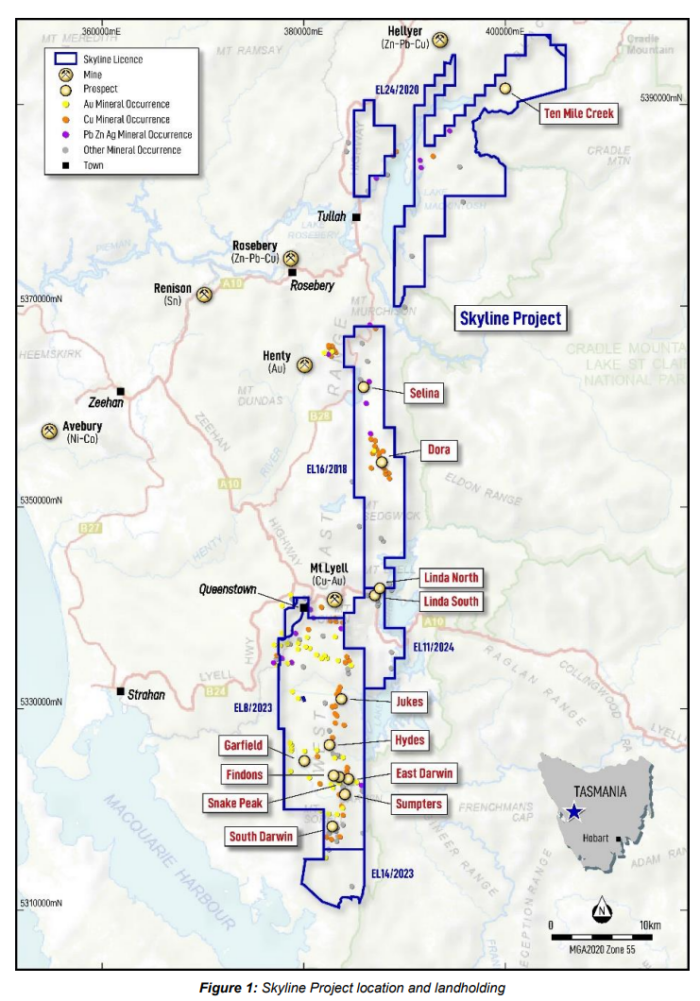
Skyline covers 494 square kilometres of western Tasmania with about 80km of strike, which is the length of prospective ground a geologist can follow across the map.
The ground sits across five granted exploration licences, with Jukes and Hydes the two prospects BUS will drill first.
At Jukes, the most advanced of them, drilling has traced copper from near surface down to about 430 metres, and the system stays open along strike and at depth.
Borg says the copper at Jukes is very similar in style to Mt Lyell’s, and the grades so far are comparable.
About 5km south at Hydes, copper sits at surface on top of a dense, magnetic body underground. The one hole drilled there started 400 metres from the outcrop because the crew couldn’t get access at the time, and it never reached the target.
Behind those two sit half a dozen more prospects with copper at surface or in a handful of old drill holes.
We built a flyover of the ground so you can get a visual, from Skyline’s five licences along the Mount Read Volcanics to Mt Lyell about 10km up the road.
Four other mines work in the district, and the roads and hydro power are already there. The drilling approvals for Jukes and Hydes are in place too, so once the deal completes attention turns to getting a rig and a crew to site.
At 8.3c a share, BUS comes out of the deal and its capital raise worth about $11 million, with around $4.8 million in the bank. Close to half the company is cash, and the rest buys Skyline, 10km down the road from a mine getting half a billion dollars spent on it.
“Jukes has already delivered broad copper-gold intersections with multiple higher-grade internal zones and remains open along strike and at depth. Our priority is to test whether those higher-grade zones can demonstrate continuity and scale.”
Brendan Borg, managing director of Bubalus Resources
Mt Lyell Copper Mine Comes Back to Life 10km from Bubalus
After 12 years sat idle, the copper mine 10km from Jukes is getting $490 million poured into it by mining giant Sibanye-Stillwater. Most of it is for a new processing plant and a refurbished shaft.
Sibanye mines platinum and gold for a living, and it’s spending half a billion dollars on an old Tasmanian copper mine. A new one takes more than 10 years to permit and build. Mt Lyell has the shaft and the town already.
Once it’s running, Mt Lyell plans to produce 26,000 tonnes of copper a year, with gold and silver on the side, all on hydro power, for 23 years.
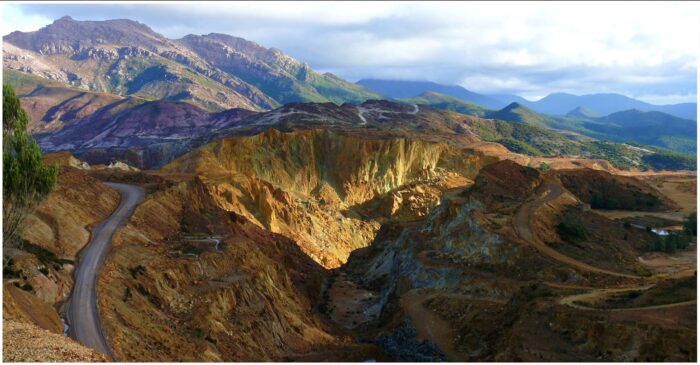
Copper-rich Mt Lyell in Queenstown, Tasmania. Credit Sibanye-Stillwater
The Tasmanian Government put in $9.5 million for early works and has a $25 million package lined up once mining starts. About 300 jobs come with it.
Mt Lyell’s general manager Clint Mayes told reporters on announcement day the rising copper price was “a nice sweetener”, and that Sibanye made the call on long-term demand. He’d always believed the mine would reopen. “There’s too much metal in the ground for it not to.”
Tasmania’s Resources Minister Felix Ellis was a plumber on the west coast when the mine shut, and he got emotional in front of the cameras on announcement day. Plenty of Tasmanians who started out at Mt Lyell are now working mines around the world, he said, and he’s looking forward to welcoming them back.
A $490 million mine next door is as good as it gets for an $11 million explorer. A major will run a mill 10km from Jukes for the next two decades, and the crews Ellis wants home will be living down the road.
Copper’s Record Price Run Set to Continue as Bubalus Buys Skyline
Copper set a record of US$14,875 a tonne in London on September 10, and later in the month closed at a record US$6.92 a pound in New York. It sits a few hundred dollars under the record as we write, and we think the run has further to go.
Copper held in London Metal Exchange warehouses fell 38% between April and late September as buyers in the US and China stockpiled it, and global mine output fell in the first half of the year.
In Chile, supervisors at BHP’s Escondida, the biggest copper mine on earth, voted 95% for a strike on September 30. There’s so little copper to spare that BHP paid up within a fortnight to keep them at work.
Even Mt Lyell, with the shaft already sunk and the money approved, pours its first copper in 2029.
The big miners are going back over old ground because the new discoveries have dried up. S&P Global went through the world’s copper finds this month and more than 60% of the copper added in the past year came from stretching out mines already running.
Grassroots exploration got a quarter of last year’s copper exploration budget, and the mine-site programs got 43%.
Which leaves the finding to the juniors like BUS.
Demand keeps climbing from power grids and the data centres the tech giants are racing to build, and the switch to electric cars and renewable power comes on top of it.
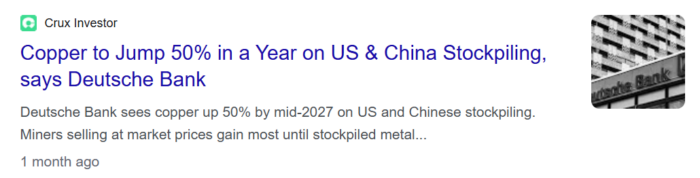
We’re bullish copper, but we like to leave price calls to the investment banks. Deutsche Bank’s head of metals research Daniel Ghali told the Wall Street Journal last month he expects copper to reach US$10 a pound by the middle of 2027.
That’s about US$22,050 a tonne, nearly 50% above where copper traded when he made the call. Ghali thinks stockpiling by the US and China could lock up about 71% of the world’s above-ground copper by the end of this year.
Citi called for US$15,000 a tonne within 12 months back in June, and copper has spent the months since closing in on it. Research house BMI sees US$17,000 a tonne within the decade as the energy transition eats into supply.
Every tonne a junior finds from here is worth more than it was a year ago.
BUS has 13 holes of confirmed copper at Jukes already and a rig a few months away. Borg says a five or 10-metre hit at 3 or 4% copper is where Jukes starts to sing.
Five Reasons We’re Backing Bubalus Resources (ASX: BUS)
1. Every Hole at Jukes Hit Copper
Jukes is the most advanced prospect at Skyline, and it’s where BUS takes the rig first.
Earlier explorers put five holes into Jukes, and the previous owner came back in 2024 and drilled eight more, plus a wedge. A wedge is a branch drilled off an existing hole to reach a new target without starting again from the surface.
All 13 hit copper (plus the wedge hole).
The best metre on the project came out of a later hole, 205 metres down, running 6.28% copper and 12.2g/t gold inside 13 metres at 1.18% copper and 1.14g/t gold. Another hole cut a metre at 6.95% copper.
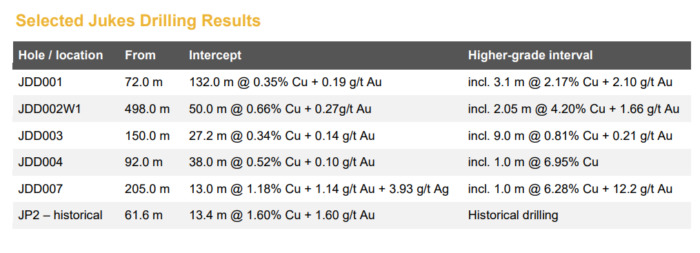
The first hole cut 132 metres at 0.35% copper and 0.19g/t gold from 72 metres down, and the wedge hit 50 metres at 0.66% copper and 0.27g/t gold from 498 metres, with 2.05 metres at 4.20% copper inside it.
An old hole from the days before the previous owner cut 13.4 metres at 1.60% copper and 1.60g/t gold from 62 metres.
Between them they’ve outlined a broad copper-gold system with several richer zones running through it. The copper starts near surface and runs to about 430 metres below it, over at least 350 metres along strike, and it’s open in both directions and at depth.
For anyone new to copper grades, 0.35% copper means 3.5kg of copper in every tonne of rock. Some of the biggest copper mines on earth make their money on grades like it.
Newmont’s Cadia in NSW digs ore running well under half a per cent copper with gold on top, and Jukes carries gold alongside its copper too.
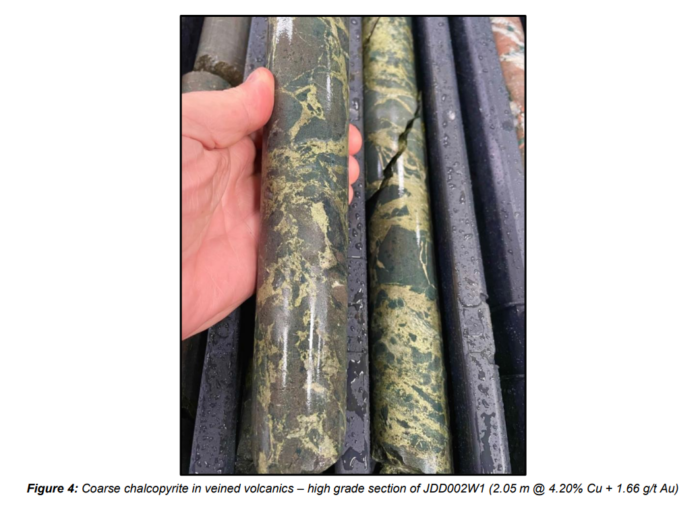
The copper at Jukes is chalcopyrite, a brassy copper-iron sulphide that’s easy to spot in the core. The photos in BUS’ announcement show it sitting in coarse veins through the volcanics.
The geologists read Jukes as an iron-oxide copper-gold system, the same family as BHP’s Olympic Dam, with features of a porphyry, the big low-grade systems that grow around granite intrusions. Both styles can grow into giant deposits.
Borg’s first job is finding out how far the richer zones run. The wedge is the only hole in its part of the system and it’s open in every direction, so it’s where BUS goes first.
2. Hydes Has Copper at Surface and an Untested Target Below
Hydes sits about 5km south of Jukes and is the other prospect BUS plans to drill in its first year.
At Hydes the copper is sticking out of the ground, and the one hole the previous owner drilled beneath it started 400 metres away and never reached the target zone.
The previous owner’s crew sawed a continuous channel across the outcrop and sampled every metre of it. It came back at 24 metres of 0.74% copper and 0.36g/t gold, including 14 metres at 0.97% copper and 0.56g/t gold.
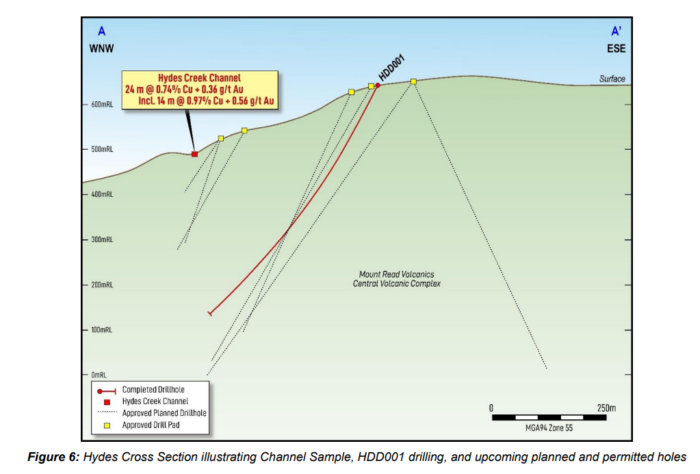
A channel is one continuous cut through the whole outcrop, so the grade is an honest average of the lot. Borg says they’re similar to the grades Mt Lyell mines.
Directly underneath sit gravity and magnetic anomalies, patches of ground denser and more magnetic than everything around them. Iron-oxide copper systems carry plenty of magnetite and other heavy minerals, so geophysicists go looking for this pattern.
The permits now let BUS drill right under the outcrop.
If the first few holes land, Skyline goes from one copper system to two.
3. 80km of Strike in Tasmania’s Mining Heartland
Skyline runs along the eastern edge of the Mount Read Volcanics, a belt of ancient volcanics that has fed western Tasmania’s mines for more than a century, with Mt Lyell among them.
Jukes and Hydes get the rig first, and behind them BUS picks up a pipeline of prospects thrown into the deal, with South Darwin the pick of them.
Explorers drilled three holes there in 2011 and 2012 and hit 124 metres at 0.40% copper and 0.12g/t gold, in the same iron-rich copper style as Jukes, plus a separate 13 metres at 1.2% copper and 0.45g/t gold.
Drilling at South Darwin also hit rare earths, including 72 metres at 1.13% total rare earth oxides with 30 metres at 2.26% inside it. As our regular readers know, rare earths go into the magnets in electric cars and wind turbines, and China controls most of the world’s supply.
BUS gets the rare earths on top of the copper, and it plans to re-log the old core and build a 3D model of South Darwin before drilling it again.
Half a dozen more prospects sit along the rest of the strike, with copper at surface or buried geophysical targets and little modern drilling between them. One of them (Linda) sits right beside Mt Lyell.
BUS plans to rank them with mapping and fresh work on the old geophysics, then drill where the signals stack up. For an $11 million company, it’s a lot of ground in reserve behind Jukes and Hydes.
4. A Copper Project for $1 Million Cash
For a drill-confirmed copper project 10km from Mt Lyell, $1 million in cash is a steal.
The previous owner wanted to keep a stake, so the rest of the upfront price is at least $2 million in BUS shares, topped up so the vendor lands on 19.95% of the company.
The vendor’s shares come out of escrow a quarter at a time, at completion and then at three, six and nine months after it, so it still holds most of its stake while the first holes go in.
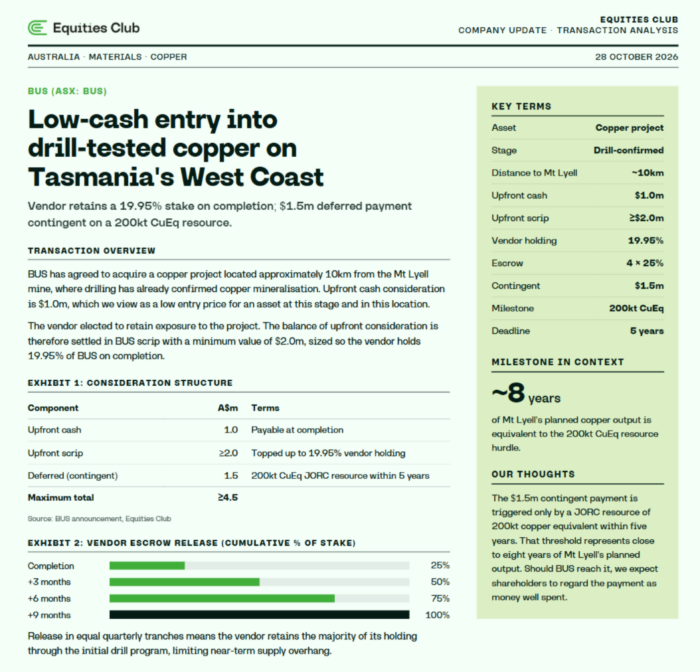
Another $1.5 million only gets paid if BUS proves up a JORC resource of 200,000 tonnes of copper equivalent within five years. For scale, 200,000 tonnes is close to eight years of Mt Lyell’s planned output, and if BUS gets there, shareholders will be happy to pay it.
The previous owner’s CEO stays on as a consultant for six months, and the vendor gets to nominate a director while it holds more than 10% of BUS. BUS plans to keep the Tasmanian exploration crew too, so the people who drilled Jukes stay with the project.
BUS is raising $3 million to close the deal, with the directors and Jolly putting their own money in, and comes out the other side with around $4.8 million in the bank. The first $2.5 million of it goes into Skyline over 12 months, most of it on 4,000 metres of drilling at Jukes and Hydes.
Sibanye paid US$10 million for Mt Lyell with copper at US$8,000 a tonne. It’s over US$14,000 now, and BUS is paying $3 million up front for ground 10km away. The potential upside from here is big in our eyes.
5. A Board Built to Find Gold and Copper
Nick Jolly you’ve already met, and his last two stops ended in a multibillion dollar takeover and an 18 bagger high point.
Spartan was a $2.4 billion takeover, with Jolly running the geology and signing off on the ounces that got Ramelius to pay up.
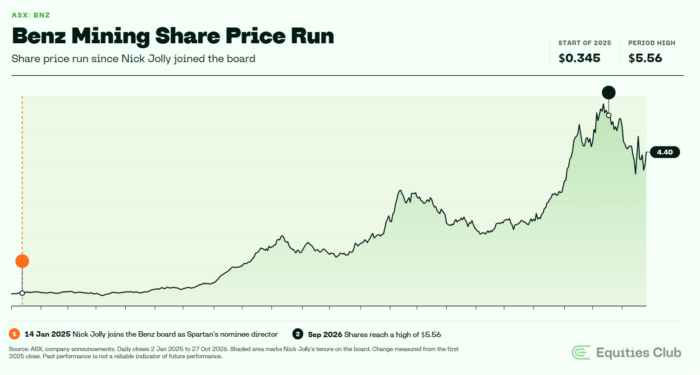
Jolly joined the Benz Mining board in January last year, the day it completed the Glenburgh purchase in WA, when Benz was a 30c stock. Benz hit gold at Glenburgh, the shares hit a high of $5.56 last month, Benz is now in the ASX 300.
One discovery did all of it, and it’s why we buy explorers before the first hole goes in.
Before them he held management roles at Northern Star, Australia’s biggest gold miner. Jolly will give BUS proven technical advice on top of his board seat.
He joins Brendan Borg, who moves up from managing director to executive chair as Alec Pismiris retires from the board.
Borg has more than 25 years in exploration and mining, and sat on the Leo Lithium board when it sold its remaining 40% of the Goulamina lithium mine in Mali to Ganfeng for US$342.7 million.
When the Avon Plains results came back light earlier this year, Borg bought 200,000 BUS shares on market with his own money. We liked seeing it then, and we like it more now.
What Could Go Wrong for Bubalus
Every result in this article comes from the previous owner or earlier explorers, and BUS still has to drill it into a JORC resource (the industry’s audited count of what’s in the ground).
Western Tasmania is steep, wet country that’s hard to work in, and iron-oxide copper systems can sit deep. As drilling can be expensive, BUS will need to raise more money at some point in the future, and we’d hope at a much higher price.
We’ve weighed all of it against copper near record highs and a board with a proper discovery record, and we’re happy holding BUS through the drilling.
What We’re Watching at Bubalus
- Completion of the Skyline deal, targeted for December
- The rig turning at Jukes in January
- Geophysics at Hydes, then the first three or four holes into it
- Mapping and geophysics across the rest of the 80km of strike
- First assays from the BUS drilling
The Bottom Line on Bubalus Resources
The hills around Queenstown have been orange for a century because of what’s under them, and in 2029 Sibanye starts digging it out again.
The local Resources Minister Felix Ellis wants the miners who left town to come home for it. Some of them might find work 10km down the road at Jukes first.
Copper is near the highest price it has ever traded and the banks see it going higher. BUS has copper in all 13 holes drilled there and a rig a few months off.
At 8.3c, with half the company in cash, you’re paying about $5 million for Skyline before a single BUS hole goes in.
The geologist who just joined the board took his last junior from 30c to $5.56, and Borg bought BUS shares with his own money on the worst day the stock had this year.
Mt Lyell sat shut for 12 years with too much metal in the ground to stay that way.
Ten kilometres away, BUS gets its first look at how much copper is in Jukes this summer, and we’d rather be in before the rig is.