
When we added Mount Ridley Mines (ASX: MRD) to the portfolio at 2.4c in March, we were backing a pile of dirt with big numbers attached.
Grass Patch is a clay deposit 25km north of Esperance in WA. It holds heavy rare earths, light rare earths, gallium and the largest scandium resource on the planet (China would prefer the rest of us went without every one of them).
This morning MRD pulled 91.8% of the scandium out of the clay, up from 80% in August, using half the chemicals. Every rare earth number went up as well, and the only metal that went backwards was gallium.
We knew in March that a resource is only worth something if the metal comes out of the clay at a price worth paying, and back then the first metallurgical test was still two months away.
Then Chris Larder turned up. He brought with him a leach process he’d spent more than a decade building, named Selectro. He then took the chief technology officer job and handed MRD the recipe.
A leach is the chemical bath that pulls metal out of crushed rock, and for clay like this the whole industry uses hydrochloric acid.
In August, Selectro went head to head with the traditional acid on the same Grass Patch sample. We wrote it up here and said the process might end up worth more to MRD than the ground it sits on.
After today we’re more convinced of it. Three tests in, the recoveries have gone up every time, and the bulk sample that proves it at scale is next on the list.
Selectro Halves the Reagent Dose
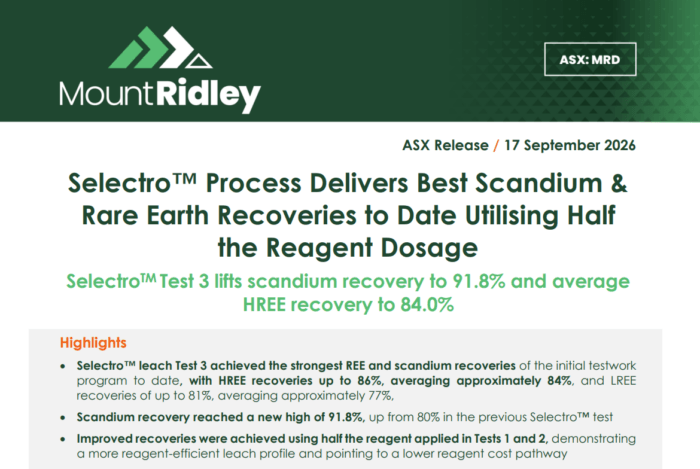
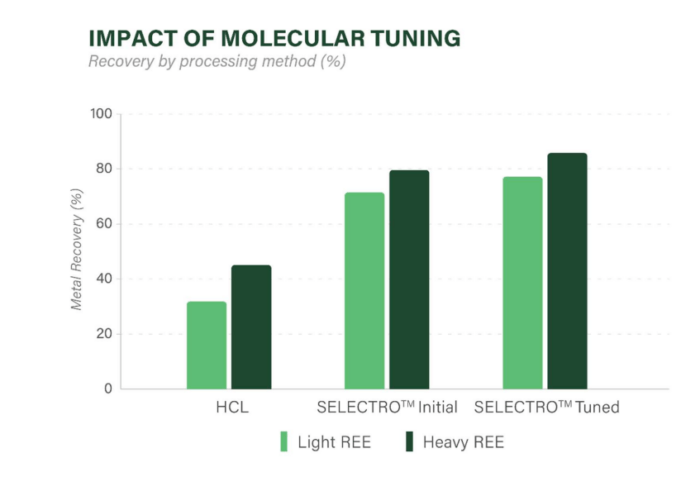
Larder cut the reagent dose in half for the third and final test of the program, which MRD released today. The heavy rare earths averaged 84%, which beats the best single heavy rare earth result from August, 83.1% on terbium, and the lights came in at 77%.
The reagent is the chemical in the bath and one of the biggest running costs in a leach circuit. Selectro already runs it in a closed loop, so the same chemicals go round and round like the bags at an airport.
Now it needs half as much to begin with, and Larder says he hasn’t found the bottom of the dose.
“The results make it clear that tuning delivered material improvement, with scandium recovery increasing from 80% to 91.8% while the reagent dose was halved. Being able to manage the process to get outcomes like that is genuinely exciting.”
Chris Larder, chief technology officer of Mount Ridley Mines
MRD trades at a $67 million valuation and the share price is up 75% from when we told readers we had added it to our portfolio. It has since claimed the world’s biggest scandium resource and patented the Selectro process to pull it out.
Selectro vs Hydrochloric Acid on Grass Patch Scandium and Rare Earths
Every test in this program came out of one bucket. A lab ground 16.8kg of Grass Patch drill core into one uniform composite. Each test ran on a 90 gram scoop of it, so every run started from the same dirt.
The acid went first. Selectro then went three times, and Larder fine-tuned the recipe between each run.
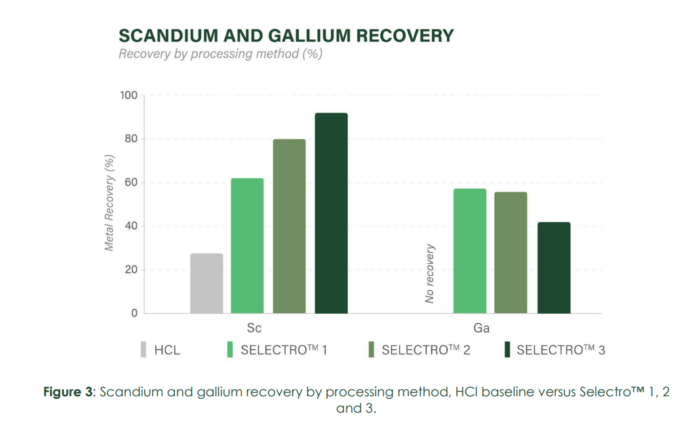
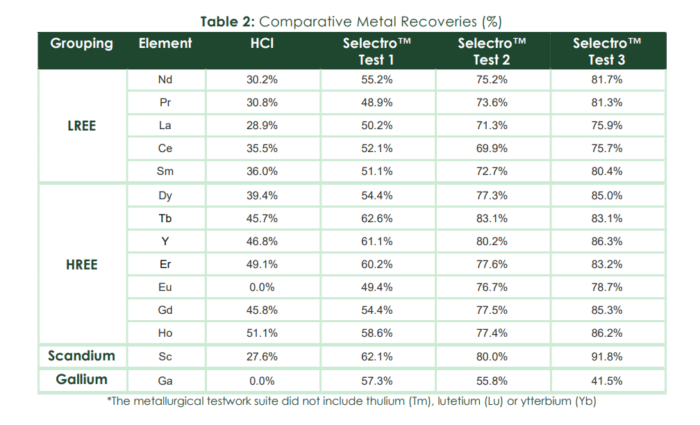
Scandium recovered 27.6% with the acid. Selectro knocked it out the park with 62.1%, 80% and then finally 91.8%.
Dysprosium is the heavy rare earth inside the magnets in EVs and defence systems, and it fetches the highest sales price. It doubled from 39.4% under acid to 85% with Selectro.
Neodymium, the light rare earth that does the volume in the magnet trade, went 30.2% under acid, then 55.2%, 75.2% and 81.7%.
Test 3 was the reagent test. Larder halved the dose and got the best numbers of the program, on raw feed straight out of the ground, before any concentration step and before anyone had tried to optimise the recipe.
The announcement says MRD is still to find the lower limit of reagent concentration, so the next run pushes the dose down again.
Selectro also hit its top recoveries inside four hours in a test that ran for 24. It runs at low temperature and normal air pressure, which Larder ties to an operating cost profile he calls “potentially very attractive”.
Gallium Recovery Drops at the Lower Reagent Dose
Gallium went the other way. Test 3 pulled 41.5% of it, down from 55.8% in August. The same cut in reagent that lifted scandium and the rare earths is what took gallium down, so each metal has its own sweet spot on the dose.
MRD’s next job is finding the dose that suits all of them, and it expects reagent tuning and a richer feed from beneficiation to claw the gallium back. Even at 41.5%, Selectro is miles ahead of the traditional acid, which recovered 0% of the gallium.
What Comes Next for Mount Ridley (ASX: MRD) and Selectro
The lab is floating Grass Patch material right now. Flotation runs crushed ore through a frothy tank of water and air, where the minerals you want ride the bubbles to the top and the clay sinks.
Lab work in August found the rare earths sit in phosphate minerals, which float well. Binning most of the clay before the leach hands Selectro a richer feed, and less clay in the tank means less reagent spent on clay.
Then comes the bulk sample, which is the one we’re waiting on. Every test so far has run on a handful. The bulk program runs a much bigger lump of Grass Patch through both the half-dose recipe from Test 3 and the floated concentrate, and shows whether the lab numbers survive being scaled up.
The Test 3 numbers also go into updated process economics and scoping assumptions, feeding the demonstration plant costings we wrote about last month.
Last on the list is running Selectro over another company’s ore. If the process works on third-party feed, MRD gets paid on a deposit someone else digs, and the number of clay rare earth projects looking for a cheaper leach runs well past Grass Patch.
“We haven’t yet established where the reagent concentration breaks for the process, providing further opportunity to optimise the reagent dose and recovery of targeted individual minerals.”
Allister Caird, managing director of Mount Ridley Mines
Three tests ago the acid was leaving 72% of the scandium behind. Selectro is now leaving 8%, on half the chemicals, and Larder is yet to find the floor of the dose.
The bulk sample decides whether these numbers hold at scale, and we’re backing them to hold. At 4.2c and a $67 million valuation, we think you’re paying for the dirt and getting the process thrown in.
General advice warning, disclosure and confidentiality notice
General advice warning
The contents of this document are intended to provide general securities advice only and have been prepared without taking account of your objectives, financial situation or needs. Because of that you should, before taking any action to acquire or deal in, or follow a recommendation (if any) in respect of any of the financial products or information mentioned in this document, consulting your own investment advisor to consider whether that is appropriate having regard to your own objectives, financial situation and needs. If applicable, you should obtain the Product Disclosure Statement relating to the relevant financial product mentioned in this document (which contains full details of the terms and conditions of the relevant financial product) and consider it before making any decision about whether to acquire the financial product. Whilst the Equities Club Pty Ltd (“Equities Club”) believes information contained in this document is based on information which is believed to be reliable, its accuracy and completeness are not guaranteed and no warranty of accuracy or reliability is given or implied and no responsibility for any loss or damage arising in any way for any representation, act or omission is accepted by Equities Club or any officer, agent or employee of Equities Club or any related company.
Neither Equities Club, nor any of its directors, authorised representatives, employees, or agents, makes any representation or warranty as to the reliability, accuracy, or completeness, of this document or any advice. Nor do they accept any liability or responsibility arising in any way (including negligence) for errors in, or omissions from, this document or advice.
Disclosure
The directors, authorised representatives, employees and associated persons of Equities Club may have an interest in the financial products discussed in this document and they may earn brokerage, commissions, fees and advantages, pecuniary or otherwise, in connection with the making of a recommendation or dealing by a client in such financial products. Equities Club owns 2,083,333 MRD performance rights and 303,030 shares at the time of publishing this article. Equities Club has been engaged by MRD at the time of writing.
Confidentiality notice
The information contained in and accompanying this communication is strictly confidential and intended solely for the use of the intended recipient/s. The copyright in this communication belongs to Equities Club. If you are not the intended recipient of this communication please delete and destroy all copies immediately.
Equities Club Ltd (CAR No. 001308139) is a corporate authorised representative of ShareX Pty Ltd, Australian Financial Services License (AFSL) No 519872.