
An hour up the Mississippi River from New Orleans, the last bauxite refinery in the US keeps its waste in lakes of red sludge behind levees about 15 metres high.
State inspectors found the levees leaking in mid-2024. When they went back earlier this year the sludge was still getting out, and the water in the ditches was rust-coloured and bright pink.
The sludge is called red mud. It’s what a refinery has left after it pulls the aluminium out of bauxite, and around four billion tonnes of it is sitting in dams around the world.
Alcoa’s refineries south of Perth run on bauxite out of the Darling Range and keep their red mud in dams behind the plants.
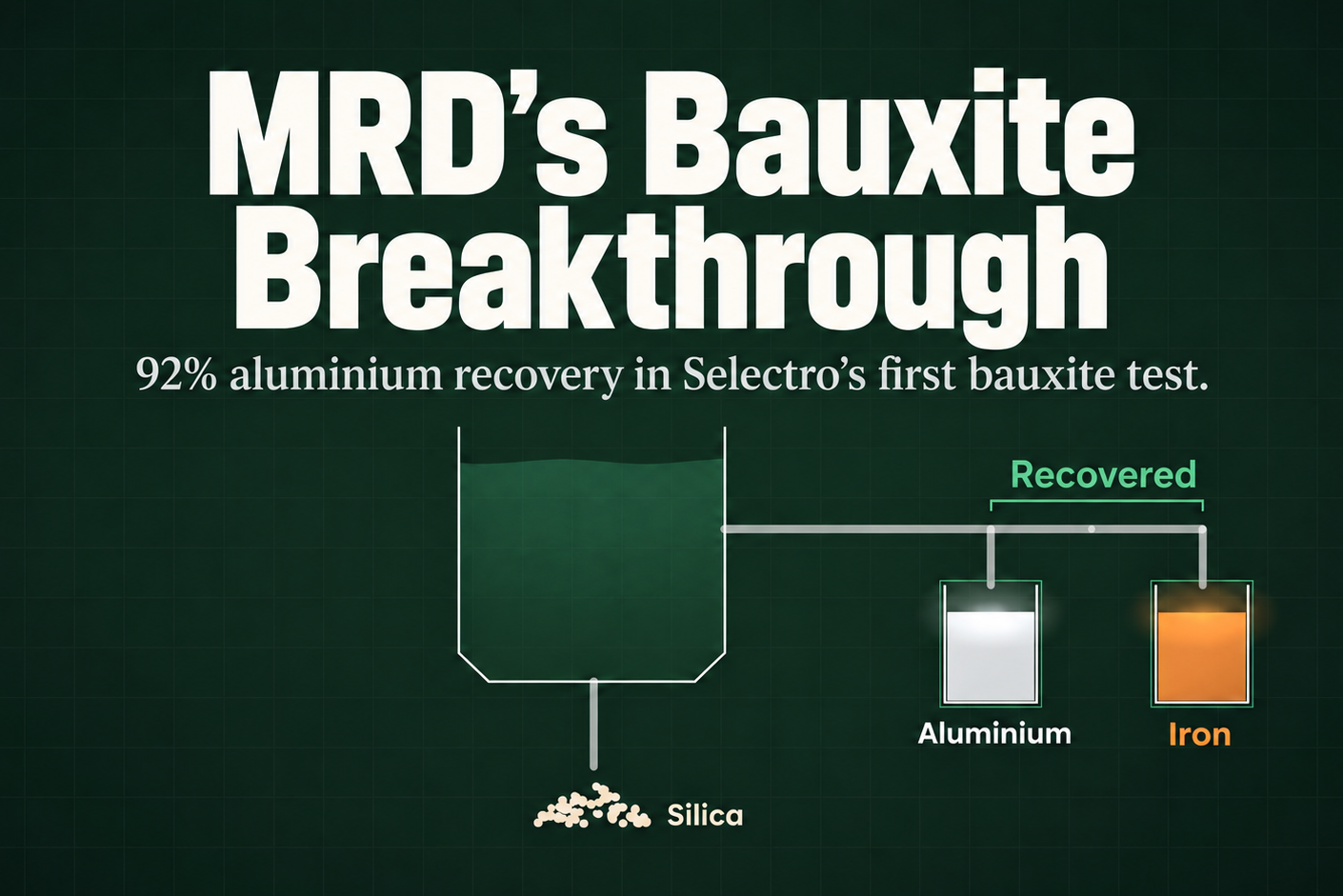
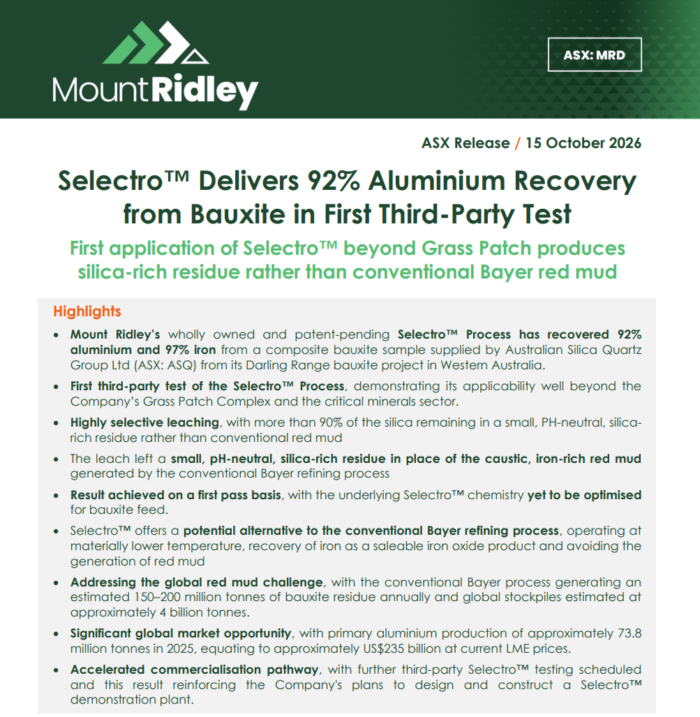
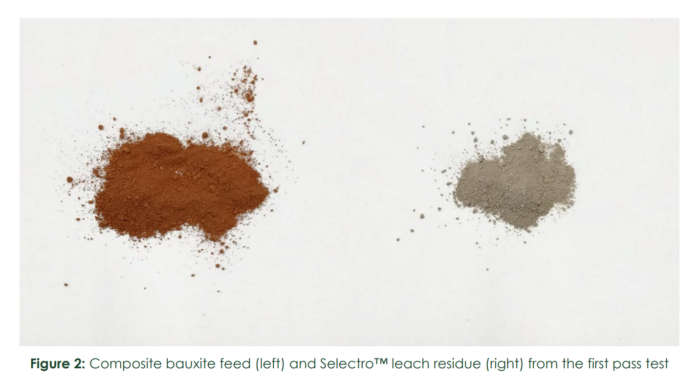
Our portfolio company Mount Ridley Mines (ASX: MRD) has just run bauxite from the same hills through a process it owns called Selectro. The photo in the announcement shows red bauxite going in and a small pile of grey silica coming out.
On its first run Selectro recovered 92% of the aluminium and 97% of the iron from a blended bauxite sample.
MRD trades at 3.6c with a market value of about $50 million. The aluminium that comes out of the world’s refineries each year is worth about US$235 billion, and MRD wants to sell those refiners a process that turns the biggest part of their waste bill into a product.
Selectro vs the Bayer Process: Bauxite Without the Red Mud
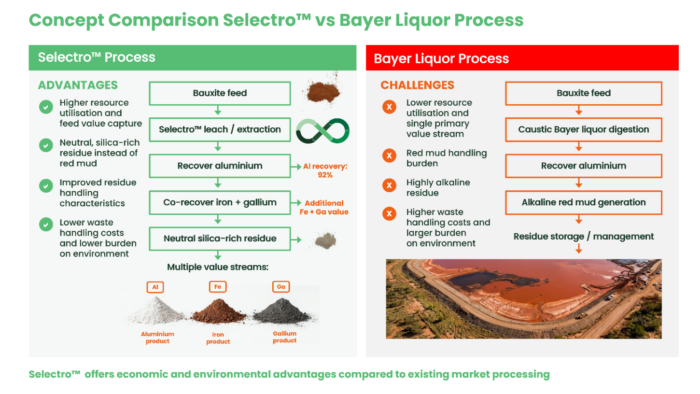
Aluminium starts out as bauxite. A refinery cooks the bauxite in a hot bath of caustic soda (the chemical in drain cleaner) and the aluminium dissolves out into the liquid.
The refinery dries what it dissolved into a white powder called alumina and sells it to smelters, who turn it into metal.
Everything the caustic soda can’t dissolve comes out the bottom as mud, and the refinery pays to keep it in a dam for good. The method is called the Bayer process and refineries have run it since the 1880s.
Iron is the first thing in the dam. It’s between a third and a half of the mud, and Selectro recovered 97% of it. MRD says it can pull the iron back out of the liquid and sell it.
Gallium is the second. It’s the metal in military radar and other defence electronics. China produces about 99% of it and the Trump administration wants it made elsewhere.
Most of the gallium in bauxite goes to the dam. In July Alcoa signed off on a plant at its Wagerup refinery south of Perth to get it back out of its own liquor, with the Australian, Japanese and US governments behind it.
Selectro has already recovered gallium from MRD’s own clay. The bauxite gallium result is still at the lab, and if it comes in a Selectro plant would have a third product to sell.
Heat is the third. A Bayer refinery cooks Darling Range bauxite at about 145°C inside pressure vessels and burns gas or coal to do it. Selectro did all of this below the boiling point of water at normal pressure.
On our own back-of-the-envelope sums, less fuel and more products to sell bring Selectro in well under the cost of the Bayer process.
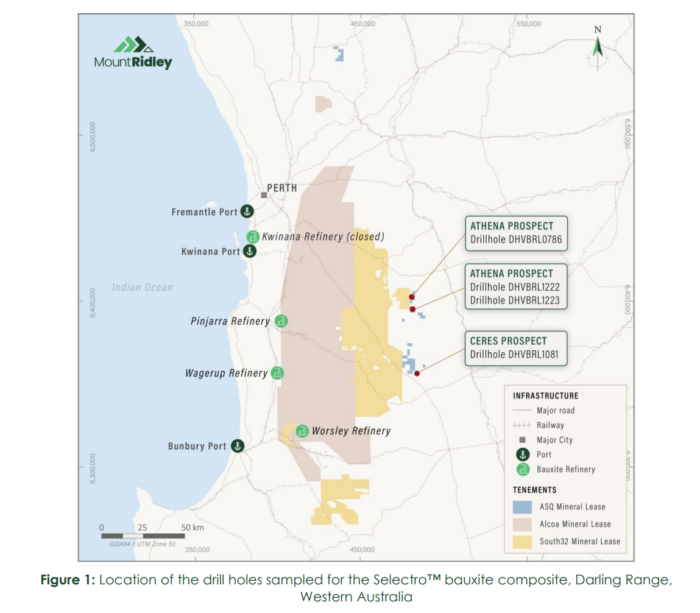
The bauxite for the test came from Australian Silica Quartz Group (ASX: ASQ), whose ground sits right next to Alcoa’s bauxite leases. ASQ sent samples from four drill holes and the lab blended them. If Selectro works on this bauxite it works on Alcoa’s.
Mount Ridley Mines (ASX: MRD) and the Selectro Leach
We added MRD to our portfolio in March at 2.4c for Grass Patch, its clay deposit 25km north of Esperance in WA. Five months later MRD upgraded the clay to the world’s largest reported scandium resource, with heavy rare earths and gallium in the same ground.
Chris Larder changed the company’s direction when he became chief technology officer in July. He brought a leach called Selectro he had spent more than a decade building.
Chris knows the process better than most, having worked on two of the three active bauxite refineries in Western Australia.
Managing director Allister Caird explains a leach with a tea bag. The ore is the tea bag and the leach is the hot water. The metal comes out into the water and you collect it from there.
Selectro’s reagent runs in a closed loop, so the plant recovers it after each batch and uses it again.
On Grass Patch clay, Selectro recovered 91.8% of the scandium in its third test, against 27.6% for the standard hydrochloric acid leach.
Bauxite looks a long way from a scandium deposit. Scandium’s main job is making aluminium alloys stronger, so Caird says MRD was heading toward the aluminium industry anyway.
The bauxite test is Selectro’s first on ore from another company.
The small-cap market has gone quiet lately and MRD was still up nearly 50% on our entry price before the result came out.
“This is a remarkable result for Selectro. Bauxite is a very different material to our Grass Patch feed, so this test gives us a clear indication of how broadly Selectro can be applied.”
Allister Caird, managing director of Mount Ridley Mines
Selectro Residue vs Red Mud: Sand in Place of Caustic Sludge
When the Selectro test was finished, about a quarter of the sample was left over. It was mostly silica (what sand is made of) and it came out close to neutral on the pH scale.
Red mud sits up near drain cleaner on the same scale and burns skin. Almost none of it can be reused, so refineries keep it in dams for good.
A Bayer refinery is left with between a third and just under half of every tonne of bauxite it puts through, and all of it is red mud.
Red mud holds scandium too, and Selectro has already recovered 91.8% of it from MRD’s clay. A US company is planning a US$850 million plant to pull gallium and scandium back out of the leaking red mud lakes up the Mississippi. It’s the best evidence we’ve seen that the metals in red mud are worth going back for.
The world mined about 440 million tonnes of bauxite last year and added 150 to 200 million tonnes of red mud to its dams. If every tonne went the way of MRD’s sample, the leftovers would come to about 110 million tonnes of sand, and the dams would take in somewhere between 40 and 90 million tonnes less a year.
We know a lab sample is a small thing to hang tens of millions of tonnes on, and MRD still has to repeat it on bigger batches in its demonstration plant.
A single plant running Selectro would keep millions of tonnes of red mud a year out of a dam.
What Comes Next for Mount Ridley’s Bauxite Testing
The team ran the bauxite through Selectro as it was built for Grass Patch clay. Tuning it for bauxite is the next job, and Caird expects the recoveries to improve from there.
MRD has more ores from other companies lined up for testing. It had told the market to expect the first outside result in early 2027, and this one turned up months early.
Bayer refineries can’t make money from bauxite with too much clay in it, because the clay uses up their caustic soda and takes alumina into the mud with it. Selectro was built on clay, so MRD thinks it can open up bauxite the industry has written off.
There are also bauxite deposits too small to pay for a refinery, and MRD sees room for small Selectro plants built next to them.
MRD is designing a demonstration plant in Perth to run Selectro in bulk on its own clay and on other companies’ ore, and it says it has the money to keep going. The plant will also make sample batches for the buyers and partners MRD wants to sign.
What We’re Watching at Mount Ridley Mines
We’re still working out how big this could get, and so is MRD.
The gallium result from the bauxite is the next news we expect. We also want to see Selectro repeat the result on a second outside ore, because ASQ chose the samples for this test.
The number we want most is MRD’s own costing against Bayer. Ours is a back-of-the-envelope sum, and the demonstration plant work should produce a proper one.
MRD is talking to industry and government about funding the next stage. Alcoa is the obvious partner. It’s an American company, and Caird wants to take Selectro to the US.
Selectro has now beaten our expectations three announcements in a row, twice on MRD’s own clay and now on another company’s bauxite. We’d have been happy with 80% of the aluminium on a first run at bauxite, and it came in at 92.
General advice warning, disclosure and confidentiality notice
General advice warning
The contents of this document are intended to provide general securities advice only and have been prepared without taking account of your objectives, financial situation or needs. Because of that you should, before taking any action to acquire or deal in, or follow a recommendation (if any) in respect of any of the financial products or information mentioned in this document, consulting your own investment advisor to consider whether that is appropriate having regard to your own objectives, financial situation and needs. If applicable, you should obtain the Product Disclosure Statement relating to the relevant financial product mentioned in this document (which contains full details of the terms and conditions of the relevant financial product) and consider it before making any decision about whether to acquire the financial product. Whilst the Equities Club Pty Ltd (“Equities Club”) believes information contained in this document is based on information which is believed to be reliable, its accuracy and completeness are not guaranteed and no warranty of accuracy or reliability is given or implied and no responsibility for any loss or damage arising in any way for any representation, act or omission is accepted by Equities Club or any officer, agent or employee of Equities Club or any related company.
Neither Equities Club, nor any of its directors, authorised representatives, employees, or agents, makes any representation or warranty as to the reliability, accuracy, or completeness, of this document or any advice. Nor do they accept any liability or responsibility arising in any way (including negligence) for errors in, or omissions from, this document or advice.
Disclosure
The directors, authorised representatives, employees and associated persons of Equities Club may have an interest in the financial products discussed in this document and they may earn brokerage, commissions, fees and advantages, pecuniary or otherwise, in connection with the making of a recommendation or dealing by a client in such financial products. Equities Club owns 2,083,333 MRD performance rights and 303,030 shares at the time of publishing this article. Equities Club has been engaged by MRD at the time of writing.
Confidentiality notice
The information contained in and accompanying this communication is strictly confidential and intended solely for the use of the intended recipient/s. The copyright in this communication belongs to Equities Club. If you are not the intended recipient of this communication please delete and destroy all copies immediately.
Equities Club Ltd (CAR No. 001308139) is a corporate authorised representative of ShareX Pty Ltd, Australian Financial Services License (AFSL) No 519872.