
The S&P 500 has closed at a record 27 times this year, near enough to one every six trading sessions. At home, Commonwealth Bank handed down an $11 billion cash profit, which shakes out to about $30 million for every day of the year.
Fund managers sitting on gains like that can’t help themselves. They go looking for the next winner, and the search always ends up at the end of the market we like (small-caps) eventually.
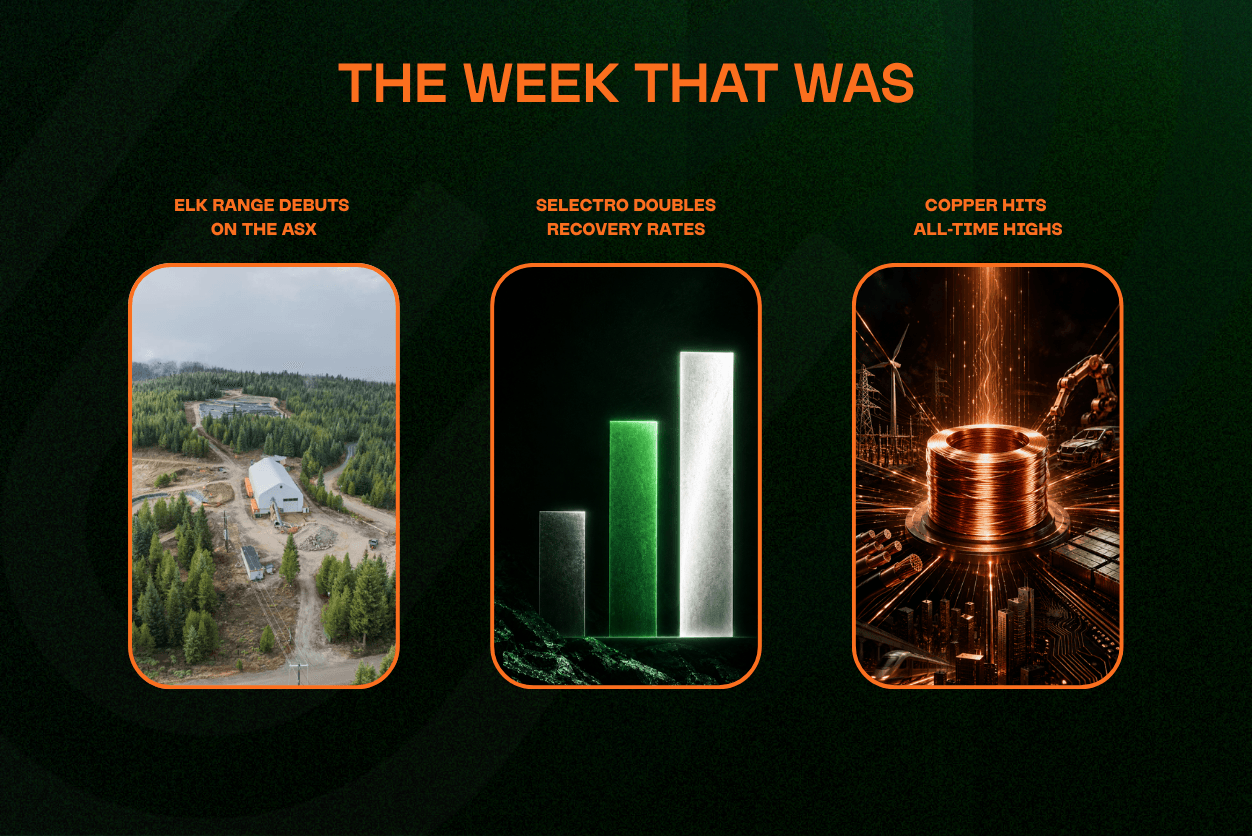
Down our end this week we had a gold IPO, a processing method that beat the industry standard, copper at a price nobody has ever seen, and Sam Weiss backing a micro-cap.
What caught our eye this week:
- Elk Range Mining lists and signs its driller, while a director starts buying on market
- Mount Ridley Mines runs Selectro against acid leaching, and it wins
- Uranium’s long-term contract market hits 2008 prices
- Fortuna Metals has a price target more than double its share price
- KTEK Aerosystems lands licence that opens US market
- Pathkey.AI signs the man who built Altium, and its first paying customer
- Copper trades at a price it has never seen
- AVITA Medical turns a record quarter into a 40% week
- Evion Group picks up a graphite tailwind in Washington
- Exultant Mining intersects sulphides at Balerion
Let’s get to it.
ELK Lists and Signs its Driller, While a Director Starts Buying
The newest name in the Equities Club portfolio started trading this week. Elk Range Mining (ASX: ELK) is an Idaho gold play whose last owner spent more than US$40 million on the ground before Elk picked it up for a fraction of that.
Our launch write-up is here, and it’s already one of our most-read pieces this year. Gold starts kicking again and it seems everyone suddenly wants a look.
The prize is the Friday Gold Mine, a permitted underground operation that was pulling ore as recently as five years ago, when gold sat near US$1,887 an ounce. It’s above US$4,340 now, more than double the price the last time a truck drove off the site.
One historical hole ran better than five grams a tonne over 110 metres, and the grade was still climbing when the drill stopped. Friday sits on the same shear zone as Buffalo Gulch and Deadwood, so there’s district-scale room to grow.
The last owner’s US$40 million went towards a permitted mine with a decline already driven into the hillside, a processing plant, roads and an on-site assay lab. Most juniors burn years and most of their raise getting that far.
Elk inherited the lot, with $10 million in the bank earmarked almost entirely for drilling.
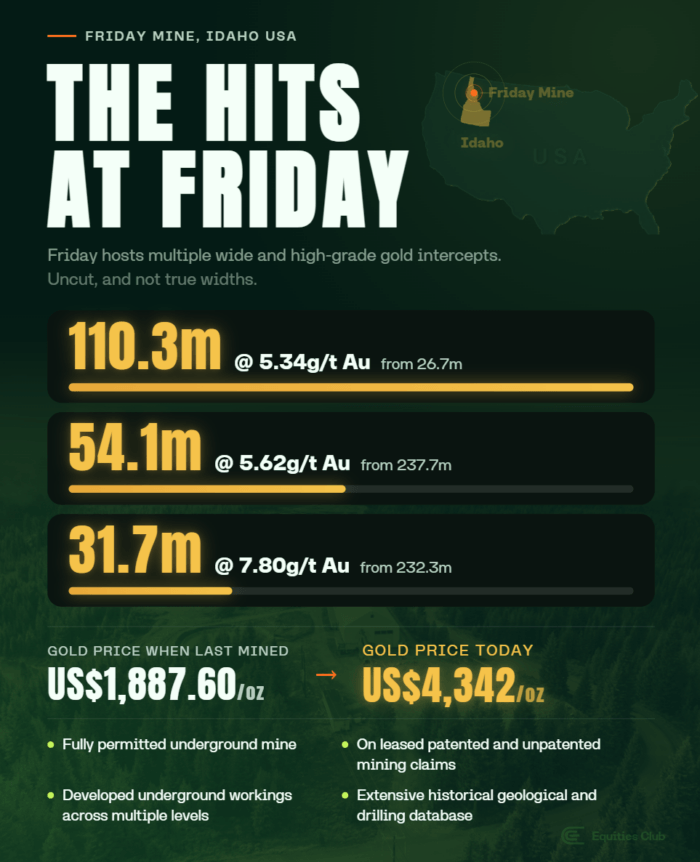
Days after listing, Elk signed Black Cloud Drilling for a maiden 2,850 metre program. They’ll be drilling eight holes aimed at confirming the old high-grade numbers and chasing the system deeper.
The rig should start turning this coming week, with assays arriving from October.
Executive director Leanne Kite also watched the sellers hit her stock on debut and went the other way, spending $47,500 on 250,000 shares in a sign of confidence.
ELK closed the week at 19c after the debut sellers washed out. From here the story belongs to the drill bit, and it starts turning within days. Stay tuned.
Selectro Passes its First Test at Grass Patch
A month after Mount Ridley Mines (ASX: MRD) handed Chris Larder the chief technology officer job, his processing method got its first run over Grass Patch ore.
You can find our write up here.
Larder spent more than a decade building Selectro, a method for pulling rare earths and critical minerals out of ore. This week MRD ran it head to head against standard acid leaching on ore from its own project north of Esperance in WA.
The metal you want is always locked inside the rock, so the industry crushes the rock and soaks it in a chemical that leaches the metal out. For deposits like Grass Patch, they’ve always used hydrochloric acid.
Larder’s method is called Selectro. It does the same job with different chemistry, and the reagent gets recovered and reused each cycle, so it’s cheaper than buying acid by the tanker.
Selectro won on every commodity MRD tested this week.
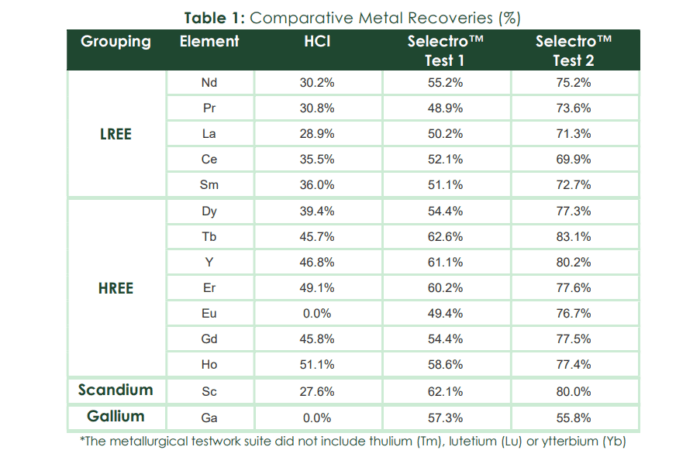
On dysprosium and terbium, the two heavy rare earths that go into EV and wind turbine magnets, Selectro averaged above 80% recovery against 38% for the acid.
Grass Patch holds one of the largest scandium resources anywhere, and Selectro recovered 80% of it against 27% for the acid.
Then there’s gallium. China refines almost all of the world’s supply, and standard acid leaching recovers none of it at Grass Patch. Selectro pulled out 55%.
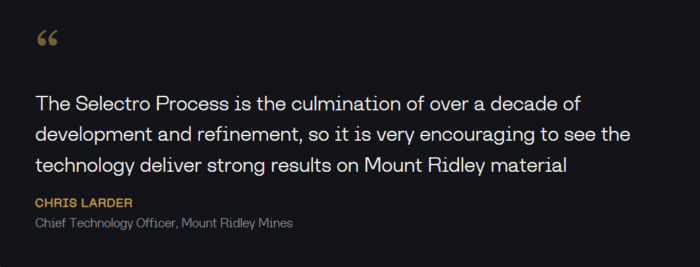
Any deposit chasing better recoveries could license Selectro, with MRD clipping the ticket on every project that runs it. And Western governments are pouring billions into rare earth supply that runs through anywhere but China, so the shopping list for better processing is long.
MRD jumped 24% to 3.1c on the day the results dropped, with $800k of stock traded. It touched 3.6c later in the week and closed at 3.2c, up a very respectable 28% on last Friday’s 2.5c.
Utilities Are Paying 2008 Prices for Uranium
The uranium spot price has sat around US$86.50 a pound since February. The buying is happening in the long-term contract market instead.
The people who run reactors buy their fuel years ahead through long-term contracts, and that price just hit US$90 a pound at the end of the March quarter, its highest since 2008. The demand comes from AI data centres that need power around the clock and the tech giants signing small modular reactor deals to feed them.
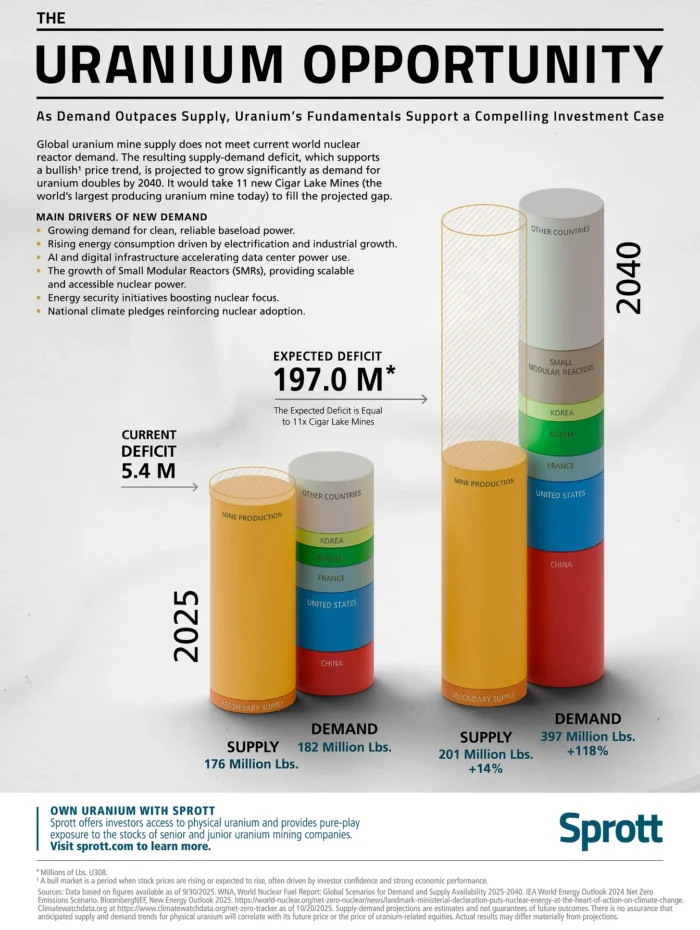
Kazakhstan digs up around 40% of the world’s uranium, and the underinvestment that followed Fukushima left a skinny project pipeline behind it.
Utilities paying 2008 prices tends to pull the rest of the sector up behind the producers, and the deals have already started at the small end of the ASX. Adavale Resources (ASX: ADD) sold its South Australian uranium assets this week to Orpheus Uranium (ASX: ORP), which is building out its ground around Marree.
Expect more of it while the term market keeps paying up.
Pitt Street Doubles Fortuna’s Valuation
We’ve been bullish on Fortuna Metals (ASX: FUN) since it joined the portfolio, so it’s good to see a research house break the company down and arrive at their own numbers.
Pitt Street Research put a 21c implied value on FUN this week, more than double the current price of 9.2c. The number came after the research house ran the ruler over the maiden resource at Mkanda.
Their approach values Fortuna at 25% of neighbour Sovereign Metals’ market cap, reflecting that Mkanda ranks inside the top six contained rutile deposits globally while sitting years behind Kasiya on study work and resource confidence.
The note also walks through the WNDRCO cornerstone investment and the 96.66% TiO2 metallurgy, plus the 5,000m aircore program now turning. All catalysts we have covered as they landed.
You can find a link to the full report here.
KTK Gets the Green Light into America
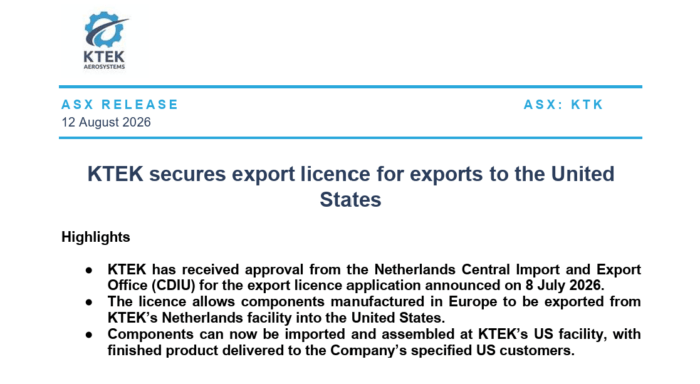
Five weeks after lodging the application, KTEK Aerosystems (ASX: KTK) has Dutch sign-off to ship drone parts out of its Netherlands facility to the US.
The approval opens the door to the biggest drone market on the planet. You can read our piece on it here.
The US accounts for close to 40% of global drone spend, driven by a defence budget that dwarfs everyone.
KTK is a $30 million market cap company now able to sell into it.
KTK makes the composite airframes and electromechanical assemblies that go inside other companies’ drones (both military and commercial), built at its European facilities. Those parts could already move freely around Europe, but selling them into America needed this licence.
The route runs from the Netherlands to KTK’s Los Angeles site, where the parts get assembled before going out to American customers. Deliveries are set to restart in September, when revenue could start to build.
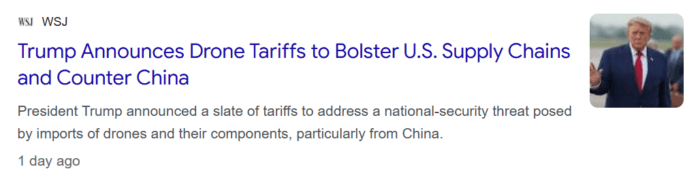
KTK is also working with Dutch authorities to extend its earlier licence covering Israel.
We’re backers of KTK, it already supplies tier-one drone makers, and September deliveries are the next date circled on our calendar.
Sam Weiss Backs Pathkey.AI
Sam Weiss spent 17 years turning Altium from a small Sydney software company into a A$9.1 billion sale to Japan’s Renesas.
This week he joined micro-cap Pathkey.AI (ASX: PKY) as strategic advisor and cornerstoned its $2.8 million raise.
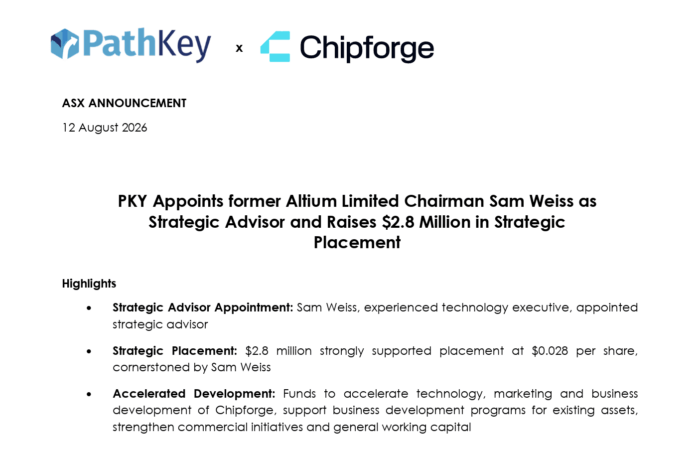
Pathkey’s platform is called Chipforge, and it uses AI to design custom computer chips, which is work that normally takes a big team of specialist engineers and a whole lot of time.
Chipforge sells to companies that could never fund their own design team. Weiss built Altium one step over in the same design chain.
Chipforge signed its first paying contract this week too, a proof-of-value program with an Australian automation company where the customer runs its own chip design through the platform. The dollars are small (which is how first revenue usually works), and Chipforge hasn’t even had its full release yet, but someone’s already paying to use it.
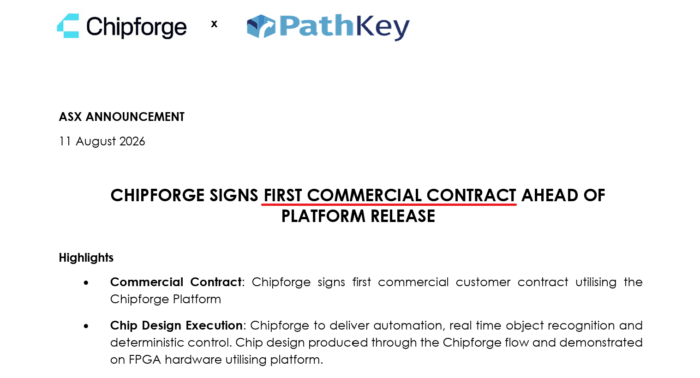
Put the backer and the first customer together and you can see why PKY ran from 3.1c to 3.8c on the week. With Weiss in the tent, PKY has one of the country’s proven software operators helping shape what comes next.
Copper: Record Highs and a Supply Wall
Copper has been mined for 10,000 years or so, and it has never been worth more than it was on Thursday. The price touched US$6.77 a pound this week and is up roughly 50% over the past year.
A single large data centre swallows 40,000 to 50,000 tonnes of copper in its cabling and cooling. Every electric car carries a few times more of the metal than the petrol one it replaces, and then there’s the grid that has to be built to charge them all.
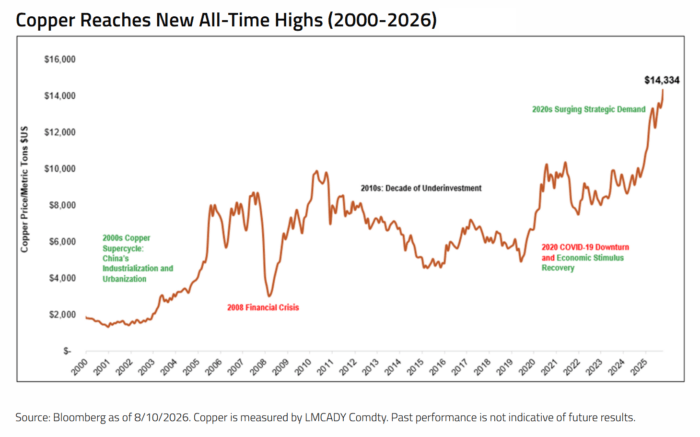
American buyers have also been stockpiling ahead of looming import tariffs, pulling metal out of warehouses everywhere else and tightening the market further.
Robert Friedland, the billionaire behind Ivanhoe’s giant Kamoa-Kakula mine, has been banging this drum for years. He calls copper ‘the new oil’ and describes demand as essentially infinite. Lately he’s added US-China trade tensions gumming up supply chains to the list.
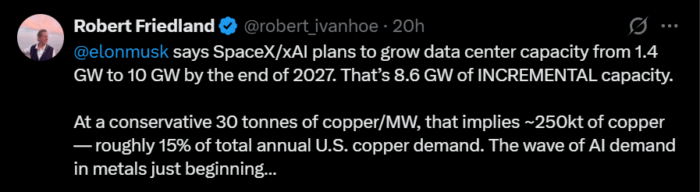
Discovery rates have fallen about 70% since the 1990s, and only 5% of the deposits found over the past 35 years turned up in the past decade. Grades keep sliding and permitting can drag past two decades, which leaves the market tight for a long while yet.
So every tonne already in the ground gets dearer while the world waits on mines that take a decade or more to build. Small explorers who hit something real, or already hold a resource, get rewarded fastest in a market like this one, and it could run for years.
Spray-on Skin Pays its Way
In the late 1990s, Perth burns specialist Fiona Wood worked out how to turn a small patch of a patient’s own skin into enough cells to treat a serious burn, all in around half an hour.
Nearly 30 years later, her invention is biotech’s mover of the week.
AVITA Medical (ASX: AVH) owns RECELL, the spray-on skin built on Wood’s work, and it just posted its best ever quarter. Revenue hit US$21.7 million, up 18% on a year ago, and operating costs fell 6% while it happened.
Management lifted full-year guidance to US$86 to US$89 million and told the market to expect cashflow breakeven in the final quarter of 2026.
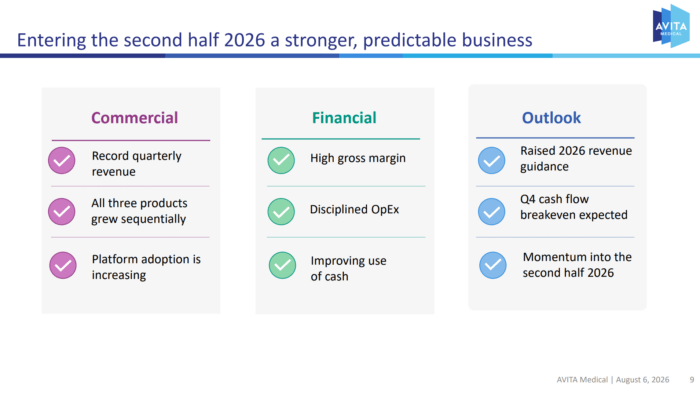
The stock had shed around 70% of its value over five years while it chased the American market, so a dated breakeven call was always going to move it.
US Medicare, the government insurer that pays a large share of America’s hospital bills, has proposed its payment rates for 2027. They include a national physician payment for RECELL and higher rates for the hospitals that use it.
If adopted, spray-on skin gets a clearer path into everyday use across American hospitals.
AVH closed last Friday at $1.54, ran as high as $2.30 midweek and finished at $2.21, up more than 40% for the week and more than 70% since the result landed.
EVG Picks up a Policy Tailwind in Washington
The US Senate voted 90 to 6 this week to extend the African Growth and Opportunity Act (AGOA) for three years to the end of 2028, with new provisions directing that critical minerals from AGOA countries get priority treatment.
Madagascar is one of the 33 beneficiary countries for 2026, and it’s where portfolio company Evion Group (ASX: EVG) is developing its Maniry graphite project.
America imports the vast majority of its graphite concentrate and all of its downstream graphite products. That includes the expandable graphite Evion’s Panthera joint venture already ships into the American market from India.
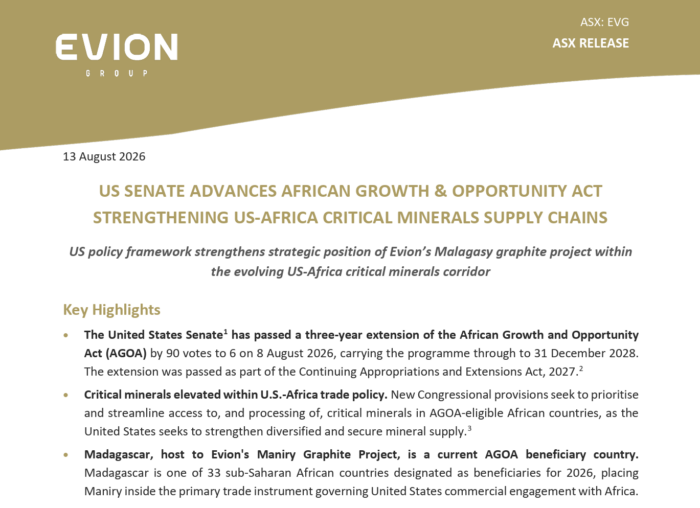
Evion has spent the year building its Washington connections. The company was accepted into the US Department of Defense Cornerstone Consortium in June and appointed The Hon. Arthur Sinodinos AO as strategic advisor the same month, so it now has people across both procurement and trade policy.
The extension still needs House approval and a presidential signature before it becomes law, but Maniry sits squarely in the path of where American graphite policy is heading.
10X Intersects Sulphides at Balerion
The fourth and fifth holes of the maiden program at Exultant Mining (ASX: 10X) both hit the sheared contact zone at Balerion, and both came back with visible sulphides carrying zinc, lead and copper.
The bands are narrow (most of them centimetres wide), and they sit right where the historical drilling pointed. Both holes are down-dip of old high-grade hits, including 0.8m at 22.0% zinc, 11.6% lead, 1.2% copper and 155g/t silver.
The sulphides are visible in the core. The grades come back from the lab, and those assays are four to eight weeks away. The rig is on the sixth and final hole of the program now.
10X carries a $6 million market cap with around $3 million in cash, so the market is paying about $3 million for Balerion and everything else the company holds.
The Week Ahead
The main event for us this week is a drill rig on an Idaho hillside. Elk Range should start turning this week, and the first target is the bottom of a hole where the grade was still climbing when the last crew went home. Five grams over 110 metres is what the old logs say. Now we find out.
MRD’s next job is proving Selectro at scale, and KTK’s September deliveries are getting closer. FUN’s aircore rigs are chasing whatever sits below the water table at Mkanda.
On commodities, gold and copper are still the two we keep coming back to, and uranium is starting to elbow its way into that conversation.
Halfway through August, and into one of the busiest periods of the year for small caps, we’re quietly optimistic about the months ahead.
Till next week.
General advice, disclosure and confidentiality
General advice warning
The contents of this document are intended to provide general securities advice only and have been prepared without taking account of your objectives, financial situation or needs. Because of that you should, before taking any action to acquire or deal in, or follow a recommendation (if any) in respect of any of the financial products or information mentioned in this document, consulting your own investment advisor to consider whether that is appropriate having regard to your own objectives, financial situation and needs. If applicable, you should obtain the Product Disclosure Statement relating to the relevant financial product mentioned in this document (which contains full details of the terms and conditions of the relevant financial product) and consider it before making any decision about whether to acquire the financial product. Whilst the Equities Club Pty Ltd (”Equities Club”) believes information contained in this document is based on information which is believed to be reliable, its accuracy and completeness are not guaranteed and no warranty of accuracy or reliability is given or implied and no responsibility for any loss or damage arising in any way for any representation, act or omission is accepted by Equities Club or any officer, agent or employee of Equities Club or any related company.
Neither Equities Club, nor any of its directors, authorised representatives, employees, or agents, makes any representation or warranty as to the reliability, accuracy, or completeness, of this document or any advice. Nor do they accept any liability or responsibility arising in any way (including negligence) for errors in, or omissions from, this document or advice.
Disclosure
The directors, authorised representatives, employees and associated persons of Equities Club may have an interest in the financial products discussed in this document and they may earn brokerage, commissions, fees and advantages, pecuniary or otherwise, in connection with the making of a recommendation or dealing by a client in such financial products. Equities Club owns 900,000 performance rights, 500,000 KTK shares and 4,500,000 EVG shares at the time of publishing this article. Equities Club has been engaged by AI1, KTK and EVG at the time of writing.
Confidentiality notice
The information contained in and accompanying this communication is strictly confidential and intended solely for the use of the intended recipient/s. The copyright in this communication belongs to Equities Club. If you are not the intended recipient of this communication please delete and destroy all copies immediately.
Equities Club Ltd (CAR No. 001308139) is a corporate authorised representative of ShareX Pty Ltd, Australian Financial Services License (AFSL) No 519872.