
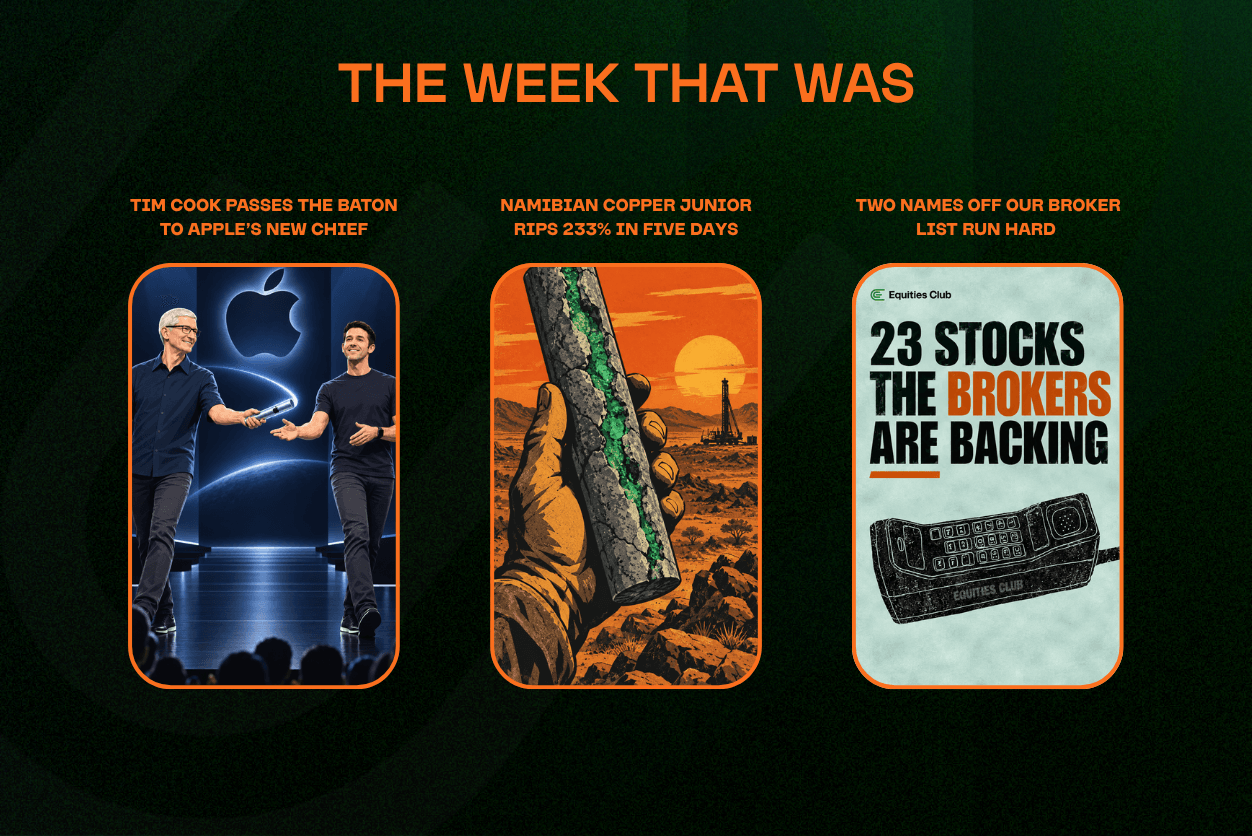
There’s a fair chance you’re reading this on an iPhone, and a decent chance you have no idea the company that made it changed CEOs on Tuesday.
Tim Cook, or Tim Apple as Donald Trump once called him, stepped back this week 15 years after taking over from near-deity Steve Jobs.
Apple’s share price rose a tidy 2,258% while he was in charge.
Apple is worth around US$4.8 trillion today, more than double every one of the 2,000-odd companies on the ASX added together.
Taking over is John Ternus, a mechanical engineer who walked into Apple in 2001, before the first iPod had shipped and six years before anyone had seen an iPhone.

A long way down the food chain, at our end of the market, a Namibian copper junior is up more than 1,000% since listing in May off the back of two drill holes.
A gold explorer reopened a Victorian tunnel sealed since 1906, two names off our broker list ran hard in the same week, and a lithium producer went shopping 4,000 metres up in the Andes.
Here’s what caught our eye this week:
- Kaoko Metals up 233% on visible copper in its first two holes in Namibia
- BHL reopens a Mt Egerton tunnel sealed since 1906
- MRD raises to take Selectro out of the lab, and we topped up
- Fortuna presents at Africa Down Under
- VR8 rips almost 80% and delivers the first big result off our broker list
- Ceretas cracks $1, the second name off that same list to run
- 10X puts a crew back on a copper line nobody has drilled in 50 years
- Liontown heads to Argentina and buys into lithium brine
Let’s get to it.
Copper Finally Pays Someone
We have been banging on about copper for months, and this week a junior with two drill holes and no assays back put on 233%.
Kaoko Metals (ASX: KAO) listed in early May this year at 20 cents after a $6.5 million raise, hunting copper in Namibia.
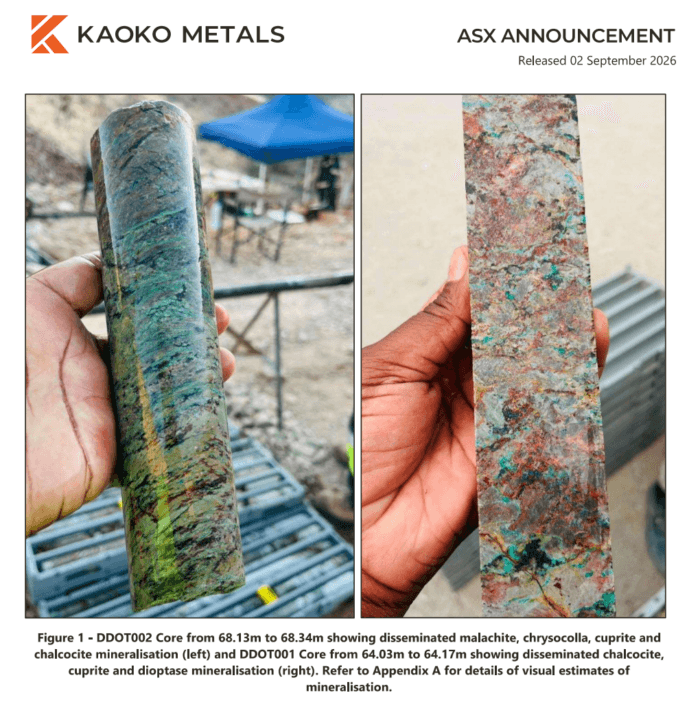
On Wednesday it reported the first two diamond holes ever drilled at Chalkos, its copper-silver project in the Kunene region of northern Namibia.
Both holes hit copper from shallow depths, 60 metres of it in one and 51 metres in the other, and the copper runs through several stacked layers of rock.
The assays are still weeks away, so how rich it is stays a waiting game for now, but the copper is green in the core and you can see it without a lab.
Then it rocketed. The shares more than tripled intraday to a record $2.28, closed Wednesday at $1.80 for a 145% day, lifted again on Thursday and finished the week at $2.50 in a trading halt for a capital raise.
A 233% gain in five days on a company that does not have a single assay back yet.
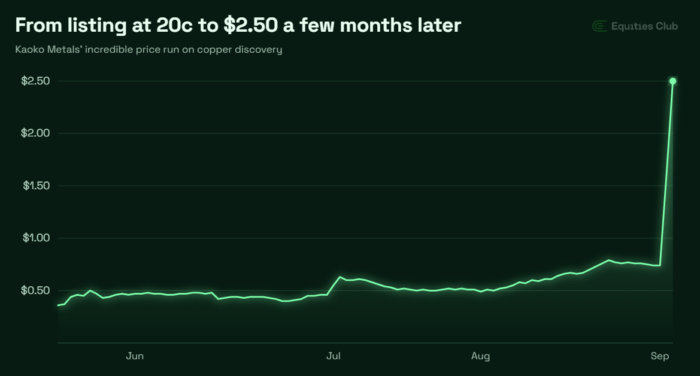
Results like that are the whole reason we love life at the small end of town. The company floated at 20 cents in May, the rig started turning in August, and by the first week of September the shares were $2.50.
Copper sits around US$6.60 a pound after setting an all-time high in early August.
We’ve been hunting a small-cap copper company to add to our portfolio, and weeks like this one are why.
BHL Walks into a Century-Old Tunnel
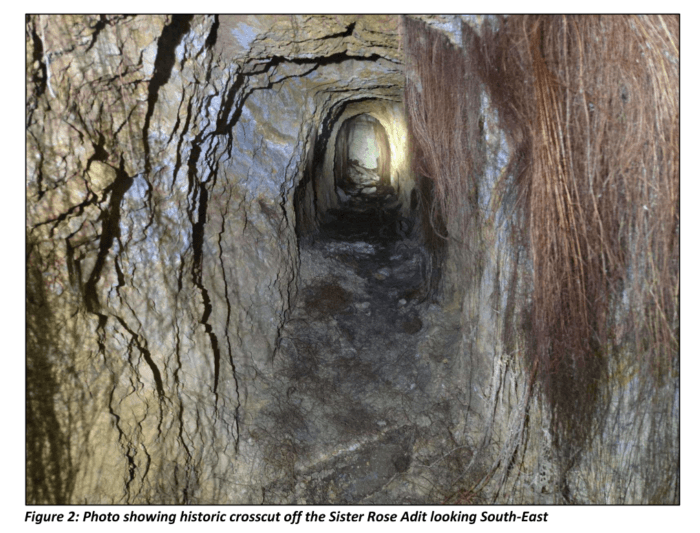
The miners at Mt Egerton once dug a side tunnel off their main one and ran straight into a crack in the ground with gold-bearing quartz sitting along it. They left it alone.
At 1906 gold prices there was not enough gold in it to bother with, so they kept going, and when the water beat the pumps that year everyone went home and the tunnel sat sealed in Victoria for the next 120 years.
Black Horse Mining (ASX: BHL), our 2025 Small-Cap of the Year, reopened it this week. Sampling the wall where that quartz sits returned 0.60 metres at 10.92 grams a tonne gold and 0.7 metres at 10.67 grams, on a structure the old boys walked past.
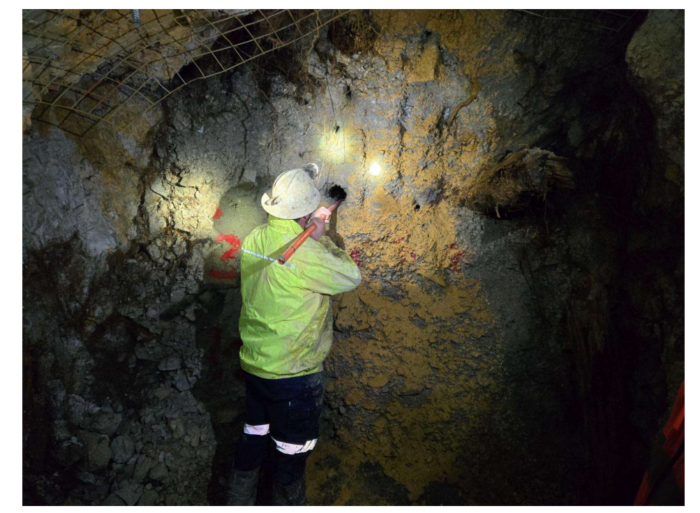
The crew that walked past it in 1906 was digging gold worth about US$20 an ounce. On Friday it closed near US$4,430.
Historical drilling has already hit the same structure 14 metres below the tunnel, and the two results now line up along one continuous body of gold. BHL has now measured it underground with a tape measure, and the crew found the old plans were wrong. They had the tunnel joining a shaft, and it never did.
All of that feeds the rig mobilising late September, around 10 holes for 4,000 metres, chasing this structure down and along strike.
Mt Egerton produced 1.29 million ounces at roughly 12 grams before it closed, and more than 90% of the drilling since has stopped above 150 metres. Everything below that is still sitting there untouched.
MRD Puts $2 Million Behind Selectro
Most critical minerals companies on the ASX share a problem. The metal is in the ground, measured and signed off, and the acid used to get it out leaves most of it behind.
Scandium and gallium in particular sit behind a processing route the industry has never really improved.
Our portfolio company Mount Ridley Mines (ASX: MRD) may have a fix.
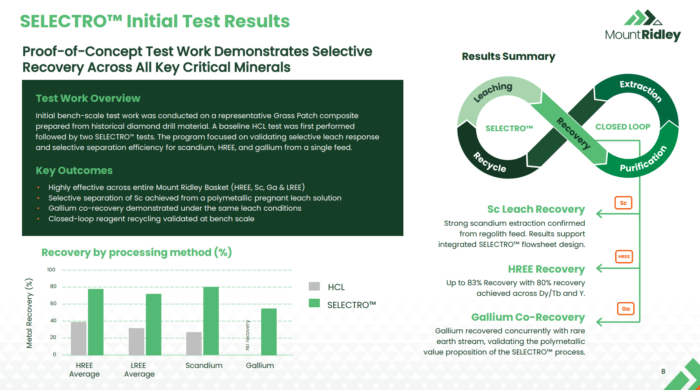
Selectro is the leach process MRD owns outright. A leach is the chemical bath that pulls metal out of crushed rock. Last month Nagrom, an independent Perth lab, ran raw drill samples from Grass Patch, MRD’s project near Esperance in WA, through Selectro and through hydrochloric acid side by side.
The acid returned 27% of the scandium and none of the gallium. Selectro pulled out 80% of the scandium and 56% of the gallium, and that was before anyone had tuned the process for that ore.
That result is behind the recent run up in the share price, and this week MRD went back to the market for $2 million at 3.3 cents on the back of it.
The raise came in oversubscribed and the directors put another $100,000 of their own money in on the same terms. We like the company enough that we topped up our own holdings.
The cash pays for a flotation program, where crushed ore goes into a frothy tank and the metal-bearing minerals float off the waste, to lift the feed grade before leaching, then a much bigger Selectro run to show the numbers hold at scale.
Get that far and the next two conversations are federal funding and other companies asking whether their own ore can go through the same process.
Fortuna at Africa Down Under
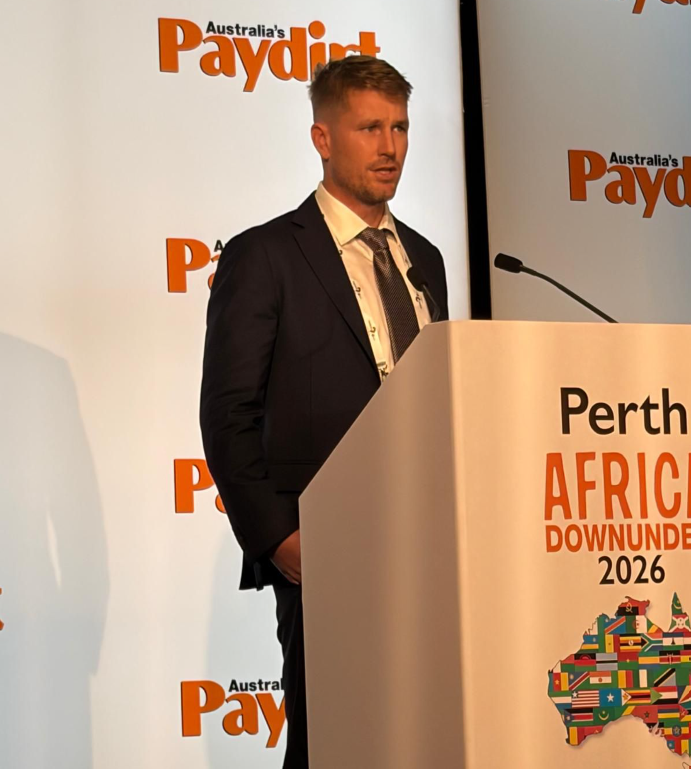
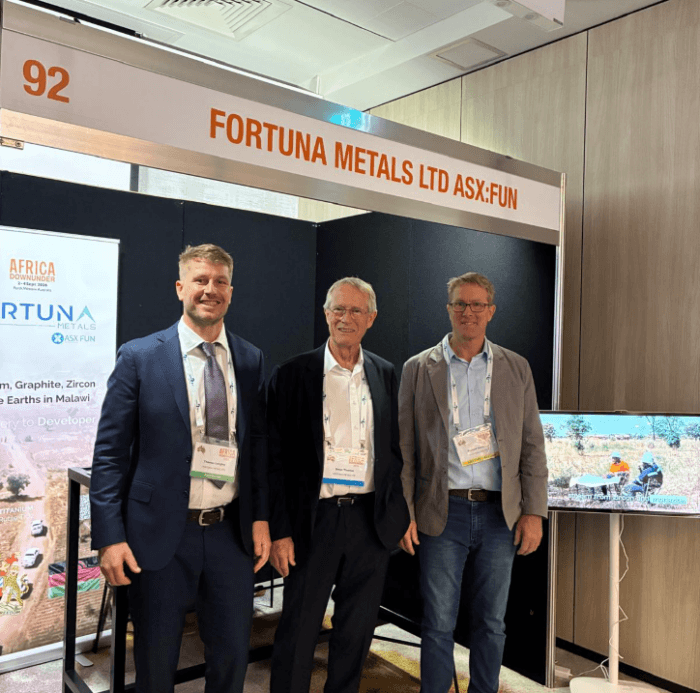
We were at Africa Down Under in Perth this week and caught Fortuna Metals (ASX: FUN) chief executive Tom Langley presenting. Malawi’s minister of mines was up not long before him, selling the room on Malawi as a place to build mines.
Langley ran through the numbers at FUN’s Mkanda project: 298 million tonnes at 0.87% rutile in the maiden resource, with the rail line 11 kilometres away. Core drilling starts in October.
Rutile is the highest-grade natural feedstock in the titanium chain, so it needs less processing before it turns into paint pigment, welding rods, aircraft parts or the joints inside humanoid robots. Global supply has been shrinking for years.
He also spent time on what the project has meant for the area around it, which not every executive bothers with.
Sovereign, Lindian, Lotus and Globe Metals are all working ground in Malawi, a country that barely registered on the ASX five years ago.
The Japanese government has also backed Malawi, putting US$7 billion behind the Nacala corridor, the rail and port line FUN’s ore would ride out on.
The Broker List Pays Out
In July we published what a dozen brokers were backing for the back half of 2026, all of it given to us on the condition we never named them.
One of those names was Vanadium Resources (ASX: VR8).
Less than two months later, VR8 has delivered.
VR8 owns 86.49% of Steelpoortdrift in South Africa’s Bushveld complex, a vanadium project with a mining licence and a finished feasibility study. Vanadium hardens steel and sits inside flow batteries, the big units built to store grid power.
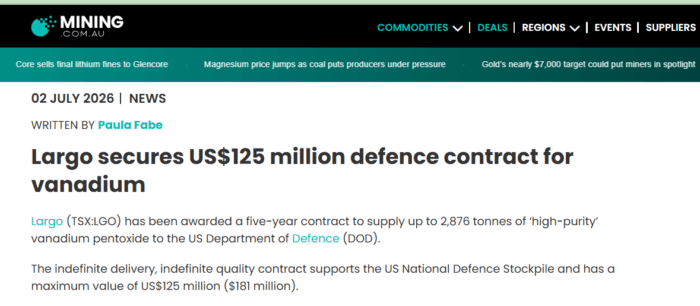
Washington handed Largo a US$125 million defence contract this year at close to US$20 a pound, against a market price near US$5.
The shares ripped almost 80% on Thursday, after VR8 secured first right of refusal until 31 July 2027 over part of the Highveld Industrial Park in Mpumalanga, the site it wants for its V-Iron plant. First right of refusal means VR8 gets the first shot at the ground before anyone else can buy it.
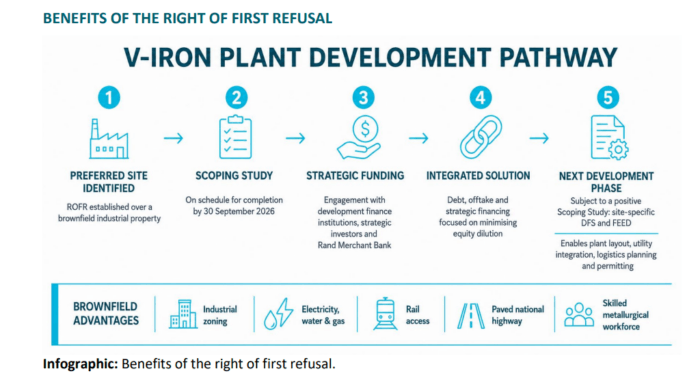
Power, water, gas and rail are already there, and the site once shipped vanadium slag to the US and Europe using a process close to what VR8 is proposing. The scoping study lands by 30 September.
There are another 22 names sitting in that article. We have gone back through it this week and would suggest you do the same.
Make That Two off the List
Ceretas (ASX: CTS), a brain tech company that’s flown under the radar of many, also came off that same July list (here’s the link once more if you didn’t click it above).
CTS listed at 25 cents in July having raised $8 million for the IPO. This week it cracked $1, touching $1.08.
A patient wears the Ceretas headset and it fires low-intensity ultrasound through the skull at the brain circuits Alzheimer’s pulls apart. The whole treatment happens through the headset.
The University of Queensland spent more than a decade getting it there, and a first trial in 12 patients in 2024 found it safe and well tolerated with early signs it helped.
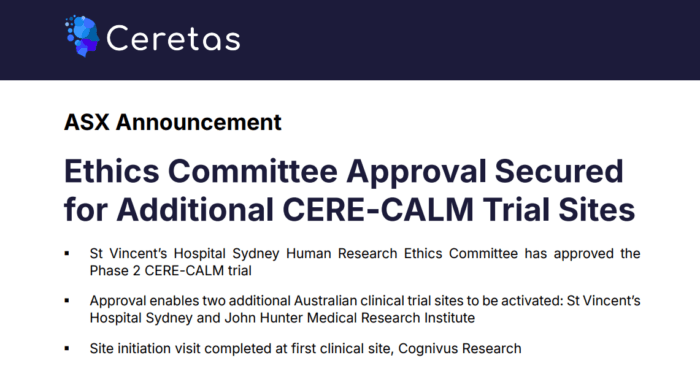
Proving that properly needs hospitals, and every hospital has to clear its own ethics committee before it can enrol a single patient.
This week St Vincent’s Hospital Sydney signed off on the Phase 2 trial and opened two more Australian sites, while the lead site has finished its setup, so first patients are only weeks away.
The trial puts 66 Alzheimer’s patients through six treatments over 12 weeks to see whether the agitation and distress that wear families out long before memory loss does can be settled down.
From 25 cents in late July to $1 in early September. A good six weeks for anyone who was in early.
10X Walks a 50-Year-Old Copper Line
In the early 1970s two crews spent two years walking hills three hours west of Sydney, in lines 240 metres apart, stopping every 30 metres to scoop a bag of dirt for the lab.
Copper and zinc lit up along a 2.4 kilometre line with the metal still running at both ends when they packed up and went home. Nobody thought to test those samples for gold, and nobody has put a drill in the ground since.
Our portfolio company Exultant Mining (ASX: 10X) put a field crew back on that line this week.
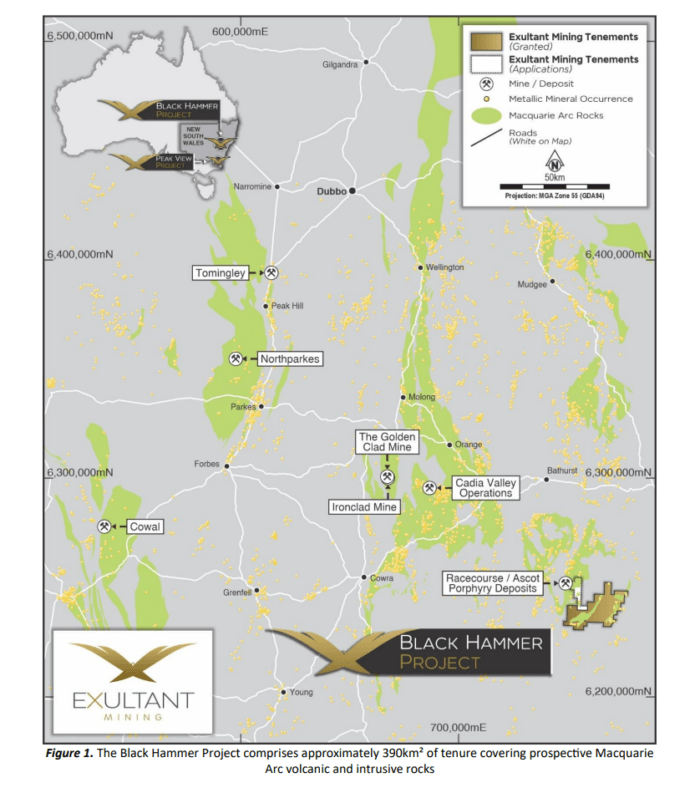
The ground is called Watsons, one corner of Black Hammer, 390 square kilometres 10X holds in the belt that hosts Cadia, Newmont’s mine near Orange with 50 million ounces of gold in it, and Evolution’s Cowal further west.
Watsons is the first of three targets pulled from 12 prospects across Black Hammer, with Porters Retreat and Vermithor behind it, and assays from 10X’s other NSW project landing in the middle of the work. Our full write-up is here.
Take the $3.5 million of cash out of the $5.5 million the market says 10X is worth, and the ground is being valued at around $2 million. Three untested targets in Cadia’s belt for that money is why we hold it.
Liontown Buys into Argentine Brine
There are two ways to get lithium out of the ground, and Liontown Resources (ASX: LTR) has only ever done one of them. Kathleen Valley in WA is a mine in the way everyone pictures a mine, trucks and a crusher turning ore into concentrate.
This week it signed a binding farm-in with NEXT Lithium over Centenario, a salt flat in Salta Province, Argentina, sitting around 4,000 metres up in the Andes. A farm-in means Liontown earns its stake by paying for the work.
The lithium there is dissolved in salty groundwater, and the work is pumping it into ponds and letting the sun take the water off.
The deal is US$5 million cash and US$10 million in shares up front, then US$40 million of spending over four years to take the whole thing.
Brine is about half the world’s lithium supply and a different cost structure to hard-rock mining.
Lithium carbonate was assessed around US$18,160 a tonne in early August, more than double where it sat through 2025, and spodumene is back near US$2,000 a tonne. At these prices there are healthy margins for lithium producers.
We’ve been big on Argentina ever since our geologist mate Jordan wrote a great piece for us on the country last year. Check him out if you haven’t already.
Watching a producer of Liontown’s size spend money in Argentina is another vote of confidence. It’s the same reason we backed Powerhaus Uranium (ASX: POW), which listed in late August at 20 cents and starts drilling for uranium in Chubut, down in Argentina’s Patagonia, next month.
Liontown joins BHP, Rio Tinto, Glencore and a long list of others already spending in Argentina.
The Week Ahead
Kaoko goes into Monday in a trading halt with its first assays still weeks off at the lab. There are a handful of other juniors drilling copper targets right now with nothing priced in for a hit, and we are still hunting one for the portfolio.
In our portfolio, BHL’s rig lands at Mt Egerton late in the month, POW starts drilling in Chubut in October, FUN’s core drilling at Mkanda starts the same month and MRD’s flotation work kicks off on the back of this week’s raise.
10X also has assays from its other NSW project due while the crew is still walking Watsons.
Oil closed the week just under US$95 a barrel, up 6.6%, with tankers through the Strait of Hormuz down to a trickle. The energy names stay in play for as long as that lasts.
The defence stocks that carried 2025 have drifted sideways for months, and it will take a contract announcement to get them moving. Tech went quiet too.
Money is still pouring into AI and data centres, and we keep an eye on which small caps sit close to it.
And a happy Father’s Day to the dads reading this between the socks and the homemade cards. Till next week.
General advice, disclosure and confidentiality
General advice warning
The contents of this document are intended to provide general securities advice only and have been prepared without taking account of your objectives, financial situation or needs. Because of that you should, before taking any action to acquire or deal in, or follow a recommendation (if any) in respect of any of the financial products or information mentioned in this document, consult your own investment advisor to consider whether that is appropriate having regard to your own objectives, financial situation and needs. If applicable, you should obtain the Product Disclosure Statement relating to the relevant financial product mentioned in this document (which contains full details of the terms and conditions of the relevant financial product) and consider it before making any decision about whether to acquire the financial product. Whilst Equities Club Pty Ltd (”Equities Club”) believes information contained in this document is based on information which is believed to be reliable, its accuracy and completeness are not guaranteed and no warranty of accuracy or reliability is given or implied and no responsibility for any loss or damage arising in any way for any representation, act or omission is accepted by Equities Club or any officer, agent or employee of Equities Club or any related company.
Neither Equities Club, nor any of its directors, authorised representatives, employees, or agents, makes any representation or warranty as to the reliability, accuracy, or completeness, of this document or any advice. Nor do they accept any liability or responsibility arising in any way (including negligence) for errors in, or omissions from, this document or advice.
Disclosure
The directors, authorised representatives, employees and associated persons of Equities Club may have an interest in the financial products discussed in this document and they may earn brokerage, commissions, fees and advantages, pecuniary or otherwise, in connection with the making of a recommendation or dealing by a client in such financial products. Equities Club owns 1,554,000 FUN shares, 200,000 10X shares, 625,000 POW shares, 187,500 BHL shares, and 2,083,333 MRD performance rights at the time of publishing this article. Equities Club has been engaged by FUN, 10X, POW, BHL and MRD at the time of writing.
Confidentiality notice
The information contained in and accompanying this communication is strictly confidential and intended solely for the use of the intended recipient/s. The copyright in this communication belongs to Equities Club. If you are not the intended recipient of this communication please delete and destroy all copies immediately.
Equities Club Ltd (CAR No. 001308139) is a corporate authorised representative of ShareX Pty Ltd, Australian Financial Services Licence (AFSL) No 519872.