
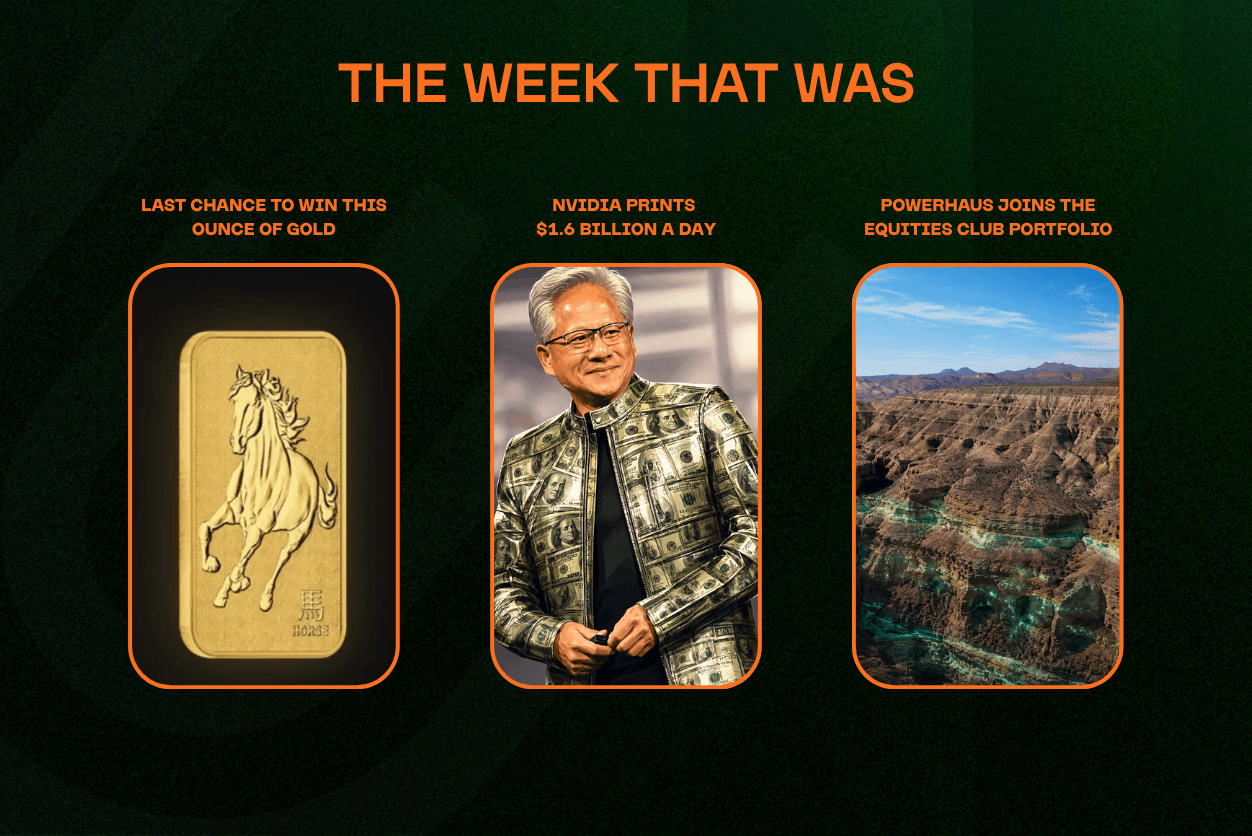
Jensen Huang dialled into Nvidia’s earnings call on Wednesday night (presumably clad in leather jacket) and told the world the company made US$96.2 billion in the past 13 weeks.
That’s more than a billion US dollars a day (call it $1.6 billion in ours).
One day of chip sales at Nvidia buys any one of about 1,800 of the 2,000 companies on the ASX outright, with a few hundred million left over.
Every one of those chips is wired with copper and runs in a data centre the tech giants are signing up nuclear reactors to power, and this week we had news on both at our end of the market.
Copper hit an all-time high, and Powerhaus Uranium joined the portfolio, led by a team that has sold two uranium companies already. More on them below, let’s get to it.
What caught our eye this week:
- Copper bulls continue the charge to an all-time high
- MRD claims the world’s biggest scandium resource
- Powerhaus Uranium becomes our newest portfolio addition
- Two catalyst-loaded companies front a packed corporate lunch
- FUN’s deeper drill program nearly doubles in Malawi
- The rig is spinning for ELK as directors buy up
- WhiteRock Lithium goes bananas on debut
- The drill campaign for 10X wraps up at Balerion
- A German buyer takes a quarter of EVG’s Maniry
- X2M runs 350% on an AI data centre deal
- 170 metres of mineralisation in Nevada for 49M
- DroneShield posts a record half, but still registers a loss
STOP RIGHT THERE – It’s Gold Comp Time
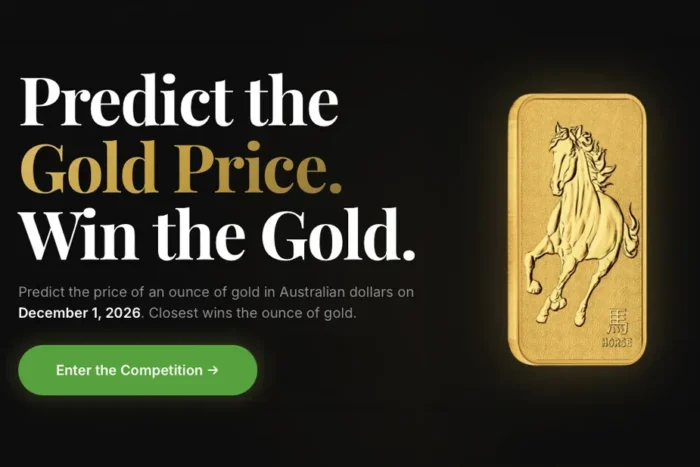
Whatever you were about to do next can wait, because tomorrow our gold competition closes and someone on this list is going to win a full ounce of gold.
At current prices that’s north of $6,200. Pick a number, and if it’s the closest to the pin, the ounce is yours.
Click below and tell us where you think the price of gold is on December 1 to be in the running.
Enter the comp by clicking here.
Send this to a mate too. If they win off your tip, they’re buying the beers till Christmas.
Copper Price Hits All-Time High as Supply Keeps Failing
Robert Friedland got up in front of a business school crowd in LA last year and told them the world has no idea how much copper it’s about to need.
“You people have no idea whatsoever what we’re facing. You’re dreaming,” he said. Darryl Kerrigan would have been proud.
Friedland is the billionaire behind Ivanhoe Mines and two of the great copper discoveries of the modern era, Oyu Tolgoi in Mongolia and Kamoa-Kakula in the Congo, and his presentation quickly became a maths tutorial.
The world uses about 30 million tonnes of copper a year and only four million of that comes from recycling, so to keep global growth ticking along at 3%, the industry has to dig up as much in the next 18 years as it has in the past 10,000.
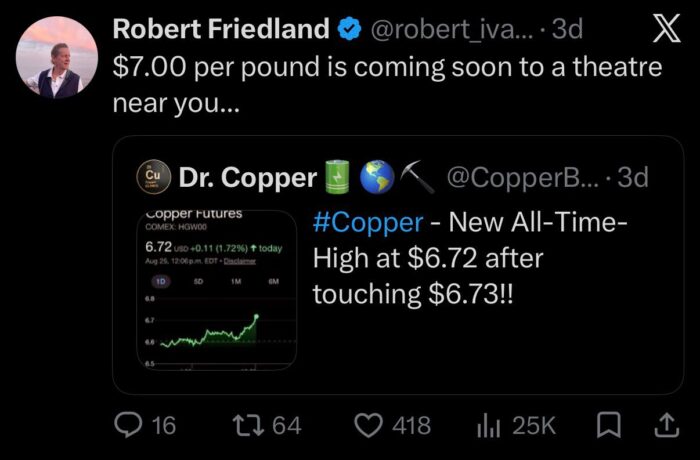
He’d have loved this week. Copper hit an all-time high above US$6.80 a pound, and it’s up close to 50% on this time last year.
Supply keeps getting interrupted at the worst possible time. Grasberg in Indonesia, the second biggest copper mine on earth, is still running at around half capacity after last September’s mudslide, and earlier this month the smelter that processes its ore sprang a boiler leak and shut for weeks.
Flooding has hit Friedland’s Kamoa-Kakula, and Zijin (his partner in the mine) said this week its copper target for the year is under pressure. LME stockpiles have nearly halved since May.
All those problems get fixed eventually, but the glaring one that can’t is that a major copper deposit hasn’t been found in 20 years (and boy do we pray we’re on the one that breaks the streak).
The big mines pull a little less copper out of every tonne of rock each year, and a new mine takes a decade or more to permit and build. Even BHP, which said last week it’s steering more than half its future spending into copper, has its extra tonnes landing in the mid-2030s.
We’re on the hunt for a copper junior to add to the portfolio (and the pool room). Watch this space.
Mount Ridley Mines (ASX: MRD) Claims World’s Largest Scandium Resource
“The World’s Largest Publicly Reported Scandium Resource” was plastered across the top of Wednesday’s announce from Mount Ridley Mines (ASX: MRD), and it had the desired effect, up 16% on $1.6m stock traded that day.
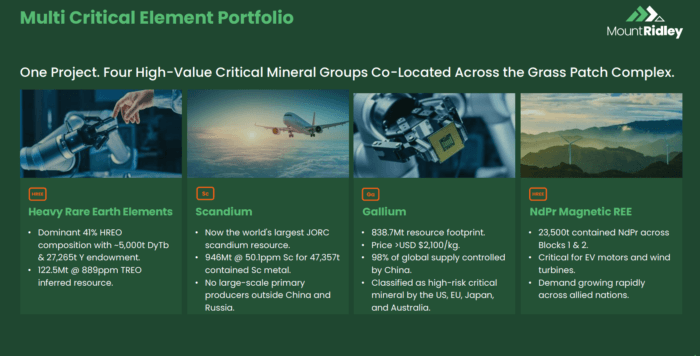
Grass Patch is MRD’s clay deposit 25km northeast of Esperance where MRD nearly tripled the size of its scandium resource to 946 million tonnes at 50.1 ppm scandium.
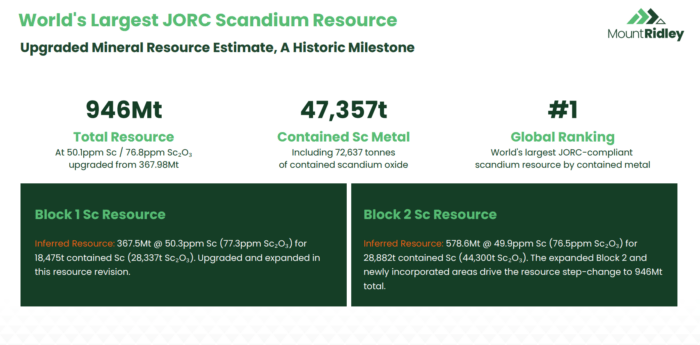
That works out to 72,637 tonnes of scandium oxide and backs up the bold announcement header. To put in perspective, the whole world made about 80 tonnes of the metal last year.
The extra tonnes came from 3,271 old samples sitting in storage from a decade of drilling for nickel and copper. MRD sent them back to the lab to be tested for scandium and the resource grew 2.5x for the cost of the assays (and we’re quietly hoping there’s more in the shed).
You can find our full write up here.
We added MRD to the portfolio in March based off the three critical minerals it had in one deposit (scandium, heavy rare earths and gallium).
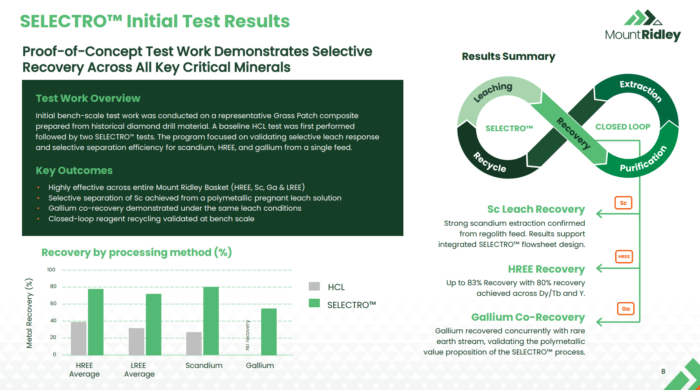
We were under no illusions as to the challenge of extracting scandium out of the clay in their deposit, because hydrochloric acid leaves nearly three quarters of it in the rock.
Then Chris Larder joined as CTO and brought with him Selectro, a leach process he’d spent 10 years building and MRD has now lodged a patent application over. Selectro recovered 80% of the scandium in its first test on raw Grass Patch clay and took most of the heavy rare earths and about half the gallium with it. The acid method got 27.6% from the same sample.
Lab work earlier this month found the rare earths at Grass Patch sit in phosphate minerals. Phosphates can be floated off the waste clay before any chemistry starts, a cheap step that processing plants everywhere already run, so Selectro should have a richer concentrate to work on when the next round of testwork runs.
Of the few scandium names on the ASX the one getting the attention is Sunrise Energy Metals (ASX: SRL). Sunrise is building its mine at Syerston in NSW with a US$400 million loan from the Pentagon and carries a $2.8 billion valuation. Robert Friedland from the copper section above is its co-chair and biggest shareholder.
Sunrise’s dirt runs 414 ppm against MRD’s 50, so we won’t pretend the two deposits are twins. MRD holds more of the metal and trades at $50 million.
MRD finished the week up an impressive 43% on last week’s closing price.
Powerhaus Uranium (ASX: POW): Our New Portfolio Addition
Siobhan Lancaster told us you can dig a small hole in a riverbed at her new project in Argentina and pull out uranium that’s yellow against the dirt. Her team did it on their first site visit from about knee depth.
Lancaster was on the Extract Resources team that found Husab in Namibia and sold the company for $2.2 billion while Fukushima was melting down. She then ran 92 Energy, which hit uranium on its fourth hole in Canada and was taken over inside three years of listing.
Argentina was Philippe Portella’s idea. He’s a geologist who spent 35 years hunting uranium for the French, and when Lancaster asked him where the next giant deposit was hiding, he said Patagonia. Her first reaction was “that’s a bit interesting, I’ll have to have a think about that.”
The thinking ended in Lancaster leading Powerhaus Uranium (ASX: POW), the third uranium explorer she’s built and our newest portfolio addition, which listed on Tuesday at 20 cents with a $17 million market cap and $9 million in the bank.
You can read our full write-up here.
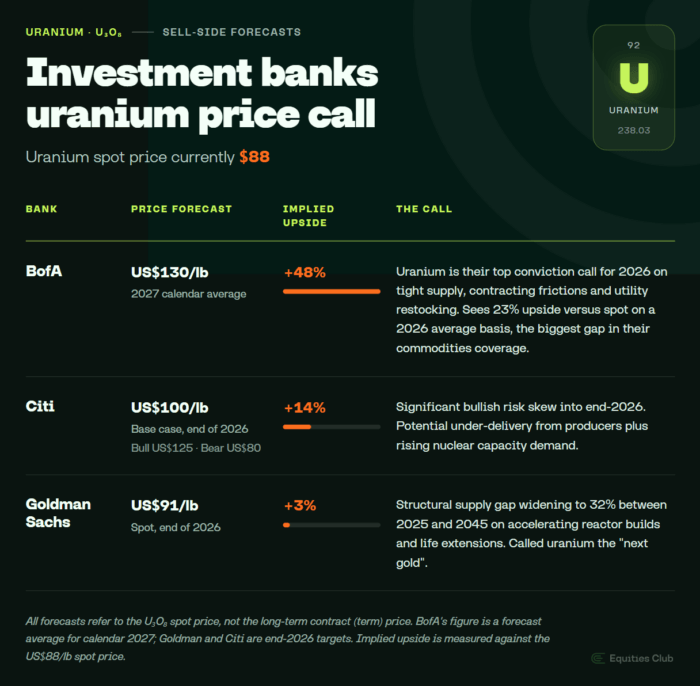
Governments (and major tech companies) are building reactors, with the US aiming to quadruple its nuclear fleet by 2050 and Microsoft paying to restart Three Mile Island so its data centres never lose power. Uranium is at its highest price since 2008, after a decade where the industry barely explored and barely discovered.
The flagship for POW is Malbec, around 2,000 square kilometres of ground in Chubut, a province in Argentine Patagonia. The uranium sits in sandstone, the same style Kazakhstan has mined for decades at the lowest cost on earth. Surface samples have run up to 771 ppm and rock chips a short drive away up to 3,183 ppm, and nobody has ever put a drill hole through any of it.
That changes around October, when 20 to 30 holes for 5,000 metres go in with the uranium term price at US$97 a pound. Hidden Bay in Canada’s Athabasca Basin comes with the deal, on the doorstep of the world’s richest uranium mines.
POW finished its first week at 24 cents, up 20% on the IPO price. The past two times the POW team put a drill into uranium, somebody bought the company.
Albion Resources and Botala Energy: Two Catalysts Walk into a Lunch
We got a lunch invite this week and turned up to a room of brokers and investors, all there to hear two companies with big news due inside the next few weeks.
Albion Resources (ASX: ALB)
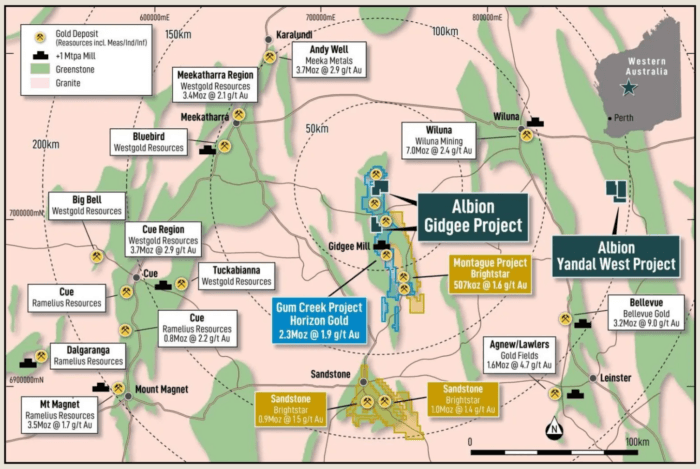
CEO Peter Goh went first and took the room through the drilling about to start at Gidgee, Albion Resources (ASX: ALB)’s gold project in WA’s East Murchison.
The tenement package sits surrounded by JORC resources, with Horizon Gold’s 2.3 million ounces at 1.9g/t on the same fault line to the south and Wiluna’s 7 million ounces up the road. The old holes on ALB’s ground came back with strong grades, and the rig starts shortly.
ALB trades at 6 cents for a market cap around $8 million, and this drill campaign is already paid for.
Botala Energy (ASX: BTE)
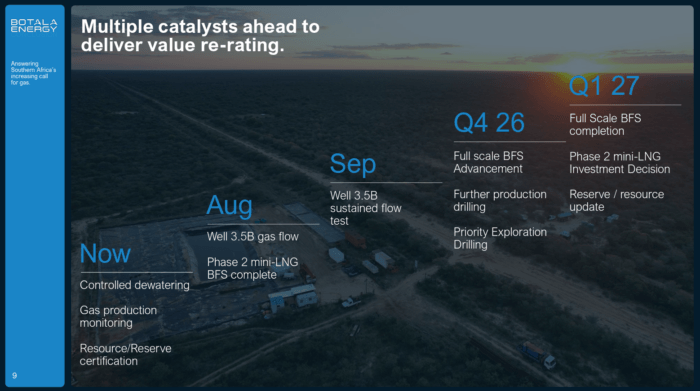
Kris Martinick followed and was upfront that the next fortnight decides a lot for Botala Energy (ASX: BTE), with flow rates from its Botswana gas pilot due in a week or two.
A flow rate is how much gas a well gives up once the water is pumped off the coal seams, and a good one is what gets a gas field financed.
Botala’s current gas resource comes from under 5% of its ground, in a corner of southern Africa that keeps running out of power. BTE trades at 6.1 cents with a market cap around $25 million.
We walked out well fed with two more names on the watchlist, and we’d make room on yours. In a couple of weeks, both of these stories will look different, one way or the other.
Fortuna Metals (ASX: FUN) Drills Deeper at Mkanda
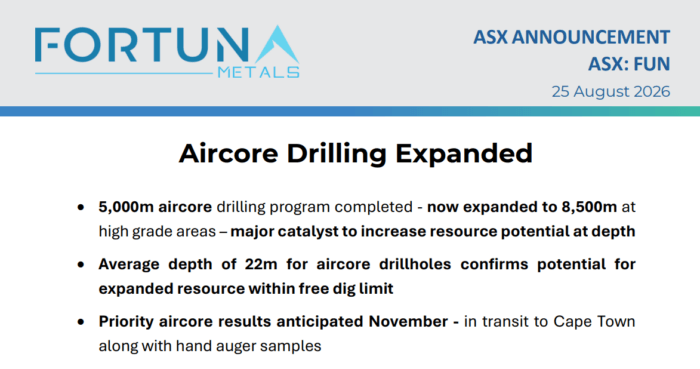
Fortuna Metals (ASX: FUN) expanded its aircore drilling program at Mkanda this week, with the new rig reaching rutile the hand augers never got to.
The current resource of roughly 300 million tonnes is already one of the world’s biggest for rutile, and it was built entirely from hand auger holes that stopped around 8 metres down. Most of them stopped at the water table with rutile still running under the workers’ feet.
The aircore rig is averaging 22 metres in the same soft ground with rutile running to the bottom of the holes. Whatever sits between 8 and 22 metres gets added to the resource once the assays come back, and aircore is cheap drilling.
Sovereign Metals (ASX: SVM) ran this play next door at Kasiya, where aircore drilling tripled the resource on its way to becoming the largest rutile deposit in the world.
FUN sits 20km down the same corridor chasing the same style of mineralisation, into a rutile market that has been short for years.
Priority assays land in November and feed an updated resource.
Elk Range Mining (ASX: ELK) Drilling Update from Friday Gold Mine
Last week the rig started turning at Elk Range Mining’s (ASX: ELK) Friday gold project in Idaho, and this week we got video proof.
CEO Edward Keys, who has made camp on the floor of the mill on site, took to YouTube to walk through what the first eight diamond holes are chasing.
The last owners put a hole under the old mine that ran 110 metres at more than five grams and finished in 133 grams a tonne, then sold the place for a fraction of the US$40 million they’d spent. Keys is drilling straight back into that ground.
The eight holes add up to nearly 3,000 metres and every hit that matches the old numbers counts toward a maiden JORC resource.
This week we also saw two more directors buy shares on market, which takes the total to three. Confidence like this so soon after an IPO is rare, hats off to management.
WhiteRock Lithium (ASX: WLC) Goes Bananas on ASX Debut
We flagged WhiteRock Lithium (ASX: WLC) in last week’s wrap as the lithium IPO to watch, and it ran harder than we expected. It listed at $3.25 and was knocking on $4.90 within days.
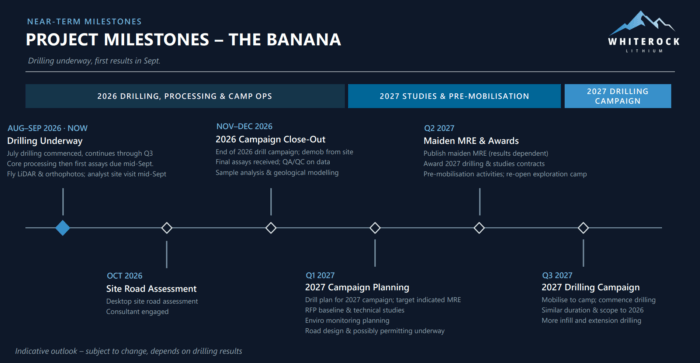
The flagship is called the Banana Project (we’d have backed it for the name alone). It’s a big slab of 100% owned ground in Quebec’s James Bay region, where some of the best lithium discoveries of the last boom were made. Every diamond hole drilled there so far has hit lithium-bearing pegmatite, and early test work points to simple, cheap processing.
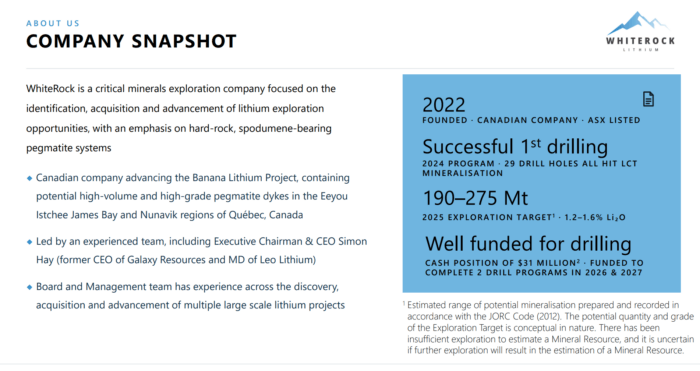
Simon Hay runs it. He built the Goulamina lithium mine in Mali, which has proven a hard place to keep a mine after it’s built, and we suspect he’ll enjoy Quebec a lot more.
A $400 million lithium explorer is bigger than the stocks we usually write about, but Hay has built a mine before and every hole at Banana so far has hit. It’s on the watchlist.
Exultant Mining (ASX: 10X) Wraps Up Maiden Drilling at Balerion
Exultant Mining (ASX: 10X) pulled the rods on the six holes it drilled for its maiden program at Balerion this week.
Visible sulphides turned up in five of the six, and the last hole cut a 6.5 metre shear zone carrying zinc, lead and silver-style sulphides that looks like it thickens at depth. The assays land in four to six weeks and will settle that.
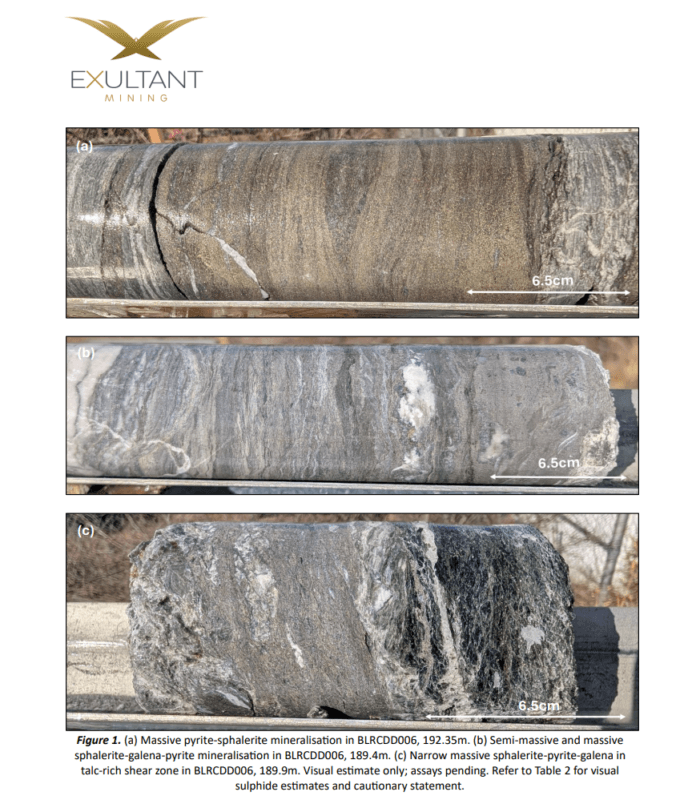
We’ve been staring at the core photos all week like everyone else, and they look good, but we’ve been burnt by shiny rock before.
In the meantime the team turns to Black Hammer, where the old-timers pulled grades up to 14% copper and 26 g/t gold.
Evion Group (ASX: EVG) Signs German Buyer for a Quarter of Maniry Graphite
Evion has spent more than a year in meetings with Europe’s lenders, and most of them ended with some version of the same polite brush-off. Lovely project, call us when someone’s agreed to buy the graphite.
This week, someone did. You can find our full write up here.
A German graphite house, an established outfit that has supplied and processed flake across Europe for a long time, signed a binding deal to take about a quarter of everything Stage 1 at Maniry will dig up, every year for the first five years of the mine’s life.
Graphite that has never touched China is scarce, and the buyers who need it are locking it in years before a mine pours its first concentrate.
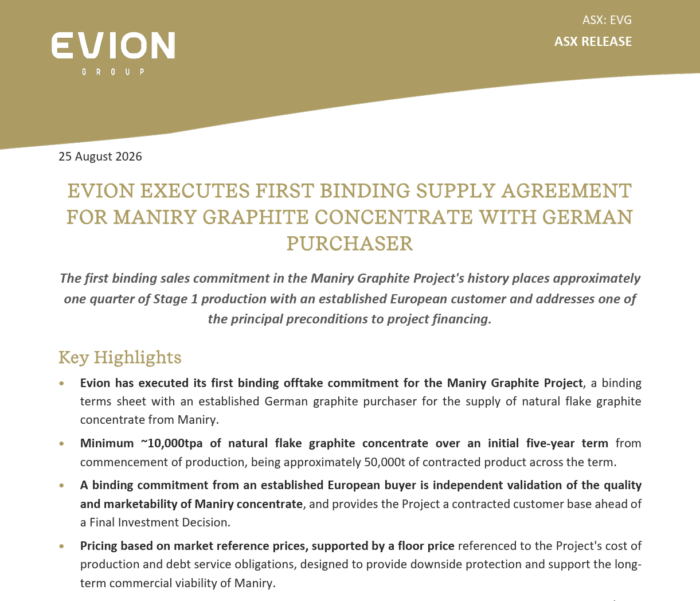
Each shipment sells at the market price or at a floor that covers digging it up and paying the bank, whichever is higher, so Beijing can flood the graphite market again and the bills still get paid.
Our portfolio company Evion Group (ASX: EVG) has been stacking these pieces up for a while. The mining permits landed in July after a four-year wait, and Brussels has named Maniry a strategic project, which puts the lending arms of the EU and German governments at the table.
A bank lending against a hole in the ground wants to know who’s buying what comes out of it, and now Evion can point to a signed German.
The feasibility study puts a value on Maniry at more than 10 times what the whole company trades for today. A loan offer is the next domino, and if it lands, Evion has a mine to build.
X2M Connect (ASX: X2M) Rips 350% on AI Data Centre Deal
X2M Connect (ASX: X2M) started the week at a fifth of a cent, touched 1.2 cents by Thursday, and closed at 0.9.
Anyone holding on Monday finished the week up 350%, with close to $10 million worth of stock changing hands along the way.
The trigger was a binding agreement to deliver and manage an AI-enabled GPU data centre, with an estimated project cost north of $250 million over three to five years.
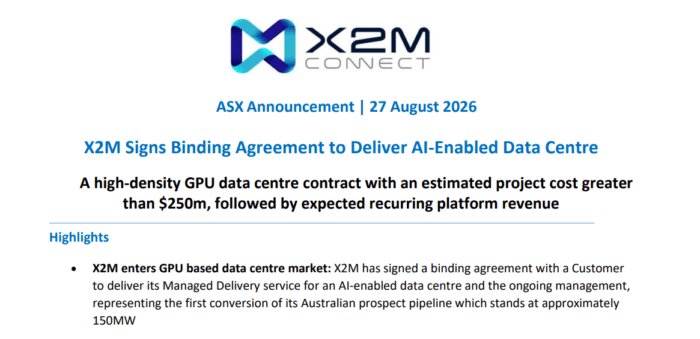
X2M expects to book that full cost as revenue and clip a margin on top, plus recurring platform and management fees for the life of the facility.
X2M has spent a decade connecting metering devices for water and energy utilities, and the pitch is that the same smarts can squeeze more compute out of every megawatt inside a data centre.
This deal is the first conversion from a roughly 150MW pipeline of Australian sites, most of them in Queensland. The agreement is conditional on a development approval, and X2M hasn’t put a megawatt figure on the facility.
49 Metals (ASX: 49M) Hits 170 Metres of Gold in Nevada
One from outside the portfolio that caught our eye this week. 49 Metals (ASX: 49M) wrapped up its maiden drill program at Gold Mountain in Nevada and saved the best for last, 170.7 metres at 0.9g/t gold, the thickest hit the project has seen.
Another hole cut 67.1 metres at 1.7g/t around a core that ran as high as 20g/t.
Worth being clear that 170 metres is the length down the hole rather than the true width of the zone.
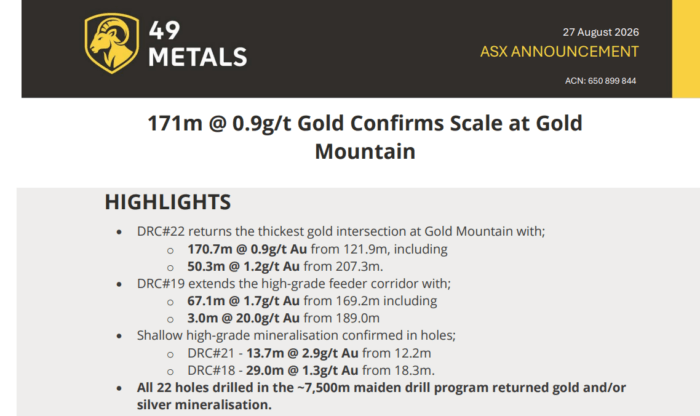
The company hasn’t published true widths yet, but with a 45 degree hole drilled into steep structures, our rough read is the true width is around half the downhole number, call it 60 to 80 metres. Still a serious chunk of mineralised rock.
The scorecard for the program reads 22 holes drilled, 22 hits of gold or silver. You don’t see that every day from a first pass.
Gold Mountain sits on the Walker Lane trend, one of the most productive gold belts in the US.
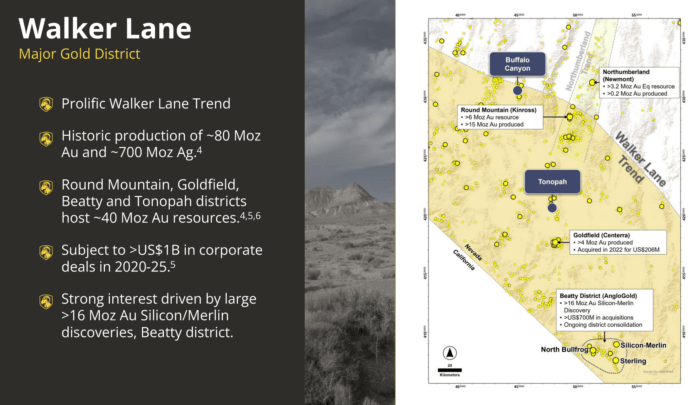
What the company first read as a handful of narrow structures is shaping up as a much broader system with high-grade feeders running through it, and it’s open in every direction drilled so far.
The grades outside those feeders are modest, and joining the dots will take plenty more drilling. But at high gold prices, bulk systems like this get a second look.
Follow-up drilling is planned before the end of the year, so this is one for the watchlist. 49M finished the week up 30% at 13c.
DroneShield (ASX: DRO) Posts a Record Half and Cops a Selldown Anyway
Last week we flagged DroneShield (ASX: DRO) as one to watch into results. It reported its best half ever and the shares fell anyway.
The company sold $126 million worth of counter-drone kit in six months (a record), but it’s spending money faster than it makes it and the half ended in a loss.
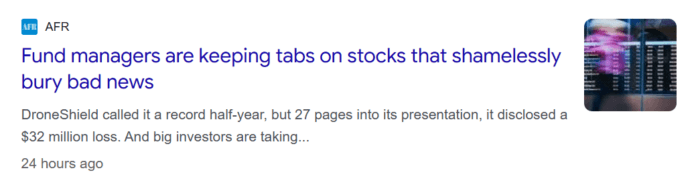
The stock dropped 10% on the day, because after doubling and doubling again, a market darling gets marked down for any imperfection it shows.
It’s also why our own drone exposure sits at the picks-and-shovels end through portfolio company KTEK Aerosystems (ASX: KTK). Suppliers get paid for every unit that goes out the door, and with shipments starting next month, KTEK’s revenue arrives with the boom.
What to Watch Next Week
Gold ran to a three-month high this week and gave some back on Friday after the new US Fed chair talked tough on inflation and the market priced in an American rate rise as a coin flip for next month.
Higher US rates reliably knock gold around, so we’ll be watching (we’re hoping for a hold, but we’re eternal optimists).
Results are landing thick and fast across the ASX, and boards like to raise money on the back of good news, so expect a run of small-cap capital raisings in the coming weeks.
Tech and biotech had a quiet one, and in our experience a quiet week at this end of the market usually means a busy one is coming.
And the gold comp closes tomorrow. Get your guess in and send it to a mate before the door shuts.
Till next week.
General advice, disclosure and confidentiality
General advice warning
The contents of this document are intended to provide general securities advice only and have been prepared without taking account of your objectives, financial situation or needs. Because of that you should, before taking any action to acquire or deal in, or follow a recommendation (if any) in respect of any of the financial products or information mentioned in this document, consulting your own investment advisor to consider whether that is appropriate having regard to your own objectives, financial situation and needs. If applicable, you should obtain the Product Disclosure Statement relating to the relevant financial product mentioned in this document (which contains full details of the terms and conditions of the relevant financial product) and consider it before making any decision about whether to acquire the financial product. Whilst the Equities Club Pty Ltd (”Equities Club”) believes information contained in this document is based on information which is believed to be reliable, its accuracy and completeness are not guaranteed and no warranty of accuracy or reliability is given or implied and no responsibility for any loss or damage arising in any way for any representation, act or omission is accepted by Equities Club or any officer, agent or employee of Equities Club or any related company.
Neither Equities Club, nor any of its directors, authorised representatives, employees, or agents, makes any representation or warranty as to the reliability, accuracy, or completeness, of this document or any advice. Nor do they accept any liability or responsibility arising in any way (including negligence) for errors in, or omissions from, this document or advice.
Disclosure
The directors, authorised representatives, employees and associated persons of Equities Club may have an interest in the financial products discussed in this document and they may earn brokerage, commissions, fees and advantages, pecuniary or otherwise, in connection with the making of a recommendation or dealing by a client in such financial products. Equities Club owns 2,083,333 MRD performance rights, 500,000 KTK shares and 4,500,000 EVG shares, 625,000 ELK shares, 625,000 POW shares, 1,554,000 FUN shares, and 200,000 10X at the time of publishing this article. Equities Club has been engaged by FUN, ELK, POW, MRD, KTK, 10X and EVG at the time of writing.
Confidentiality notice
The information contained in and accompanying this communication is strictly confidential and intended solely for the use of the intended recipient/s. The copyright in this communication belongs to Equities Club. If you are not the intended recipient of this communication please delete and destroy all copies immediately.
Equities Club Ltd (CAR No. 001308139) is a corporate authorised representative of ShareX Pty Ltd, Australian Financial Services License (AFSL) No 519872.