

Anyone who bought SpaceX on debut six weeks ago paid US$135 a share. It’s US$111 now.
The float raised US$86 billion, more than any exchange has ever handled in one go, and the stock ran to US$225 inside the first week. Elon became the world’s first trillionaire on the way through. A title he held for about a month and a half…

Down our end of town, a brain-tech IPO listed on Thursday and had doubled by Friday, oil punched back through $100 a barrel after Houthi drones hit two Saudi tankers, uranium is finally getting some love, and Wesfarmers put $1.4 billion behind lithium.
We’ve been busy behind the scenes gearing up for a big second half. More on that shortly.
Let’s get to it.
- Three new names join the Equities Club books in August
- Evion’s Madagascar mining permit lands, nearly four years on
- Oil breaks US$100 after two Saudi tankers are hit
- Brain-tech IPO Ceretas more than doubles on debut
- Wesfarmers backs lithium with a $1.4 billion expansion at Mount Holland
- Uranium at US$86 a pound as reactor pipeline grows and supply stays flat
- MRD hands its new CTO 24 million ambitious performance rights
- ECT runs 30%, then halts with an acquisition due Monday
- Twiggy becomes the biggest shareholder of the West’s biggest tungsten producer
- The US House passes a US$1.15 trillion defence bill tying itself to Israel
- BHL reopens the Sister Rose tunnel, drilling now set for spring
Three New ASX Small-Caps Join Our Portfolio in August
Volumes have been thin since early June, and the Middle East has given anyone still on the fence a reason to stay there a few more weeks.
We said a couple of weeks back that a big month was coming. This is it.
We’ve spent that stretch in front of more management teams than we saw in the whole of last year, and the answer to almost every one was no from us. Plenty of them were good companies too.
We back a handful of names a year, and each has to be cheap and early enough today to still have multi-bag potential in front of it.
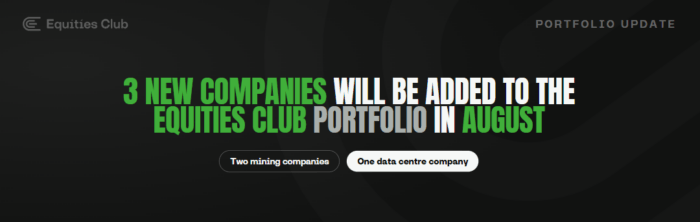
Three cleared it. One’s a gold play with ounces already in the ground. One’s a microcap plugged straight into the American data centre build. The third is a uranium explorer chasing something big enough to matter.
All three land in August. The full write-up goes out the morning each one does, and it goes to subscribers first, so get on the list.
Evion Group (ASX: EVG) Lands Maniry Graphite Mining Permit
Evion Group (ASX: EVG) spent last week in a halt, waiting on Madagascar. Tuesday morning it turned up: mining permits granted.
The feasibility study for Maniry, Evion’s graphite mine down in the south of the country, came out in November 2022. Everything was there. The reserve, the mine plan, the economics, all of it worked out in detail. The only thing missing was the piece of paper that lets you dig.
Then Madagascar rewrote its mining code and changed governments, and Evion’s application went to the back of a queue behind a new administration. That’s where it sat for the better part of four years.
Long enough that David Round, finance director when the study went out, is managing director now.
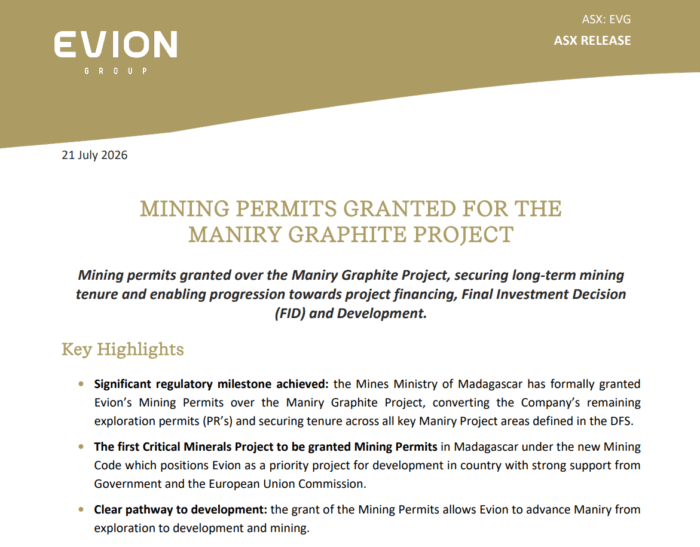
We’d wager a fair few meetings across Europe ended the same way over that stretch: “lovely the project, come back when you’ve got the permit”. Round now gets to walk into the next one with it in his hand.
Which is where this gets interesting, because Europe never stopped circling. The EU named Maniry a Strategic Project and started paying out a €3 million grant, and Evion has funding applications sitting with the European Investment Bank and Germany’s KfW. It’s all a lot of attention for a mine nobody was allowed to build.
The study values Maniry at US$263 million before tax across a 21-year life, with Stage 1 costing US$79.2 million to build and returning that in 3.8 years. None of those numbers moved while the paperwork sat idling.
Offtakes come next, where a buyer commits to tonnes still in the ground. A bank will also lend against that.

The market spent the week selling everything though, EVG included, down to 2.3 cents and a market cap near $18 million.
A permitted project carrying a US$263 million valuation, inside a company worth $18 million.
We hold it, and we reckon the hard part’s behind them.
Brent Crude Tops US$100 After Houthi Drones Hit Two Saudi Tankers
We said last week oil could be heading to US$100. It took four days.
On Wednesday the Houthis put drones and missiles into two Saudi tankers in the Red Sea. They’d declared a blockade on Saudi shipping days earlier and claimed the ships broke it.
Brent crude went through US$100 a barrel the following day for the first time since May, closing at US$100.69, while West Texas settled at US$92.19. Oil has now run more than 30% in three weeks.
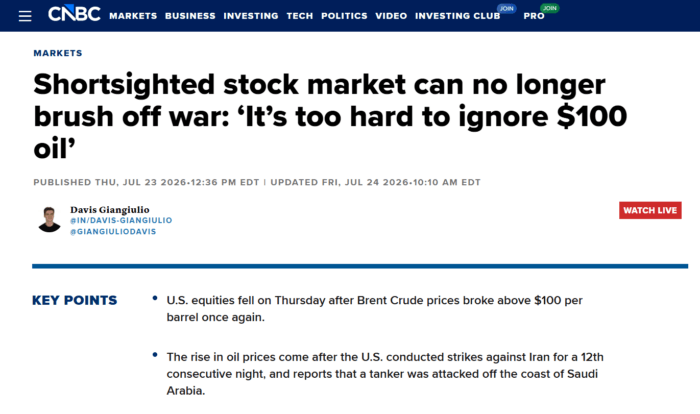
Trump said that if the Houthis do it again the US will hold Iran responsible, on the grounds the Houthis are Tehran’s proxy, and hours later he told Axios he was weighing a “massive attack” on Iran.
American strikes have now run 12 nights straight, and this was the week it showed up on the screens, with the S&P 500 heading for its worst session in a month and the US 10-year yield pushing above 4.7%.
Diesel runs every drill rig a small-cap has in the ground, along with the trucks carting supplies and crew out to them, so anyone drilling through the back half of the year is spending more than budgeted.
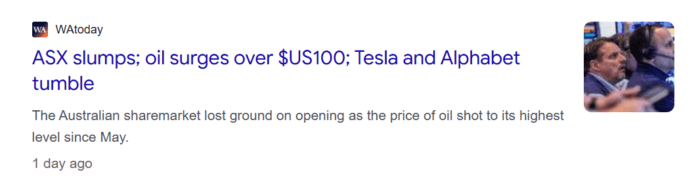
It gets worse when you go to raise, because higher oil feeds inflation, inflation keeps rates where they are, and investors get a lot more careful about what they’ll back.
You’ll feel it at the servo first, though the bigger drag is that nobody can say whether this stops at the Red Sea or spreads across the Gulf, and small-cap raises get harder while that question is open.
Brain-Tech IPO Ceretas (ASX: CTS) Doubles on Debut
One thing worked this week, and it was a Brisbane brain-tech that listed on Thursday.
Ceretas (ASX: CTS) came on at 25c and closed the week at 51c. Co-founder Ryan Laws told the AFR they’d been bombarded with interest, and most of the pre-IPO holders topped up, so there wasn’t much stock going around on debut.
The tech comes out of the Queensland Brain Institute at UQ, where roughly $20 million of research funding sits behind firing low-intensity focused ultrasound through the skull. It works two ways.
The first is the neural circuits behind memory and the behavioural symptoms of dementia, which is where most of the $8 million raise will end up. It pays for a Phase 2 trial called CERE-CALM, running up to 66 patients with two-thirds on the treatment and the rest on a placebo.
The second is opening the blood-brain barrier, the idea being you could clear out the proteins that build up an Alzheimer’s brain and get other drugs in while you’re there. That one is still preclinical.
What’s behind all of it is a Phase 1 trial from 2024 that ran on 12 patients and came back safe and well tolerated, with early signs the behavioural symptoms improved.
UQ has form here. EM Vision and ResApp both came out of the university, and Pfizer paid around $180 million for ResApp in 2022 after it opened at half that.
The 66 patients being tested soon will tell you whether Thursday’s buyers were early or just quick. We’ll be keeping an eye on it.
Wesfarmers Backs Lithium With a $1.4 Billion Mount Holland Expansion
Eighteen months ago Albemarle shut the Kemerton refinery and hundreds of people lost their jobs, with spodumene down at US$575 a tonne and mines around the state going into care and maintenance.
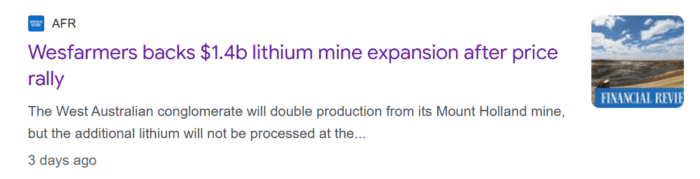
On Wednesday Wesfarmers and its Chilean partner SQM signed off on a $1.4 billion expansion at Mount Holland, 500km east of Perth, with each side tipping in up to $715 million to double concentrate output from 380,000 tonnes a year to 760,000. Construction starts late next year and the first tonnes land in 2030.
Spodumene is the mineral that gets crushed and refined into battery-grade lithium, and it has run back towards US$3,000 a tonne before settling near US$2,000, which is comfortably above what it costs to dig up.
We started writing about the turn back in November, when Pilbara tripled off its lows and Barrenjoey put a US$3,250 spodumene forecast on 2026. Wesfarmers has now put $1.4 billion behind the same idea.
Plenty of people still say the oversupply’s coming, and there was more of that talk this week, with Jefferies analyst Michael Simotas asking whether roughly $3 billion of total spend at Mount Holland earns Wesfarmers an acceptable return.
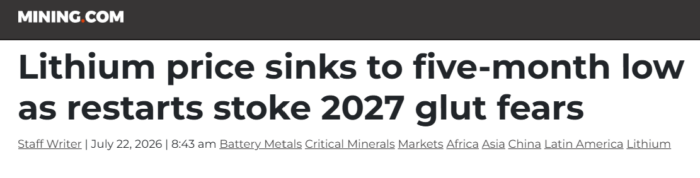
Wesfarmers can afford to be wrong until 2030. A junior can’t be wrong too far past its next raise, which is the whole difference between the two ends of this market.
Uranium Hits US$86 a Pound as Reactor Demand Outruns Supply
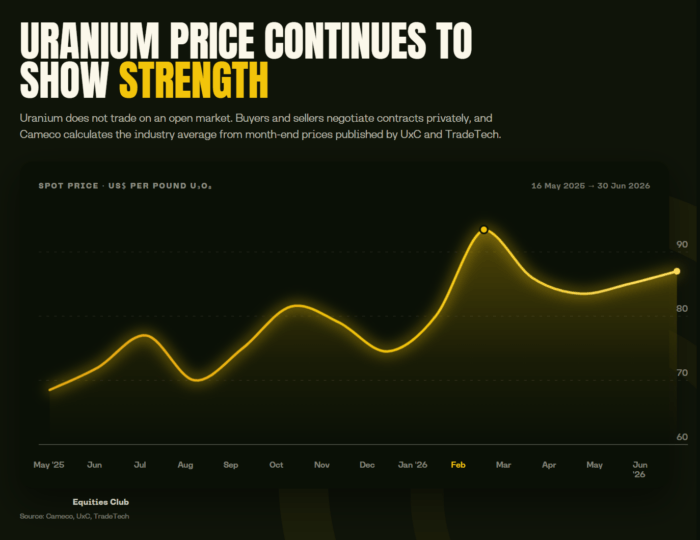
Spot uranium now sits at US$86 a pound. Demand climbs every year and supply sits about where it did a decade ago.
There are 440 reactors running around the world getting through roughly 152 million pounds a year, and they’ll pay whatever it takes to keep going. Fuel is a rounding error next to the cost of running a plant, and an idle reactor costs an operator far more than an expensive pound of uranium ever will.
Another 79 reactors are under construction. Add the 120 planned and the 326 proposed and global capacity more than doubles from here.
Germany switched off its last three reactors in 2023 and the argument about whether that was clever hasn’t quietened down since. Plenty of countries that spent the past 20 years backing away from nuclear are now edging back towards it.
Data centres have made the case stronger for them. An AI facility wants the same steady draw every hour of every day, and nuclear does it better than almost anything.
Supply is another story, and part of it is a Cold War hangover. From 1993 to 2013 the Americans fuelled their reactors with uranium pulled out of old Soviet warheads, bought and blended down under a deal literally called Megatons to Megawatts. For 20 years, roughly one in every 10 American light bulbs ran on bombs that used to be pointed at them.
Cheap Russian fuel kept new mines off the drawing board for two decades, and a mine takes a decade or more from discovery to first production. The holes in today’s supply were dug back then.
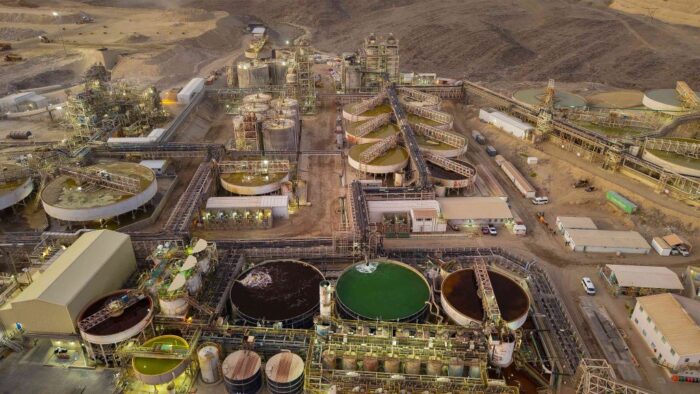
Paladin’s world-class Langer Heinrich Mine (LHM) located in Namibia
Paladin Energy (ASX: PDN) managing director Paul Hemburrow told analysts this week that utilities are already chasing supply out into the 2030s with nobody able to tell them where it comes from.
We’re uranium bulls, though only for projects with the scale to be worth the wait. Plenty more from us here.
Mount Ridley Mines (ASX: MRD) Grants Its New CTO 24 Million Performance Rights
Most executive appointments get a glance and a scroll, and Mount Ridley Mines (ASX: MRD) put one out on Wednesday that we nearly treated the same way. Then we got to the rights table on page two.
Chris Larder takes over as chief technology officer after running the metallurgy at Grass Patch since April, and he now owns the entire processing route for the heavy rare earth, scandium and gallium deposit sitting 25km north of Esperance.
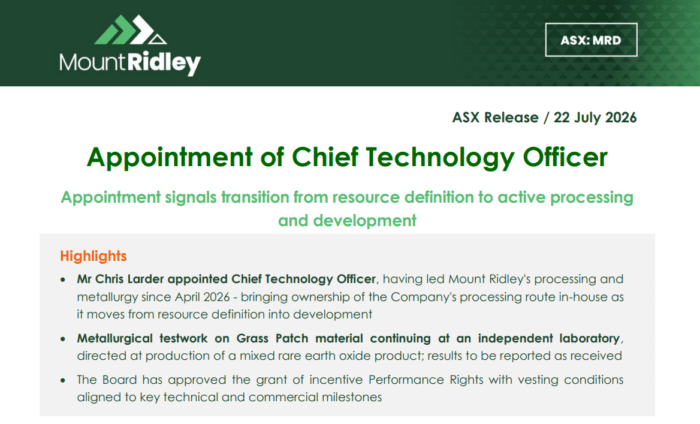
Larder has spent 30 years inside Western Australian processing plants, including Alcoa’s Wagerup refinery, which makes gallium, and Lynas’ operation at Mt Weld. Those are the only two plants in the state already handling what MRD has in the ground.
The board then granted him 24 million performance rights, and a performance right converts into a share only if its condition is met:
- 2 million at a 6 cent share price
- 3 million on filing a patent over MRD’s own process technology
- 4 million when a pilot plant makes rare earth oxide at 99% purity
- 10 million at 15 cents, once the patent and pilot conditions are done
- 5 million when MRD sells or licenses that technology for at least $10 million
One of the brokers in our July piece backed MRD and liked the size of the clay-hosted deposit, with the caveat that the beneficiation and separation work still had to be solved. Larder now gets paid when he solves it, and paid again when a buyer hands over $10 million or more for it.
MRD is worth about $36 million today. Clear those hurdles and it should be worth a whole lot more than that.
Environmental Clean Technologies (ASX: ECT) Halts After a 30% Run
In February we published the Broker Black Book, and one of the anonymous brokers gave us Environmental Clean Technologies (ASX: ECT) as his pick of the year, at 11.5 cents and a $48 million market cap.
It went quiet for months, then ran 30% this week, so we dug his notes back out.
ECT bought a company called Terrajoule in December, and with it an exclusive licence to a Rice University method for destroying PFAS in contaminated soil.
PFAS turns up in firefighting foam and in the waterproofing on your jacket, and the carbon-fluorine bond holding it together is the strongest in organic chemistry. Nothing in the environment breaks it down (hence, the name forever chemicals).
Most treatments today just dig up the dirt and move it somewhere else. The chemicals ride along unchanged, so the paddock they left is clean and the paddock they arrive at is the new problem.
The Rice method runs a short, high-power electric pulse through contaminated soil, heating it past 1,000 degrees in seconds and snapping those bonds apart. Lab work has come back above 96% defluorination.
Robert Bilott sits on ECT’s advisory board. He’s the lawyer who took on DuPont in 1998 after a farmer walked into his office with videotapes of his cattle dying beside a contaminated creek, then spent 20 years pulling billions out of DuPont and 3M over PFAS. Mark Ruffalo played him in a film.
After 20 years of these cases, Bilott knows just about everyone sitting on poisoned ground. Since December, he’s been advising the company selling the clean-up.
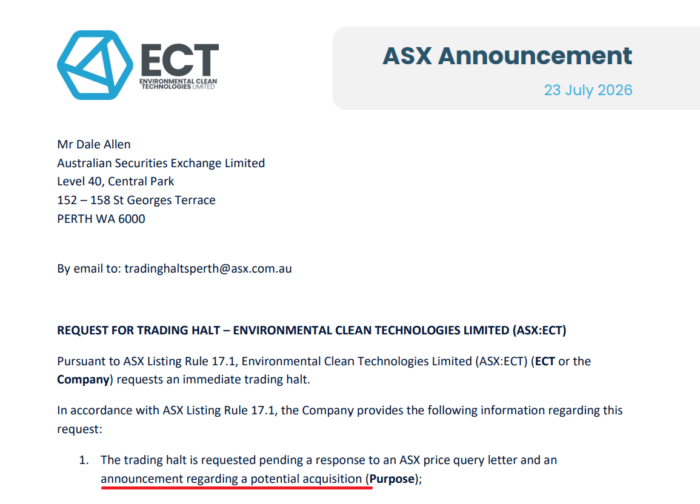
ECT ran 30% this week before going into a halt on Thursday, answering an ASX price query and preparing an announcement about a potential acquisition. Trading resumes Monday unless it lands sooner.
When ECT bought Terrajoule it told the market that was the first acquisition of several. Monday tells us whether they meant it.
Andrew Forrest Takes a $190 Million Stake in EQ Resources (ASX: EQR)
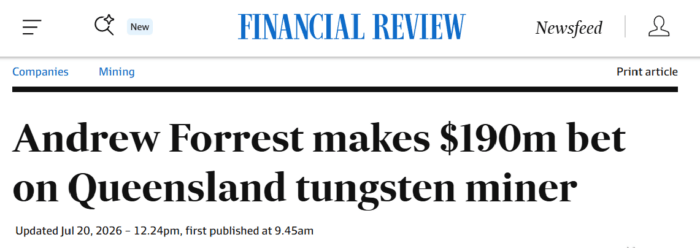
On Monday, Andrew Forrest bought Oaktree Capital’s entire 16.8% stake in EQ Resources (ASX: EQR), a block worth roughly $190 million, making him the biggest shareholder of the largest tungsten producer in the Western world.
The stock jumped 34% to 30 cents, its best day since February 2025.
Tungsten hardens drill bits, machine tools, armour-piercing rounds and the tooling that makes semiconductors. China supplies most of the world’s and added it to its export control list last year, mid trade fight with the US. The price has run more than 200% since January.
Oaktree, a private equity firm, backed EQR in 2023 when tungsten was going cheap, funding the Barruecopardo mine in Spain and the Mt Carbine expansion in North Queensland. Private equity always sells eventually, and Twiggy took the whole block in a single trade.
Half the market follows Twiggy into whatever he buys, and the juniors sitting on tungsten and rare earths outside Chinese hands spent the week getting looks they weren’t getting a month ago.
US House Passes a US$1.15 Trillion Defence Bill Tied to Israel
The US House passed its 2027 defence bill on Wednesday by four votes, 216 to 212, authorising US$1.15 trillion of military spending.
Buried in it is Section 219, which hands a single Pentagon official the job of coordinating defence research and industrial work between the US and Israel.
The two countries already build hardware together, from Iron Dome through to counter-drone gear, and the provision would make that faster and harder to unwind. It drew objections from Democrats and a few Republicans.
Approving the spending is step one, and a second bill later in the year hands the money over. Before any of that, the House version has to be squared with a Senate version Democrats blocked last week. This bill has become law 65 years running, so it will probably get there, just not this month.
KTEK Aerosystems (ASX: KTK) sits at the far end of that pipe, making the airframes and sub-assemblies that Elbit Systems and UVision bolt into finished drones.
KTK gets paid by the contractors who hold the government contracts, so it earns off every drone shipped with its parts inside. Getting onto one of those approved supplier lists takes between one and three years, and KTK is already on them.
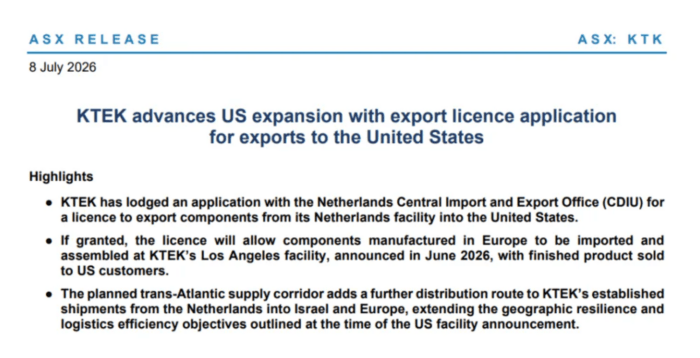
The company took a production and engineering facility in Los Angeles in June and applied for a licence to move parts from its Netherlands plant into the US for assembly, because American buyers want product arriving from an American address.
Black Horse Mining (ASX: BHL) Reopens the Sister Rose Tunnel
We have been waiting a while for Black Horse Mining (ASX: BHL) to get moving, and this week gave us something to hold onto.
The company is reopening an old tunnel into the hillside at Sister Rose, and despite a wet stretch of weather it has the entrance dug out, made safe and lined so the walls stay put. That job should be finished in three to four weeks.
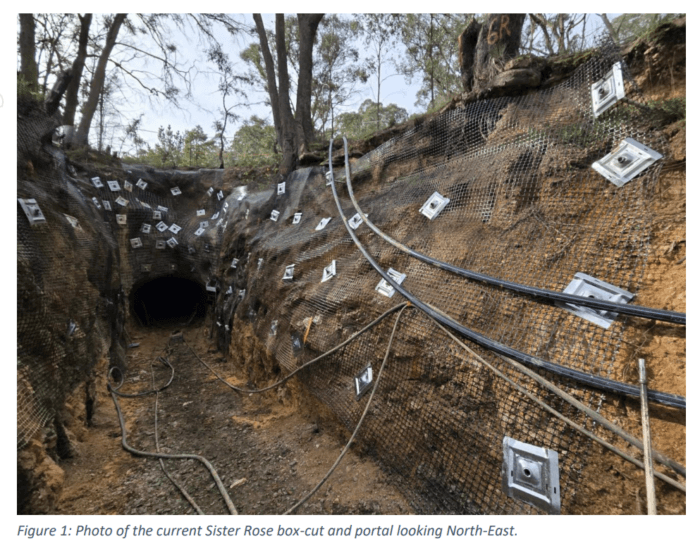
What they’re after is the old mine shaft sitting behind it. Find that and you know where the historic workings actually run underground, which puts the drill holes where they’ll count.
Rain has cost them time on that front, with the rig pulled off site while access tracks are rebuilt and drilling now pushed to September or October. The tracks are getting an upgrade so the wet does not stop them again.
BHL sits in our portfolio and we’re happy to wait, because of what’s underneath.
Mt Egerton produced 1.29 million ounces at roughly 12 grams per tonne before flooding forced it shut more than a century ago. The gold never ran out. The water just came in faster than the old pumps could shift it, and the miners walked off ground that was still paying.
The ground below those workings has never been drilled, and that’s the part BHL is chasing. The water might’ve won a century ago, but the pumps have come a long way since.
The Week Ahead for ASX Small-Caps
The next few weeks are as full as any we’ve had this year. Three new companies join the portfolio shortly, and we’re looking forward to walking you through why each one made it.
We’ll be watching the Gulf same as everyone, hoping the tankers keep sailing and the whole thing calms down. Oil at US$100 makes life harder for every explorer we cover, and cheaper fuel plus a ceasefire would suit us all.
On uranium, we’ve said our piece above, and one of our three August additions is our way of backing it.
The data centre money is the one we keep coming back to. The Americans are spending hundreds of billions of dollars a year on the things, and so far the ASX small-cap end has barely seen a cent of it. Money that big always finds its way downhill eventually, and we plan to be there when it does.
Till next week.
General advice, disclosure and confidentiality
General advice warning
The contents of this document are intended to provide general securities advice only and have been prepared without taking account of your objectives, financial situation or needs. Because of that you should, before taking any action to acquire or deal in, or follow a recommendation (if any) in respect of any of the financial products or information mentioned in this document, consulting your own investment advisor to consider whether that is appropriate having regard to your own objectives, financial situation and needs. If applicable, you should obtain the Product Disclosure Statement relating to the relevant financial product mentioned in this document (which contains full details of the terms and conditions of the relevant financial product) and consider it before making any decision about whether to acquire the financial product. Whilst the Equities Club Pty Ltd (”Equities Club”) believes information contained in this document is based on information which is believed to be reliable, its accuracy and completeness are not guaranteed and no warranty of accuracy or reliability is given or implied and no responsibility for any loss or damage arising in any way for any representation, act or omission is accepted by Equities Club or any officer, agent or employee of Equities Club or any related company.
Neither Equities Club, nor any of its directors, authorised representatives, employees, or agents, makes any representation or warranty as to the reliability, accuracy, or completeness, of this document or any advice. Nor do they accept any liability or responsibility arising in any way (including negligence) for errors in, or omissions from, this document or advice.
Disclosure
The directors, authorised representatives, employees and associated persons of Equities Club may have an interest in the financial products discussed in this document and they may earn brokerage, commissions, fees and advantages, pecuniary or otherwise, in connection with the making of a recommendation or dealing by a client in such financial products. Equities Club owns 500,000 KTK shares, 4,500,000 EVG shares, 2,083,333 MRD performance rights, 187,500 shares of BHL at the time of publishing this article. Equities Club has been engaged by KTK, BHL, MRD and EVG at the time of writing.
Confidentiality notice
The information contained in and accompanying this communication is strictly confidential and intended solely for the use of the intended recipient/s. The copyright in this communication belongs to Equities Club. If you are not the intended recipient of this communication please delete and destroy all copies immediately.
Equities Club Ltd (CAR No. 001308139) is a corporate authorised representative of ShareX Pty Ltd, Australian Financial Services License (AFSL) No 519872.