
US aluminium giant Alcoa is building a gallium plant at its Wagerup refinery south of Perth with the Australian, Japanese and US governments behind it.
When it runs it could supply up to 10% of the world’s gallium.
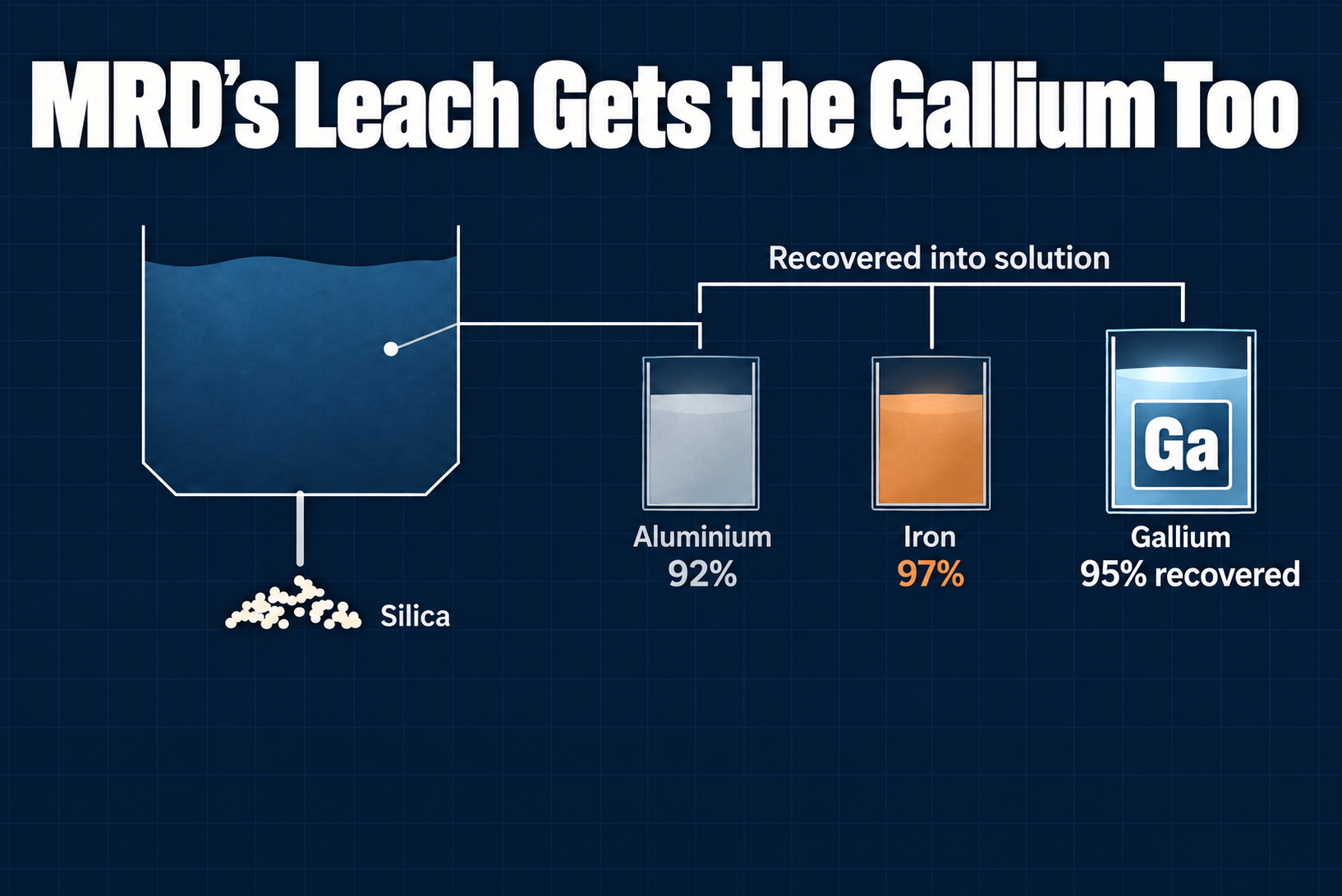
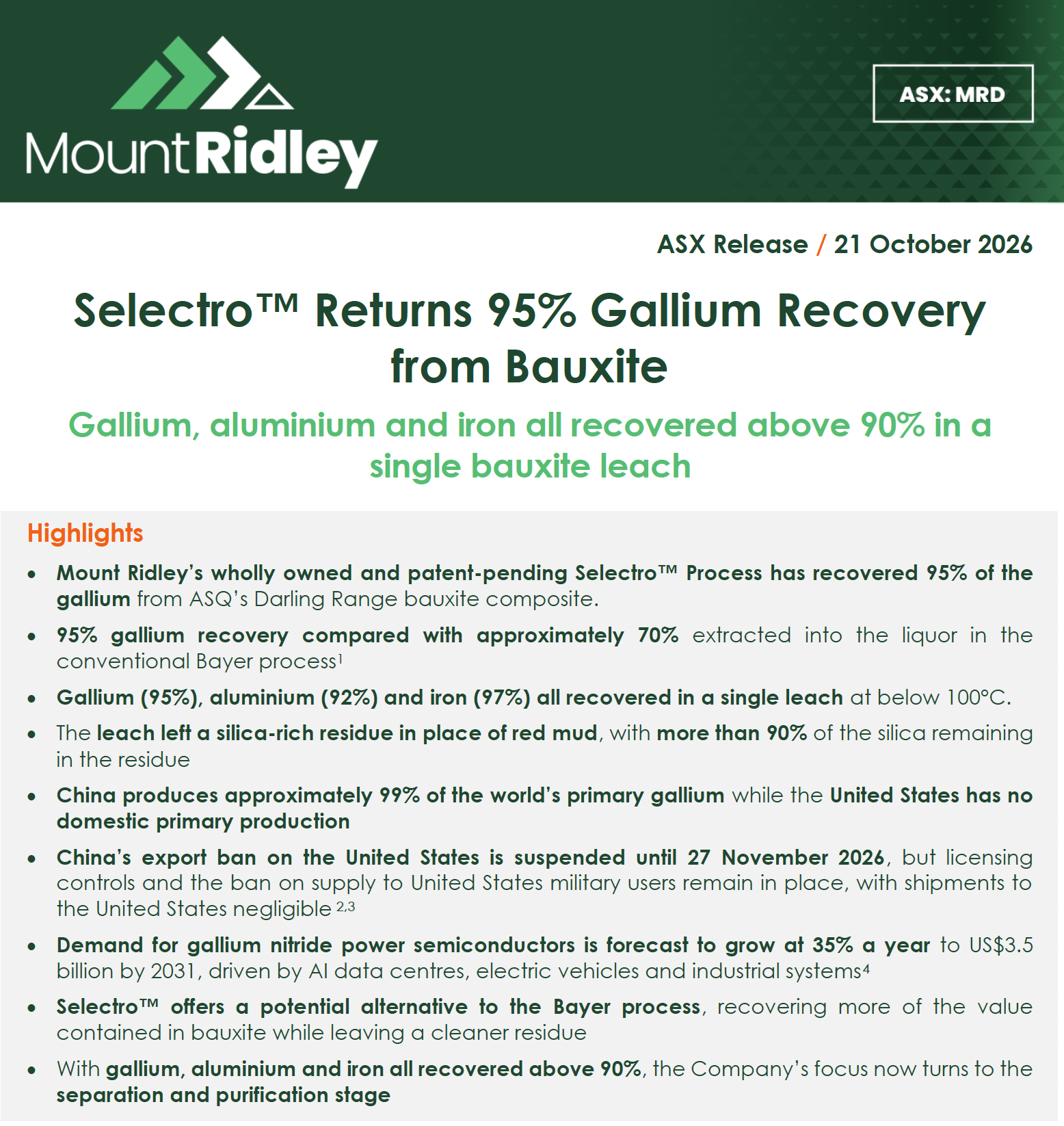
This morning, Mount Ridley Mines (ASX: MRD) reported its Selectro leach got 95% of the gallium out of a sample of the same Darling Range bauxite Alcoa refines.
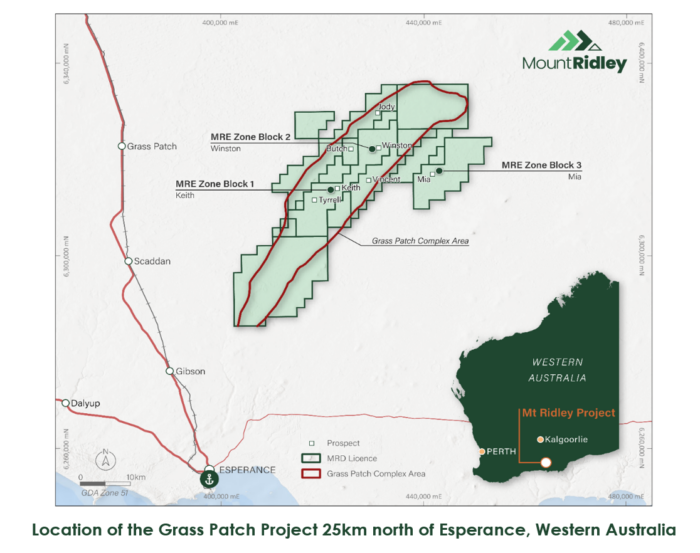
Selectro is a leach MRD built to get scandium and rare earths out of its clay at Grass Patch near Esperance. Last week MRD ran bauxite through it for the first time and reported 92% of the aluminium and 97% of the iron came out.
The gallium from the same test needed a more sensitive assay and took another week.
Selectro recovered more than 91% of the gallium, the aluminium and the iron in one leach below the boiling point of water, and all it left behind was a pile of sand.
China refines 99% of the world’s gallium. Washington’s own geologists say many defence applications have no substitute for a gallium chip, and a full Chinese ban on exporting it would cost the American economy between US$3.4 billion and US$9 billion.
The Pentagon is basically using some military equipment with a metal it can’t buy from the only country making it.
Three governments are paying for Alcoa’s plant to get at 70% of the gallium in bauxite. MRD got 95% in a lab, and we’d say the same three governments should be reading this announcement.
Mount Ridley and the Metal the Pentagon Can’t Buy
Gallium chips handle more heat and more power than silicon ones. They go into military radar and electronic warfare systems and into the electronics inside AI data centres and electric cars.
The market for the data centre chips alone is growing 35% a year and will be worth US$3.5 billion by 2031.
America makes no gallium of its own and imports every kilo it uses.
In December ’24 China banned gallium exports to the US. Last November, as part of the one-year trade truce Trump and Xi struck, Beijing paused the ban until November 27 this year. It hasn’t said what happens after that.
Every shipment of gallium leaving China has needed a government export licence since 2023. The ban on selling to the US military was kept in place as well, so barely anything is getting through.
MRD’s News Is Flowing
Last Wednesday’s aluminium result put 20% on the stock by Friday. Monday brought a second patent on the bauxite chemistry and this morning the gallium.
We wrote last week Selectro had beaten our expectations three announcements in a row, and it has just made it four.
We bought MRD at 2.4c in March for the scandium in the clay. Selectro didn’t exist at MRD then.
Chris Larder brought it with him when he joined as chief technology officer in July, and the leach has been the news ever since. At 4.3c this morning the company is worth $62 million.
How Selectro Got 95% of the Gallium Out of Bauxite
A refinery extracts the aluminium out of bauxite with the Bayer method, which involves cooking it in caustic soda. About 70% of the gallium ends up in the liquor from the cook (the liquid the aluminium dissolves into) and the other 30% goes out in the red mud.
Red mud is the caustic sludge left after the cook, and it is kept in a dam forever. Even the 70% in the liquor only gets recovered where a refinery has built a dedicated circuit for it. This is what Alcoa is building at Wagerup.
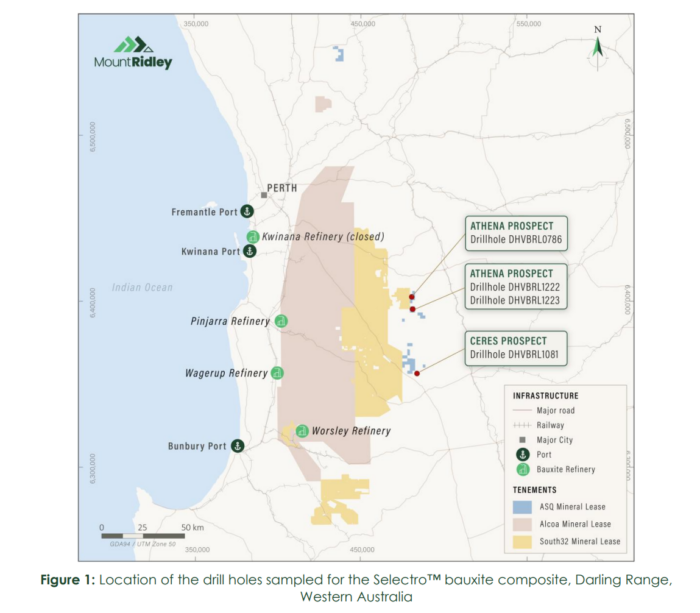
The sample came from Australian Silica Quartz (ASX: ASQ), whose ground sits next to Alcoa’s bauxite leases. ASQ sent 16 drill samples from four holes at its Athena and Ceres prospects and the lab blended them into one composite.
Bauxite carries about 80 grams of gallium in every tonne, which is too little for the lab’s standard assay to see. The gallium had to go through a more sensitive test, and it came back at 94.9%.
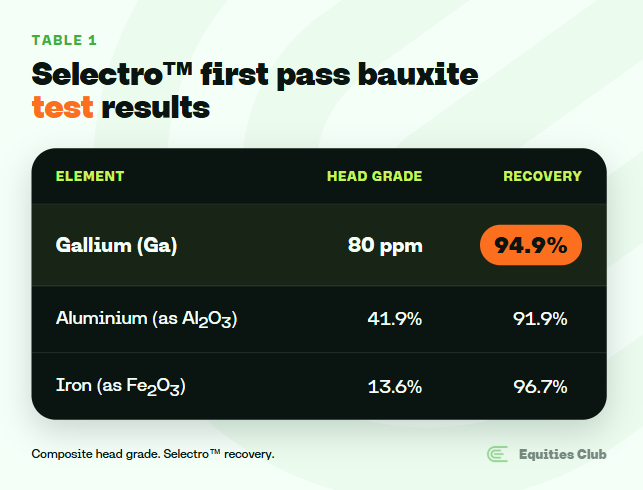
Most of the alumina in Darling Range bauxite sits in a mineral called gibbsite with the gallium locked in beside it. Selectro dissolved the gibbsite and the gallium came out with the alumina, which is why the 95% on gallium landed so close to the 92% on aluminium.
On MRD’s own clay at Grass Patch, Selectro recovered 56% of the gallium. MRD puts the jump to 95 down to tuning the reagent molecule for bauxite before the test.
A week ago, with the gallium still at the lab, managing director Allister Caird told us the early signs were Selectro could pull every valuable metal in the bauxite out in a single leach. This morning he had the number to go with it.
We said last week a gallium result could give a Selectro plant a valuable third product to sell.
The US government’s geological survey put imported gallium at about US$580 a kilo last year, so each tonne of this bauxite holds about US$46 of gallium before the aluminium and iron are counted.
The Patent Mount Ridley Lodged Before the Number
MRD wants to license Selectro to anyone whose ore it works on.
On Monday the company said it had lodged a second provisional patent with IP Australia covering the version of the chemistry tuned for bauxite. It lodged it on October 15, six days before the gallium number came out.
The August patent covers Selectro on the Grass Patch clay. The two sit separately, so MRD can license the bauxite chemistry to a refiner and keep the Grass Patch IP out of the deal.
Caird told us the plan is to file in the important Western jurisdictions, and when we asked how you value a process like Selectro he said it depends on how many feedstocks it works on and he doesn’t know yet.
A royalty on a process running inside somebody else’s refinery is about the cheapest income a company this size could ever earn.
What Comes Next for MRD’s Selectro Process
The three metals are sitting in the one solution and MRD now has to get them out as products somebody will pay for, which the announcement calls separation and purification.
A second bauxite test is running with the chemistry tuned further, and more outside ores are lined up behind it.
MRD has also brought forward the design and construction of a Selectro demonstration plant in Perth to run the process in bulk.
We want to see a gallium product at a purity a chip maker would buy and the second bauxite test holding above 90%. We said last week the number we want most is MRD’s own cost per tonne against Bayer.
Our Take on Mount Ridley Mines
We bought MRD in March for the scandium in 368 million tonnes of clay at Grass Patch. In August the resource went to 946 million tonnes and the biggest reported in the world, with the clay still open in every direction, and in September Selectro got 91.8% of the scandium out of it.
Then it went to work on somebody else’s bauxite and got more than 90% of every metal it went after.
Alcoa needs a refinery and a new plant with three governments behind it to get at 70% of the gallium in its bauxite. MRD’s pitch to a refiner is now three products out of one leach and a pile of sand in place of the dam.
MRD has a process it can sell to the people who own the bauxite, and this morning it proved the process gets the gallium too.
General advice warning, disclosure and confidentiality notice
General advice warning
The contents of this document are intended to provide general securities advice only and have been prepared without taking account of your objectives, financial situation or needs. Because of that you should, before taking any action to acquire or deal in, or follow a recommendation (if any) in respect of any of the financial products or information mentioned in this document, consulting your own investment advisor to consider whether that is appropriate having regard to your own objectives, financial situation and needs. If applicable, you should obtain the Product Disclosure Statement relating to the relevant financial product mentioned in this document (which contains full details of the terms and conditions of the relevant financial product) and consider it before making any decision about whether to acquire the financial product. Whilst the Equities Club Pty Ltd (“Equities Club”) believes information contained in this document is based on information which is believed to be reliable, its accuracy and completeness are not guaranteed and no warranty of accuracy or reliability is given or implied and no responsibility for any loss or damage arising in any way for any representation, act or omission is accepted by Equities Club or any officer, agent or employee of Equities Club or any related company.
Neither Equities Club, nor any of its directors, authorised representatives, employees, or agents, makes any representation or warranty as to the reliability, accuracy, or completeness, of this document or any advice. Nor do they accept any liability or responsibility arising in any way (including negligence) for errors in, or omissions from, this document or advice.
Disclosure
The directors, authorised representatives, employees and associated persons of Equities Club may have an interest in the financial products discussed in this document and they may earn brokerage, commissions, fees and advantages, pecuniary or otherwise, in connection with the making of a recommendation or dealing by a client in such financial products. Equities Club owns 2,083,333 MRD performance rights and 303,030 shares at the time of publishing this article. Equities Club has been engaged by MRD at the time of writing.
Confidentiality notice
The information contained in and accompanying this communication is strictly confidential and intended solely for the use of the intended recipient/s. The copyright in this communication belongs to Equities Club. If you are not the intended recipient of this communication please delete and destroy all copies immediately.
Equities Club Ltd (CAR No. 001308139) is a corporate authorised representative of ShareX Pty Ltd, Australian Financial Services License (AFSL) No 519872.