
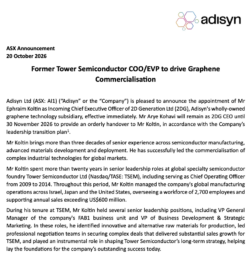
Adisyn has hired the man who ran Tower Semiconductor’s chip factories to run its graphene business.
Tower is a US$22 billion chipmaker, and Intel agreed to pay US$5.4 billion for it in 2022.
Ephraim Koltin spent more than 20 years there and finished as chief operating officer, with 2,700 staff and every plant Tower owned (in Israel, Japan and the US) reporting to him. Tower was selling more than US$600 million of chips a year on his watch.
Adisyn (ASX: AI1) today named him incoming CEO of 2D Generation, the subsidiary that grows graphene inside the same machines Tower runs.
The board said in September it wanted a chip-industry boss for 2DG, and Koltin’s job from day one is to get the 200mm wafer results in front of the chipmakers and sign the first one to a binding deal. Tower runs the same 200mm production lines AI1 proved its graphene on in August.
A heavy hitter like Koltin taking the job at a $91 million company is the biggest vote of confidence in the graphene we’ve had yet.
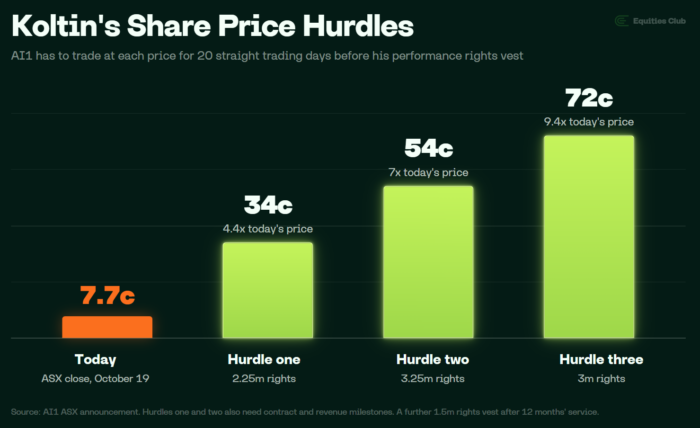
Our favourite line in the announcement sits in the appendix. Of Koltin’s 10 million performance rights, 8.5 million are worth nothing until AI1 holds 34c, four-and-a-half times today’s price.
The top hurdle is 72c, and another tranche only pays once AI1 has booked US$10 million of revenue. He makes money when shareholders make money.
AI1 trades at 7.7c with about $15 million in the bank.
Who is Ephraim Koltin, Adisyn’s New Graphene Boss
Koltin spent his Tower years inside the factories. He ran process engineering at the company’s second fab, then business development, then the first fab itself, and in 2009 he took over every plant Tower owned.
Tower’s revenue went from US$299 million in 2009 to a record US$639 million in 2012 with him running operations. He finished as chief operating officer and left in 2014.
Part of his job there was finding new raw materials for production, and he led the negotiating teams on the deals that grew Tower’s sales.
His name is on four US patents from his Tower days. One of them covers how the copper wiring layers are laid out on a chip, and he’s now in charge of the company replacing them with graphene.
One bad process step on a chip line wrecks thousands of wafers, so for two decades Koltin was who a materials company had to convince before its process got anywhere near a Tower production line. AI1 has hired him to go and do the convincing.
“I am thrilled to announce the appointment of Ephraim to lead the next phase of 2D Generation’s development.”
“He possesses excellent industry knowledge and experience, and is uniquely qualified to oversee our growth as a company.”
Kevin Crofton, executive chairman of Adisyn
Koltin spent the past eight years at Arkal Automotive and has been its CEO since December 2021. Arkal runs five factories making plastic parts for car makers like BMW and GM.
Car makers test a new part for months before it goes anywhere near a production line, so he has spent eight years getting new parts through the same grind AI1’s graphene is about to face at the chipmakers.
Arkal is owned by Raval, the Israeli manufacturer AI1 signed with in May to build radar-absorbing graphene parts for drones, so Koltin already knows AI1’s drone partner from the inside.
He also sat on 2DG’s advisory board from its early days, so he has seen the graphene work up close before agreeing to run it.
What Adisyn (ASX: AI1) Has Built in Graphene
The chips inside phones and AI servers are wired with copper tracks called interconnects, so thin that once a chip shrinks below two nanometres the copper runs hot and starts to choke.
Graphene is a sheet of carbon one atom thick, and it keeps carrying the signal at sizes where copper fails. A chip wired in graphene runs faster and cooler on less power, and across a data centre full of AI chips the electricity lost to hot copper adds up to a small city’s power bill.
TSMC, the biggest chipmaker on earth, has already named graphene as the way past copper, and the wiring inside chips is a market worth around US$31 billion a year.
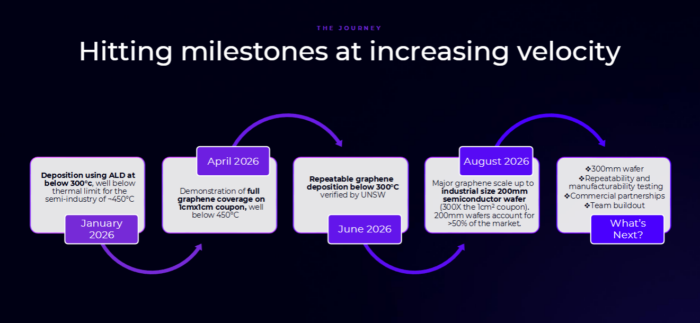
Growing graphene normally takes about 1,000°C, and a chip is wrecked above 450°C.
AI1’s team in Israel spent six years on a patented recipe that grows graphene below 300°C, inside the deposition machines chip factories already own.
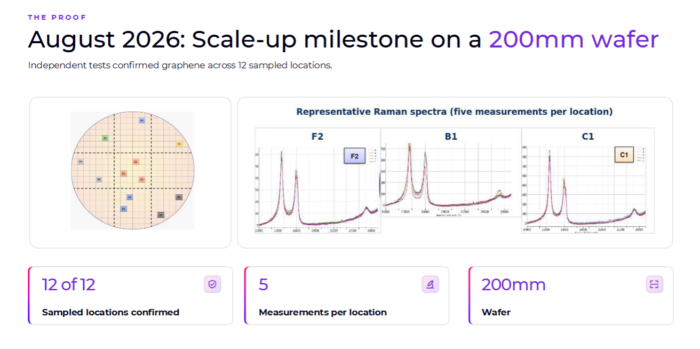
It grew the first full square of it in April, a centimetre across. In June it ran the recipe three times on three separate days and got the same graphene each time, then handed the data to a UNSW professor who trained under the man who won the Nobel Prize for graphene, and he confirmed it was real.
In August it covered a 200mm industrial wafer edge to edge, 300 times the area of the April square and two months ahead of its own plan.
Along the way AI1 had two US patents allowed and raised $14 million from Regal Funds and Israel’s largest investment house Meitav.
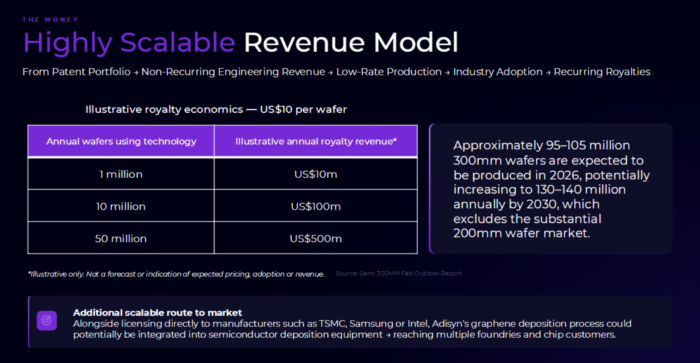
The plan is to license the recipe to chip factories and collect a royalty on every wafer that comes off the line. A fab running it gets to sell chips its rivals can’t make.
What Comes Next for Adisyn (ASX: AI1)
When we sat down with AI1’s chairman Kevin Crofton on a Saturday night back in April, he told us the companies he used to run had spent hundreds of millions of dollars trying to get graphene into a chip. He’d tried it himself on three different types of machine and failed every time.
He also walked us through how a deal like this gets done in his industry. A chipmaker pays for exclusivity on one application, or an equipment giant takes a stake in the company with a first right of refusal to buy the lot.
Koltin sat through those negotiations for 20 years from the chipmaker’s side. One tranche of his rights only vests once two contracts with parties he introduced are worth US$1 million between them, so the board has basically written his contact book into his pay.
Current 2DG boss Arye Kohavi stays until November 30 to hand the business across, then moves over to run the radar subsidiary part-time. The founder keeps the drones and the chip veteran gets the chips.
AI1 is repeating the 200mm wafer work to prove the graphene comes out even every time, then taking the data to chipmakers while it pushes toward the 300mm wafers TSMC and Samsung build AI chips on.
On the drone side, AI1 set itself a target of November 7 for the signed deal with Raval, three weeks from now.
Our View on Adisyn (ASX: AI1)
We added AI1 at 6.8c in April and it sits at 7.7c today, with a verified full wafer of graphene and two US patents added since.
Crofton told us in April that when he asked chip companies what a working low-temperature graphene process would mean to them, the reply was that it’s worth more than their own company.
AI1 is worth $91 million. The board has just hired a man who sat in those companies’ chairs for 20 years, and told him the big rewards start at 34c.

General advice warning, disclosure and confidentiality notice
The contents of this document are intended to provide general securities advice only and have been prepared without taking account of your objectives, financial situation or needs. Because of that you should, before taking any action to acquire or deal in, or follow a recommendation (if any) in respect of any of the financial products or information mentioned in this document, consulting your own investment advisor to consider whether that is appropriate having regard to your own objectives, financial situation and needs. If applicable, you should obtain the Product Disclosure Statement relating to the relevant financial product mentioned in this document (which contains full details of the terms and conditions of the relevant financial product) and consider it before making any decision about whether to acquire the financial product. Whilst the Equities Club Pty Ltd (“Equities Club”) believes information contained in this document is based on information which is believed to be reliable, its accuracy and completeness are not guaranteed and no warranty of accuracy or reliability is given or implied and no responsibility for any loss or damage arising in any way for any representation, act or omission is accepted by Equities Club or any officer, agent or employee of Equities Club or any related company.
Neither Equities Club, nor any of its directors, authorised representatives, employees, or agents, makes any representation or warranty as to the reliability, accuracy, or completeness, of this document or any advice. Nor do they accept any liability or responsibility arising in any way (including negligence) for errors in, or omissions from, this document or advice.
Disclosure
The directors, authorised representatives, employees and associated persons of Equities Club may have an interest in the financial products discussed in this document and they may earn brokerage, commissions, fees and advantages, pecuniary or otherwise, in connection with the making of a recommendation or dealing by a client in such financial products. Equities Club owns 900,000 performance rights at the time of publishing this article. Equities Club has been engaged by AI1 at the time of writing.
Confidentiality notice
The information contained in and accompanying this communication is strictly confidential and intended solely for the use of the intended recipient/s. The copyright in this communication belongs to Equities Club. If you are not the intended recipient of this communication please delete and destroy all copies immediately.
Equities Club Ltd (CAR No. 001308139) is a corporate authorised representative of ShareX Pty Ltd, Australian Financial Services License (AFSL) No 519872.