
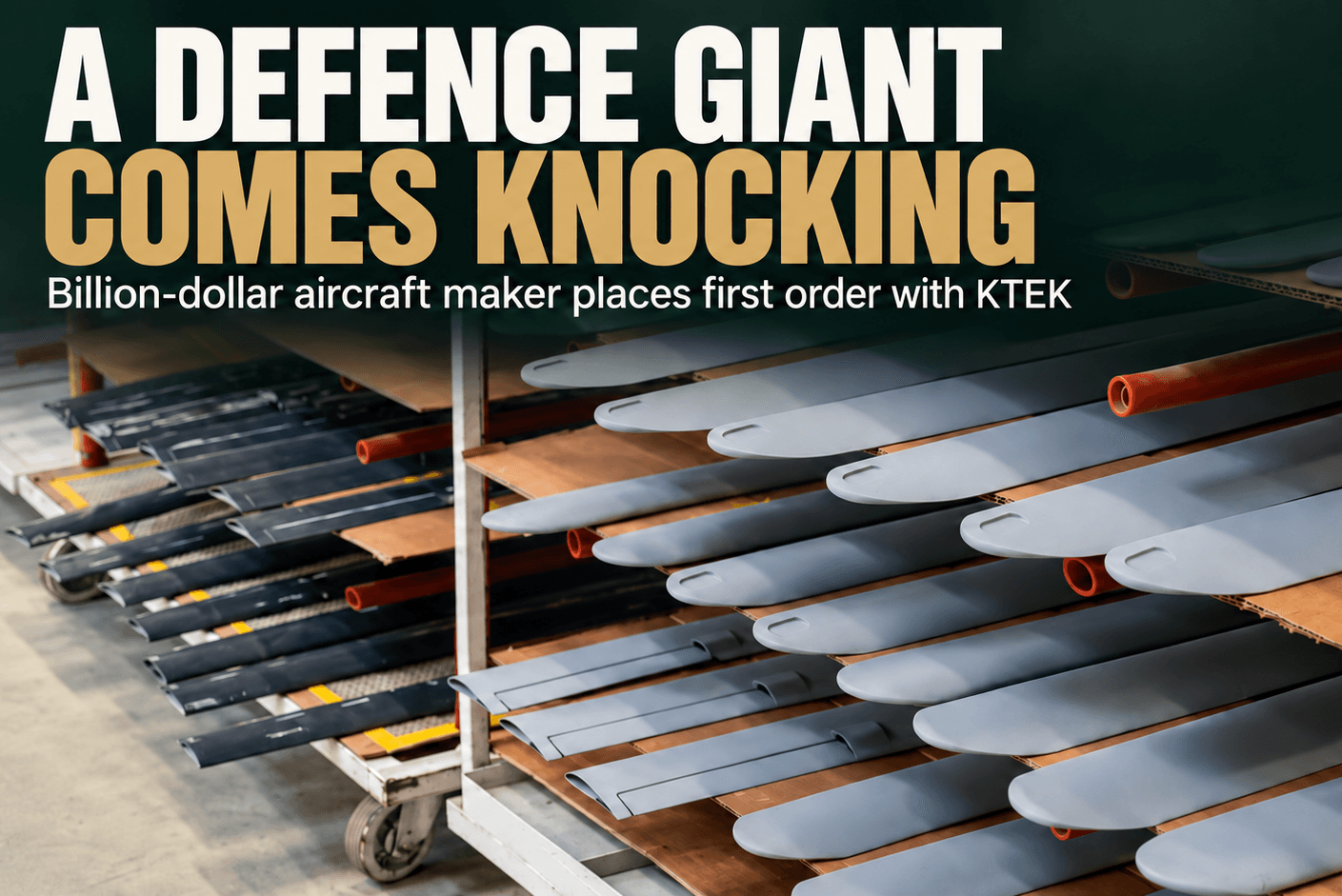
Our drone portfolio company KTEK Aerosystems (ASX: KTK) took an order this morning from one of Israel’s three big defence contractors to design part of a military aircraft.
We spent Sunday watching drone footage out of Moscow. Ukraine sent more than 1,000 of them into Russia yesterday, and earlier this month a handful out of Iraq shut the Saudi pipeline that lets tankers skip the Strait of Hormuz. Brent crude oil went through US$108, the first time since panic gripped markets in May.
Every defence budget on earth is being rewritten around drones, because a handful of them can hit a major city’s infrastructure or stop 4% of the world’s oil in one night.
KTK builds the wings and fuselage sections that go inside them, and increasingly the whole section, wired and tested, so the drone maker bolts it in and moves on.
The purchase order is binding and worth US$200,000. It’s the first payment on a US$994,100 design package the customer has now accepted.
US$200,000 is small money for a company already doing millions a year in revenue.
We care about who’s paying it.
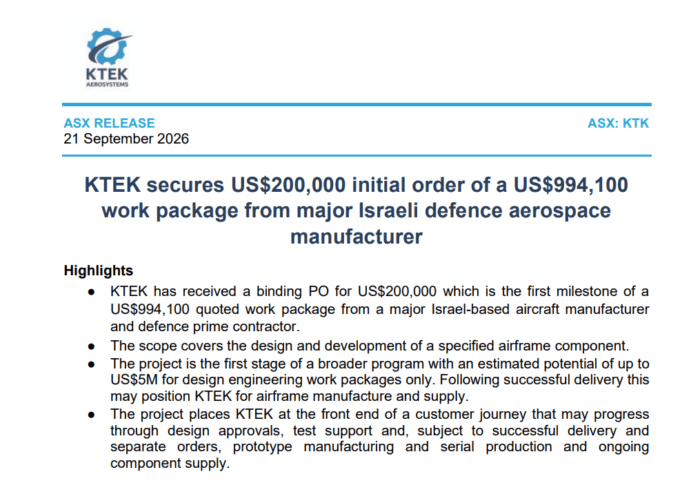
The announcement keeps the customer’s name secret for national security reasons. It describes a military aircraft manufacturer with more than 10,000 staff and billions in revenue.
We went through the annual reports of Israel’s defence companies and three come close. Each turns over about US$7 billion a year.
The defence industry calls companies like these primes. A government signs with the prime for the finished aircraft, and the prime buys the wings and frames from smaller suppliers like KTK.
A prime this size only signs up a new supplier when there’s enough work to make it worth the bother, and KTK puts the design work across the wider program at around US$5 million.
Nobody at a billion-dollar contractor pays to design a wing they plan to build a handful of.
At today’s exchange rate US$5 million of drawings comes to about a third of KTK’s $24.6 million market cap, and covers design only.
Do the drawings well and KTK is the company that designed the part, so when the prime orders thousands of them KTK is first in line to build them. A supply contract at a prime runs for as long as the aircraft does, and military drones tend to fly for 20 or 30 years.
Suppliers usually spend years getting onto a prime’s books, and KTK has done it 18 weeks after listing on the ASX.
Who’s Paying? We Did Some Digging Into Israel’s Defence Primes
Three companies in Israel fit the announcement’s description, and here they are with last year’s numbers.
- Elbit Systems turned over US$7.9 billion in 2025 with more than 20,000 staff.
- Israel Aerospace Industries did US$7.4 billion with a US$29 billion order book.
- Rafael came in at US$6.8 billion and has 10,000 employees.
Elbit alone turns over more in a day (about US$21.6 million) than KTK’s whole market cap.
Between them the three turned over US$22 billion last year and are sitting on US$80 billion of orders they haven’t built yet. Israel’s defence exports hit a record US$19.2 billion in 2025, up nearly 30% on the year before, and most of it went out the doors of these three.
Their drone history goes back further than anyone’s. IAI flew the first modern military drones over Lebanon in 1982, and its Heron surveillance drone has since been bought by around 15 countries. Australia flew Herons over Afghanistan for years.
Each of these companies has thousands of engineers on staff and 40 years of drone programs behind it, and one of them has gone outside to an 18-week-old ASX listing to design an airframe part.
Groups this size qualify a supplier once and use it for years. The volumes they order are the reason a wing is worth designing at all.
Inside KTK’s US$994,100 Airframe Design Contract
KTK will design a specified airframe component for the prime. The work covers the drawings, the stress analysis and the bill of materials, plus the engineering support to get the part through the customer’s design reviews.
In plain terms, KTK has been hired to draw a part of an aircraft and prove on paper it will hold together, before anyone builds one.
The first US$200,000 pays for preliminary design over three months. The next US$592,700 covers engineering and development over 18 months, and a final US$201,400 covers a year of production and testing support after that. The whole program runs 30 months.
Prototypes and production are outside this package. The announcement says each of those comes as its own purchase order if the design gets through, and there’s no guarantee written into today’s order.
We read it as the try before they buy test, and the prime has put nearly US$1 million behind seeing how KTK goes.
KTK Managing Director Dekel Keisar Learned the Trade Inside a Defence Prime
KTEK’s founder and managing director Dekel Keisar was Head of UAV Structural Engineering at Israel Aerospace Industries, where he worked on more than 20 military drone platforms before starting KTK in 2019.
Structural engineering is the skeleton of the aircraft. The wings and frames have to hold together when a drone banks hard at altitude, and a prime signs off on them before anything else gets built.
He built KTK to sit one rung below the primes. It already supplies finished airframe sections to Elbit and to drone maker UVision. The design work stays in Israel and the manufacturing is spread across certified partners in four countries.
Dekel still owns 36% of KTK and hasn’t sold a share since listing. He learned how primes buy from inside one, and he wins or wears this order alongside every other shareholder.
Why Every Military Wants Drones and the Pentagon’s US$70 Billion Budget
In July last year, US Defence Secretary Pete Hegseth reclassified small drones as consumables that are bought like ammunition and expended by the case.
The Pentagon’s budget request for the year ahead asks for more than US$70 billion for drones and counter-drone systems, up from about US$16.5 billion the year before. It has since asked industry for more than 300,000 small drones across 2026 and 2027, and the US Army wants a million.
In April the Australian Government put at least $12 billion toward drones over the next decade, then added up to $7 billion for shooting them down.
A drone that costs less than a car can put a hole in a refinery, and the missile fired to stop it costs more than a million dollars. Major militaries have all done the same sums.
Every one of those drones needs parts, and the companies whose names go on the side buy most of them from suppliers. KTK is one of the suppliers, and it gets paid whichever brand wins the tender.
KTK Shipments Restart and the Los Angeles Plant Opens
The war in Iran shut the shipping route KTK’s biggest customer relies on, and for most of this year finished airframes sat in a warehouse with the buyer waiting on the other end.
Around US$100,000 worth got through in August as a test run. The rest starts moving again in late September or early October.
On the other side of the world, KTK has a building in Los Angeles ready to go. The Dutch export licence it needed landed in August, so European-made parts can now land in California, get assembled, and ship to American customers from an American address.
The Pentagon’s rules favour parts made in America, and from LA KTK’s will be.
Two weeks ago Vestal signed KTK to build its prototype airframes. This morning one of Israel’s three defence giants put in an order for it to design part of an aircraft.
We picked KTK at its May float because primes buy airframes from companies like it, and 18 weeks later one of the biggest is.
The parts that sat in a warehouse all year start moving within a fortnight and the LA plant is waiting on its first American order.
One of the biggest aircraft builders on earth has paid KTK to start drawing, and the first drawings go over in three months. If they’re good, the US$5 million follows, and the order to build the part is KTK’s to lose.
We think they’ll be good. Signing off drone wings was Dekel’s job at a prime before he started KTK.
General advice, disclosure and confidentiality
General advice warning
The contents of this document are intended to provide general securities advice only and have been prepared without taking account of your objectives, financial situation or needs. Because of that you should, before taking any action to acquire or deal in, or follow a recommendation (if any) in respect of any of the financial products or information mentioned in this document, consulting your own investment advisor to consider whether that is appropriate having regard to your own objectives, financial situation and needs. If applicable, you should obtain the Product Disclosure Statement relating to the relevant financial product mentioned in this document (which contains full details of the terms and conditions of the relevant financial product) and consider it before making any decision about whether to acquire the financial product. Whilst the Equities Club Pty Ltd (“Equities Club”) believes information contained in this document is based on information which is believed to be reliable, its accuracy and completeness are not guaranteed and no warranty of accuracy or reliability is given or implied and no responsibility for any loss or damage arising in any way for any representation, act or omission is accepted by Equities Club or any officer, agent or employee of Equities Club or any related company.
Neither Equities Club, nor any of its directors, authorised representatives, employees, or agents, makes any representation or warranty as to the reliability, accuracy, or completeness, of this document or any advice. Nor do they accept any liability or responsibility arising in any way (including negligence) for errors in, or omissions from, this document or advice.
Disclosure
The directors, authorised representatives, employees and associated persons of Equities Club may have an interest in the financial products discussed in this document and they may earn brokerage, commissions, fees and advantages, pecuniary or otherwise, in connection with the making of a recommendation or dealing by a client in such financial products. Equities Club owns 500,000 KTK shares. Equities Club has been engaged by KTK at the time of writing.
Confidentiality notice
The information contained in and accompanying this communication is strictly confidential and intended solely for the use of the intended recipient/s. The copyright in this communication belongs to Equities Club. If you are not the intended recipient of this communication please delete and destroy all copies immediately.
Equities Club Ltd (CAR No. 001308139) is a corporate authorised representative of ShareX Pty Ltd, Australian Financial Services License (AFSL) No 519872.