

The ASX had a shocker of a week and gold had its worst week in eight months. We think we know who’s to blame.
The first Grand Theft Auto in 13 years came out this week and it’s the Eras Tour for men in their 30s. Research firm Sensor Tower estimates it took more than US$2.3 billion by the end of launch day with pre-orders counted (Taylor Swift’s whole tour took US$2.2 billion).
One retail analyst tips 700,000 copies sold in Australia in the first week, mostly to men aged 30 to 34.
Plenty of them read this newsletter, and we think it explains the week small-caps had.

We were right there with them, watching the screen count down on launch night and then sitting in awe for a few solid hours, before it gave way to mundane chores.
It’s a crime game and we’ve spent it painting walls, fixing steps and buying flowers. We’ve done more around the house in the game than we have around our own all year.
We still made it to work on Thursday in time to watch Anthropic raise US$81 billion in the biggest float in history.
In our portfolio, Black Horse Mining sat out a wet winter and Powerhaus spent three months waiting on a permit (nothing on GTA’s 13 years), and both delivered this week.
What caught our eye this week:
- Black Horse drills the deepest hole ever at Mt Egerton and jumps 25%
- Gold has its worst week in eight months as the Fed talks up rate rises
- Anthropic raises US$81 billion, the biggest float in history
- Actinogen’s Alzheimer’s pill misses and the shares fall 82%
- Powerhaus gets the green light to drill at Malbec
- A quarter of Mount Ridley’s scandium moves up a grade
- Fortuna counts rare earths inside its rutile
- WA1’s mine costs A$1.1 billion to build, about double what the company is worth
- DroneShield hits a new low as the market sells
Let’s get to it.
Black Horse Mining (ASX: BHL) Drills the Deepest Hole at Mt Egerton
Gold got spanked this week and the gold explorer in our portfolio went up 25%.
Black Horse Mining (ASX: BHL) jumped to 23c on Wednesday after finishing the deepest hole ever drilled at Mt Egerton. It stopped at 445.4 metres.
Mt Egerton is a Victorian goldfield that produced 1.29 million ounces of gold before it shut in 1906. We wrote last week that more than 90% of the drilling since then stopped above 150 metres.
This hole is the first of a 4,000 metre program, and the crew drilled it through the spot where the mine’s old records mark a lode called Coopers.
Between 320 and 340 metres they hit 20 metres of black shale heavy in pyrite. BHL thinks it could be the layer the miners dug out on two levels of the mine before it shut.
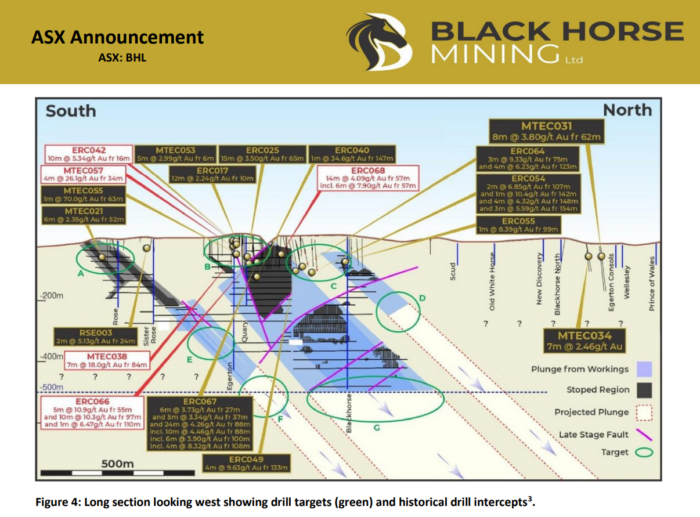
Further down the crew logged 29 metres of rock bleached by silica. Geologists read it as a trail left by hot fluids moving through the ground, and BHL called it a sign of a potentially large system.
Pyrite is the mineral they call fool’s gold, and the lab results due in December will show how much real gold came with it.
The rig is already on the second hole. Later holes go after the Sister Rose fault, where the crew sampled 10.79 grams of gold a tonne in an old tunnel.
Last week managing director David Frances told us investors had probably been wondering what the hell was going on at Mt Egerton. We think plenty of them stuck around, because it takes a crowd to move a stock 25% before a single assay.
We had a great response to our interview with Frances last week on where the project is at.
Read the video transcript: David Frances, Black Horse Mining (ASX: BHL)
It was a bit of a frustrating start for us, and investors have probably been wondering what the hell’s going on. The only reason really was because we couldn’t get access because it was too wet. We were as frustrated as anybody with the drilling, but we did put that time to good use.
We rehabilitated the Sister Rose adit, which then showed us this new structure which has got gold in it. So we didn’t sit around doing nothing. We were busy, it just wasn’t drilling, which is what everybody wants to see. We’re coming out the back end of that now, and we’ve started drilling again.
The asset itself, Mt Egerton, is an old historic goldfield in the Bendigo-Ballarat zone. It’s a very well known and highly well endowed gold zone. It was an old historic mine, one of only eight in Victoria that produced over a million ounces from hard rock. So not alluvial, an actual hard rock mine. It was stopped in about 1906, and they produced 1.29 million ounces that we know of. So a real gold mine.
It’s a very small footprint, track-mounted, silenced rig that can drill to about 1,000 metres of NQ. So that gives us the ability to test those deep parts of the ore body, which we’re really interested in. And we’re just about to finish the first hole of a 4,000 metre program with nominally eight to 10 holes.
Unfortunately, there’s no evidence at surface of where any of the historical infrastructure was. All of the shafts have been obliterated by bulldozing and all the rest of it. We know the system’s there, but we don’t know exactly where it is.
This first hole was not where we wanted to drill first, but because of the wet winter, we had to put it on a high site. And the higher priority target was the Sister Rose number one splay, which we announced recently, which had been closed for 100 years. We found a structure that was 1.3 metres wide, going nearly 11 grams per tonne.
The reason that was probably overlooked in those days, it was right on the cut-off of what those guys were mining. But for us, with modern techniques, 1.3 metres at nearly over 10 grams is pretty good. So we really wanted to check that as our first priority, just see how extensive it was, how far it went. There is a historical hole about 12 metres below it that hit two metres at five grams as well.
End of November, early December, we’re probably expecting the first results from core that we would cut from this hole. If we do start to look and we start to get some success on the deeper areas, I’d be surprised if we stop drilling.
Sure, it’s not the main north-south structure that the Mt Egerton lodes are hosted in. It’s a splay off that. And if that is the case, then there’s likely to be other situations of that structural situation within the mine itself, which is significant for us, obviously, because it increases the targets and potentially the gold endowment.
Anything from three grams to nine grams now underground, everyone’s mining it, and that hasn’t been mined at all from a massive ore body that’s produced 1.3 million ounces. That stuff’s still there. That’s the stuff people are actually mining now. That’s the prize for us.
Why the Gold Price Had Its Worst Week in Eight Months
Last week we wrote that anyone who bought gold at January’s record of US$5,594 an ounce was down about 30%. It’s 37% now.
Gold fell about 9% this week to around US$3,530, its lowest since September last year. It’s a far cry from not too long ago when there were queues down the street outside ABC Bullion in Sydney’s Martin Place.
Most of the damage came from the Fed, where the heads of its New York and St Louis branches both said this week more rate rises are likely. Traders now put the odds of a rise in December at about 98%.
The big funds sell gold when rates rise because they can earn more in US government bonds. The US dollar is also near a 19-month high on the back of higher rates, and a strong dollar makes gold dearer for buyers everywhere else.
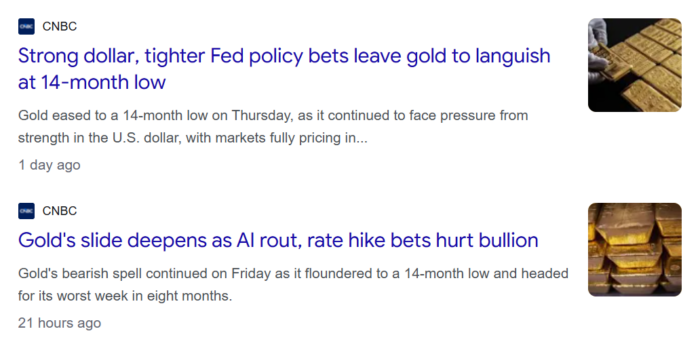
Fund managers also sold gold to cover their losses on tech stocks.
Gold miners fall harder than gold because their profit is what’s left after costs. A miner spending US$2,000 to produce an ounce made about US$3,600 an ounce at January’s record.
At this week’s price it makes about US$1,500, so its profit has more than halved.
It’s why so many gold stocks sit a long way under their January and February highs.
A miner still makes good money at US$3,500 an ounce. Last week we wrote about central banks buying the most gold in two years while the traders sold, and we’re still on the central banks’ side.
Anthropic IPO Raises More Than Any Float in History
We said last week that if fund managers paid the top of the range for Anthropic after the week AI stocks had, we’d take it as a sign they still want it.
They paid US$5 over the top.
The Claude creator priced its float at US$83 a share on Wednesday night in New York, above the US$70 to US$78 range it set the week before. It raised about US$81 billion, more than SpaceX did in June and more than any company has ever raised in a float.
Seven tech companies also agreed to buy another US$26 billion of shares at the float price.
The shares opened on the Nasdaq the next day at US$111.50 and closed at US$97.17, up 17%. By close of business Friday they were US$88.91.
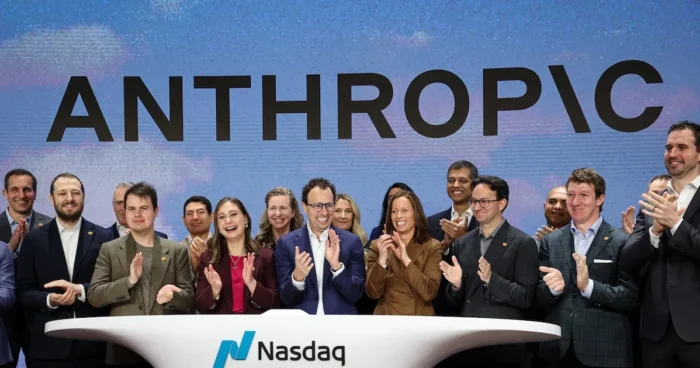
One estimate reported this week has about 2,800 current and former staff holding at least US$1 million in vested shares. Another puts 598 of them at US$100 million or more, before counting the founders.
Most of them got there by turning up to work and holding on.
We think floats this size drain money from the rest of the market. Anthropic joins the Nasdaq 100 on December 21, and the index funds tracking it will sell other stocks to pay for their slice.
Between SpaceX and Anthropic, fund managers have had to find more than US$150 billion this year for two companies. Small-caps sit at the back of the queue when money gets tight.
For scale, Firmus was valued at A$44 billion when it pulled its float in October, and Anthropic raised US$81 billion in a night.
Actinogen Medical (ASX: ACW) Alzheimer’s Trial Misses
The toughest announcement of the week came from a Sydney biotech with one drug.
Actinogen Medical (ASX: ACW) fell 82% to 0.8c on Thursday after its Alzheimer’s pill missed the main goal of its biggest trial.
The pill is called Xanamem. Patients take it once a day and it’s designed to lower the stress hormone cortisol in the brain.
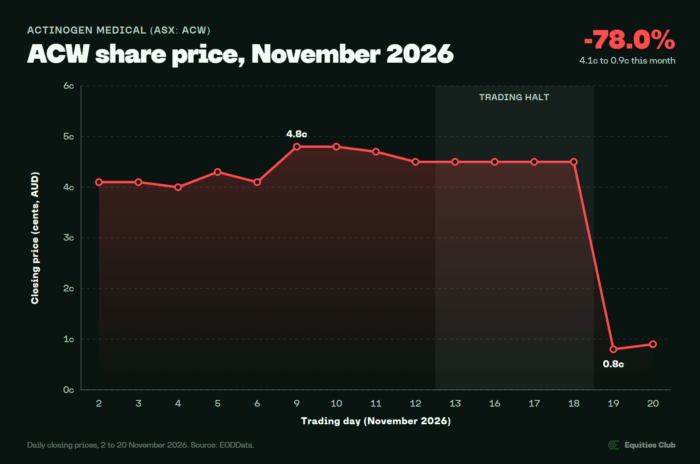
Actinogen tested it on 247 Alzheimer’s patients over 36 weeks, and across the whole group it made almost no difference against a dummy pill.
It did better in patients over 75, where 40% on Xanamem showed no decline against 22% on the dummy. Actinogen plans to take the result to the US regulator.
Actinogen has $18.9 million in the bank, which it says lasts into 2028. It has paused spending on a bigger trial until it finds a partner.
We like biotech and treat it as high risk, high reward, because a one-drug company rides on one result. We feel for the holders who wore this one.
Powerhaus Uranium (ASX: POW) Gets the Green Light at Malbec
Siobhan Lancaster told us this week we’d never get her too bullish early on with anything, so we’ll do it for her.
The managing director of Powerhaus Uranium (ASX: POW) has just been handed the environmental approval to trench and drill Malbec, her uranium project in southern Argentina.
You can find our full write-up here.
Our full chat with Lancaster is below.
Read the video transcript: Siobhan Lancaster on drilling Malbec, Powerhaus Uranium (ASX: POW)
This has been two years’ worth of work, so it’s really exciting. We’re in this game to find uranium, and serious uranium deposits.
As I said in our previous interview, we had done a huge global search around the world. This is the location that we decided had the biggest probability and chance of success, and was the most untapped opportunity. So we are so excited to get out there, to be able to trench, to be able to drill.
Our main target is the roll front uranium systems, which we believe have an analogy to the Kazakhstan-style roll front systems. Kazakh roll front systems are the lowest cost uranium mines in the world. They’re amenable to in situ leach recovery mining, which is low environmental impact and is a form of mining which is allowable within the Chubut province.
The target drill hole depth is between 150 and 200 metres for those drill holes. It’s chasing the Salamanca Formation, which is about 100 metres thick.
The second target type is the calcrete uranium target type. We have an expression or anomaly at surface at the Malbec program, so this has sort of layered in a second conceptual target for us.
We’ve done a lot of sampling on surface, and it tends to be quite extensive over two of the plateaus there. The grades are up to 770 ppm, with the average grade, I think, sitting around 250 ppm at the moment. We’ve done some more soil sampling recently and expanded that footprint on both plateaus.
As we dig and get into the calcrete, we’re seeing consistently that there are expressions of elevated radioactivity across those plateaus as well. So it’s exciting to be able to trench those areas and really get down below and see what’s there.
The trenching program is due to start in December. The initial program will be 10 trenches across two of the plateaus, Terrace del Mall and Aguada de Piedra.
The second thing that we’re going to be doing is starting the drilling, which is very exciting. That will be starting in January, and that program is expected to take up to five and a half weeks, drilling between 4,000 and 5,000 metres and about 30 holes, we’re thinking.
Lots of news flow, and of course the assay results from the recent sampling that we’ve done on site as well. Hopefully the market comes back to the party by then as well, and the uranium trade continues to be a good trade to be in.
The approval came later than POW planned, and it allows up to 66 drill sites over two years. The plan at listing was 20 to 30 holes.
A backhoe starts cutting trenches in early December, and in January the rig drills the first uranium hole ever at Malbec.
The January rig goes deeper to hunt a Kazakh-style deposit. Kazakhstan has the lowest cost uranium mines in the world.
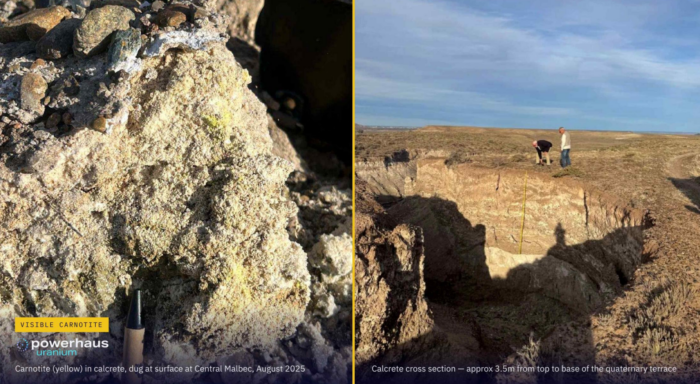
The crew has hand-dug pits on two terraces since October and seen yellow uranium mineral at both. She said they dug by hand because machines weren’t allowed on the ground until the approval came through.
In some pits the radiation detector lit up where it had read nothing from the surface, so the shallow uranium could run a lot further than POW’s maps show.
We’re as bullish on uranium as we’ve been. Power companies are signing long-term contracts at about US$99 a pound, the highest since records began in 1996.
Lancaster called it the strongest uranium market of her career and told us uranium stocks are back at their 2021 prices, when uranium was US$35 a pound.
POW is 16c and worth $13.6 million, about $8 million of it cash, and we think the next three months of results could change how people value it.
Her take on the uranium market is below.
Read the video transcript: Siobhan Lancaster on the uranium market, Powerhaus Uranium (ASX: POW)
I actually think the uranium market’s the strongest it’s been ever in my career. And in fact, you talk to any uranium commentator and they will agree that this is the best setup for a uranium market ever.
The prices of the equities don’t reflect where those uranium commodity prices are at the moment. They’re back at 2021 prices, the equity prices. In 2021, the uranium price was sitting at 35 bucks a pound, and now it’s almost 100 bucks a pound. So the dislocation doesn’t really make sense.
There is a supply deficit coming into the market, and this is what we’re trying to solve for at Powerhaus. Hopefully we can have a good discovery and help the situation come the 2030s, where there’s really not enough uranium in the market to be able to sustain this huge increased demand.
This is real demand. This is not made-up demand. This is demand from nuclear power stations being built at the moment around the world.
As I said in our previous interview, we had done a huge global search around the world, and this is the location that we decided had the biggest probability and chance of success, and was the most untapped opportunity.
It’s an exciting time to be doing what we’re doing. I’m hoping that equities catch up to the story again.
Mount Ridley Mines (ASX: MRD) Moves Up a Grade at Grass Patch
The whole world made about 80 tonnes of scandium oxide last year, most of it in China.
This week the scandium explorer in our portfolio firmed up 19,400 tonnes of it.
Mount Ridley Mines (ASX: MRD) holds the biggest reported scandium resource in the world at Grass Patch, a clay deposit near Esperance in WA.
You can find our full write-up here.
Resources come in three levels of confidence called inferred, indicated and measured, and a miner can only design a mine around the top two.
All of Grass Patch sat in inferred because the nickel explorers who drilled it kept patchy records of their lab checks.
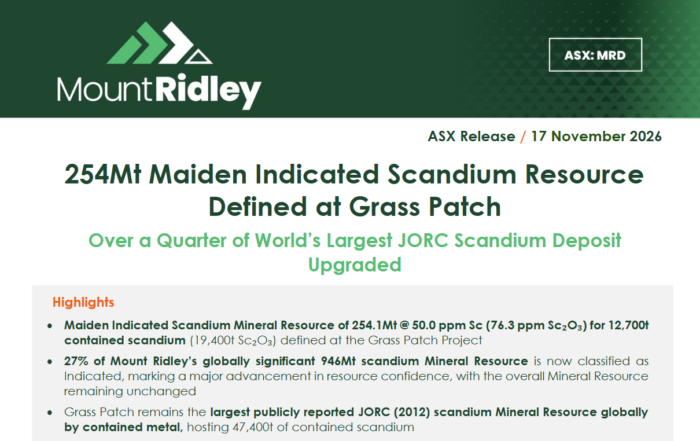
MRD sent 224 of their old sample bags back for testing and the scandium came back the same.
The geologist who signs off the resource then moved 254 million tonnes of clay up to indicated. It’s a quarter of Grass Patch and holds the 19,400 tonnes.
A mine study needs indicated tonnes, and government lenders and buyers want to see them before they put money in.
MRD is 3.9c and worth about $54 million, up from the 2.4c we backed it at in March. We think it’s still cheap for the company it’s become.
Fortuna Metals (ASX: FUN) Finds Rare Earths in Its Rutile
Zircon sells for more than rutile right now, and the rutile explorer in our portfolio found 97,400 tonnes of it this week in samples it already had.
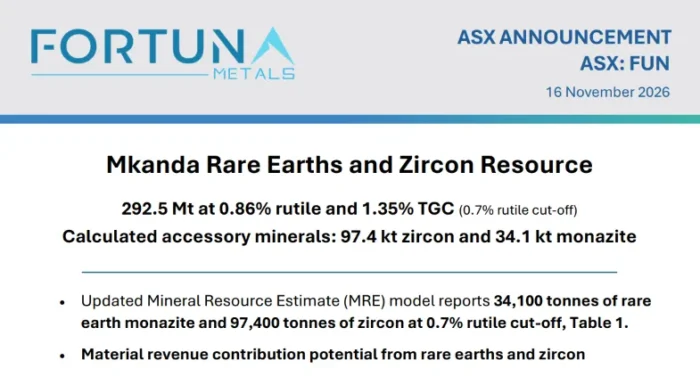
Fortuna Metals (ASX: FUN) went back through the samples behind its Mkanda resource in Malawi and counted two more minerals.
You can find our full write-up here.
Rutile is the purest natural source of titanium and Mkanda already holds about 2.5 million tonnes of it. The re-count added 34,100 tonnes of monazite to the zircon.
Monazite is the sand rare earths come from. Fortuna’s earlier assays found dysprosium and terbium in it, and high-powered magnets need both.
China has rationed the pair since April last year, and buyers outside China now pay about 20 times the Chinese price for dysprosium.
Neighbour Sovereign Metals found rare earths in its sand in January and put about US$722 million on them in its study. Fortuna has counted about half Sovereign’s monazite from only the top eight metres.
A lab is now testing how much of each mineral Fortuna can recover and sell.
FUN is 6.6c and worth about $28 million, with $11.4 million in the bank. We backed it at 4c.
More to sell from the same dig can only help the mine study that starts in December.
WA1 Resources (ASX: WA1) Delivers Its Study in a Tough Market
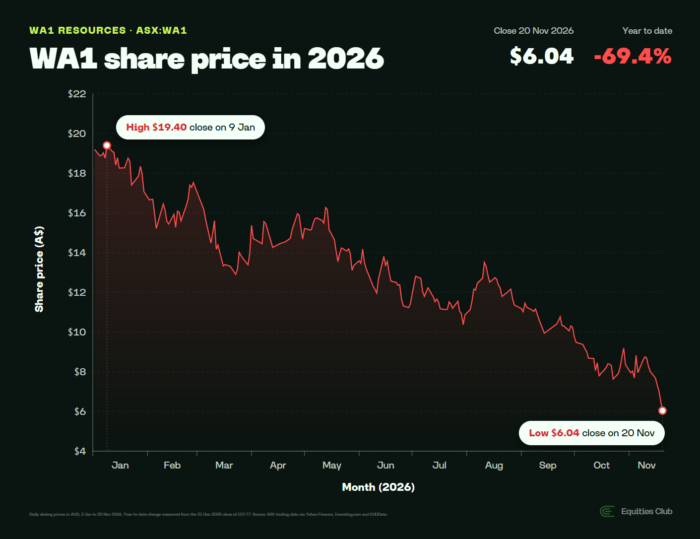
A share in WA1 Resources (ASX: WA1) cost 20c at its float and more than $22 after the company found niobium at Luni, in the remote West Arunta region of WA.
It started this year just shy of $20 and it’s $6 today. We think plenty of holders with big gains took them when they needed cash this year.
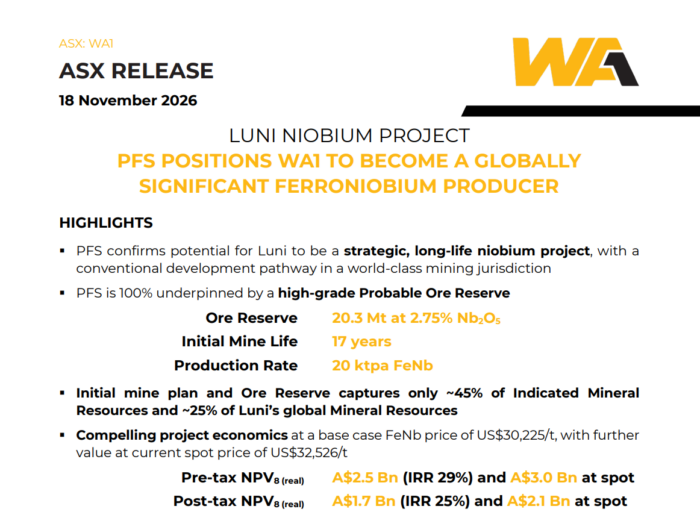
This week WA1 released its pre-feasibility study, which is the first proper costing of a mine at Luni. It has the mine producing 20,000 tonnes of ferroniobium a year for 17 years.
Steelmakers add ferroniobium to make steel stronger.
The study values the project at A$2.5 billion before tax, with average earnings of A$479 million a year.
The build costs A$1.1 billion including a refinery in Whyalla, and WA1 is worth about half as much. It has A$113 million in the bank and is still working out how to pay for the rest.
Brazil supplies most of the world’s niobium, so we’d expect Western governments and steelmakers to take a hard look. We think the share price stays stuck until WA1 shows where the rest of the money comes from.
DroneShield (ASX: DRO) Hits a New Low as the Market Sells
Counter-drone maker DroneShield (ASX: DRO) lifted its revenue 74% in the first half, and on Tuesday its shares touched $1.03, their lowest in more than a year.
It traded at $6.36 in October last year.
DroneShield builds the gear soldiers use to find and jam enemy drones. Revenue came to $125.8 million for the half and the company lost $32.2 million earning it.
The corporate regulator ASIC is still investigating its announcements and share trading from November last year.
On Tuesday US traders sold the chip stocks ahead of Nvidia’s results, and the ASX 200 fell 1.8% with tech and defence names among the hardest hit.
RBA governor Michele Bullock said the same day inflation here is still more likely to come in too high than too low.
When rates rise, fund managers sell the companies furthest from a profit first, and most of them are small-caps. Last week the Small Ords index of smaller companies fell 1.2% while the ASX 200 rose.
We still like defence, and we think a company growing this fast gets its turn again once fund managers stop selling anything with a loss.
The Week Ahead on the ASX
We don’t think it can get much worse than the week we’ve just had, and the men in their 30s should be back at their desks by Monday.
Copper-gold explorer Bubalus Resources (ASX: BUS) is in Perth this coming week for a roadshow, and we’re sitting down with managing director Brendan Borg. Bubalus is buying the Skyline project 10km from the old Mt Lyell mine in Tasmania and plans to start drilling there in January.
The October inflation figures come out on Wednesday. Prices were rising at 4% a year in August, and another hot number gives the RBA more reason to lift rates again, which makes it harder for small companies to raise money.
GTA V had a sharemarket you could punt on and we haven’t found one in the new game, so we’ll stick to real stocks.
Till next week.
General advice, disclosure and confidentiality
General advice warning
The contents of this document are intended to provide general securities advice only and have been prepared without taking account of your objectives, financial situation or needs. Because of that you should, before taking any action to acquire or deal in, or follow a recommendation (if any) in respect of any of the financial products or information mentioned in this document, consult your own investment advisor to consider whether that is appropriate having regard to your own objectives, financial situation and needs. If applicable, you should obtain the Product Disclosure Statement relating to the relevant financial product mentioned in this document (which contains full details of the terms and conditions of the relevant financial product) and consider it before making any decision about whether to acquire the financial product. Whilst Equities Club Pty Ltd (”Equities Club”) believes information contained in this document is based on information which is believed to be reliable, its accuracy and completeness are not guaranteed and no warranty of accuracy or reliability is given or implied and no responsibility for any loss or damage arising in any way for any representation, act or omission is accepted by Equities Club or any officer, agent or employee of Equities Club or any related company.
Neither Equities Club, nor any of its directors, authorised representatives, employees, or agents, makes any representation or warranty as to the reliability, accuracy, or completeness, of this document or any advice. Nor do they accept any liability or responsibility arising in any way (including negligence) for errors in, or omissions from, this document or advice.
Disclosure
The directors, authorised representatives, employees and associated persons of Equities Club may have an interest in the financial products discussed in this document and they may earn brokerage, commissions, fees and advantages, pecuniary or otherwise, in connection with the making of a recommendation or dealing by a client in such financial products. Equities Club owns 625,000 POW shares, 187,500 BHL shares,600,000 BUS shares, 2,083,333 MRD performance rights and 303,030 MRD shares, and 1,554,000 FUN shares at the time of publishing this article. Equities Club has been engaged by POW, FUN, and BHL at the time of writing.
Confidentiality notice
The information contained in and accompanying this communication is strictly confidential and intended solely for the use of the intended recipient/s. The copyright in this communication belongs to Equities Club. If you are not the intended recipient of this communication please delete and destroy all copies immediately.
Equities Club Ltd (CAR No. 001308139) is a corporate authorised representative of ShareX Pty Ltd, Australian Financial Services Licence (AFSL) No 519872