

About 25km north of Esperance in WA, Mount Ridley Mines (ASX: MRD) keeps shipping containers full of bagged drill samples at a project called Grass Patch.
The crews who filled the bags spent 2014 to 2022 looking for nickel and copper. They found little of either, so the bags went into storage. (Scandium was a tiny niche market in 2014 and wasn’t on their radar.)
We’ve been writing about the bags all year.
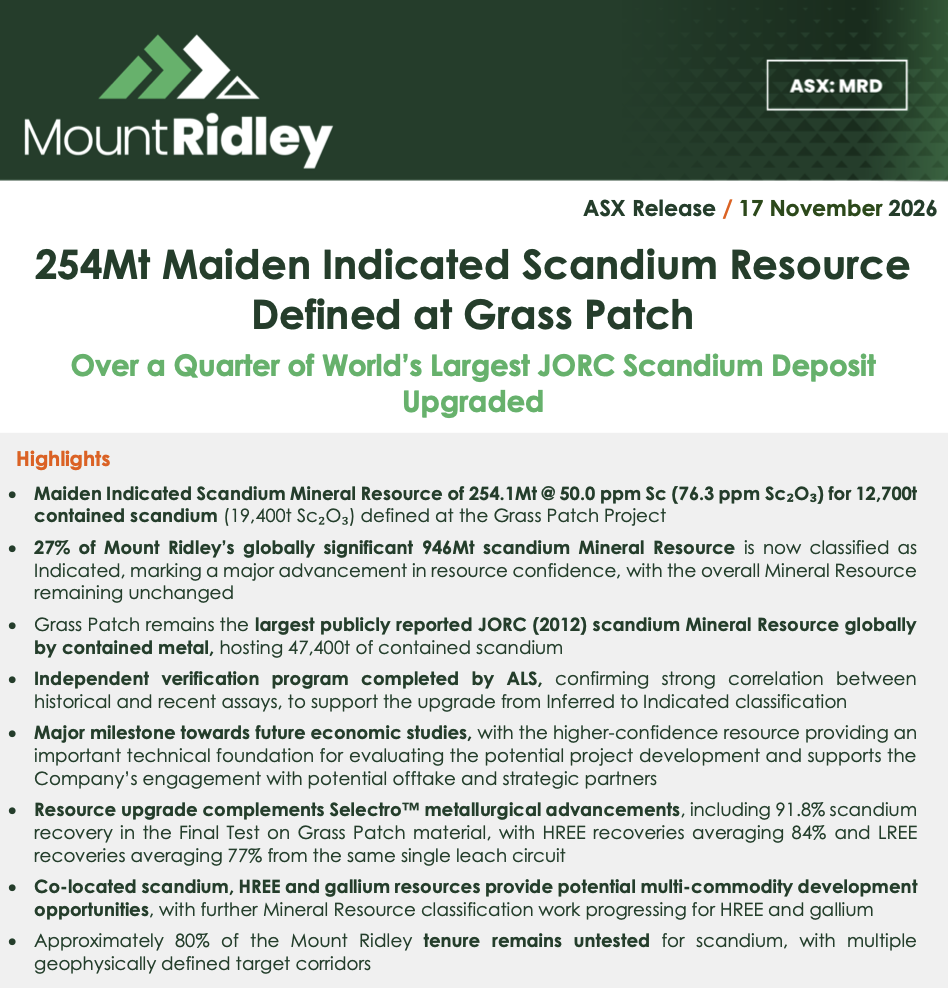
MRD sent thousands of them back to the lab to test for scandium, and in August the results made Grass Patch the biggest reported scandium resource in the world.
It holds 72,600 tonnes of scandium oxide. The whole world made about 80 tonnes last year.
China made most of the 80, and since April 2025 a buyer outside China has needed Beijing’s licence to get any (which isn’t easy to get).
The nickel crews didn’t keep enough quality-control records for their lab work, so the geologist would only grade the resource inferred. It’s the lowest grade there is.
This morning MRD told the market another trip to the containers has lifted 254 million tonnes of the clay up a grade to indicated.
It’s the driest announcement MRD has made all year, but we rate it alongside Selectro as the biggest step the company has taken.
An ASX-listed miner can only turn indicated tonnes into a mine plan, and governments and buyers want the same before they’ll commit money.
MRD closed yesterday at 3.9c, which values it at about $54 million. We backed it in March at 2.4c.
What Mount Ridley Mines Has at Grass Patch
We’ve covered Grass Patch plenty of times since MRD joined our portfolio in March, so regulars can skim this part and we’ll keep it short for everyone else.
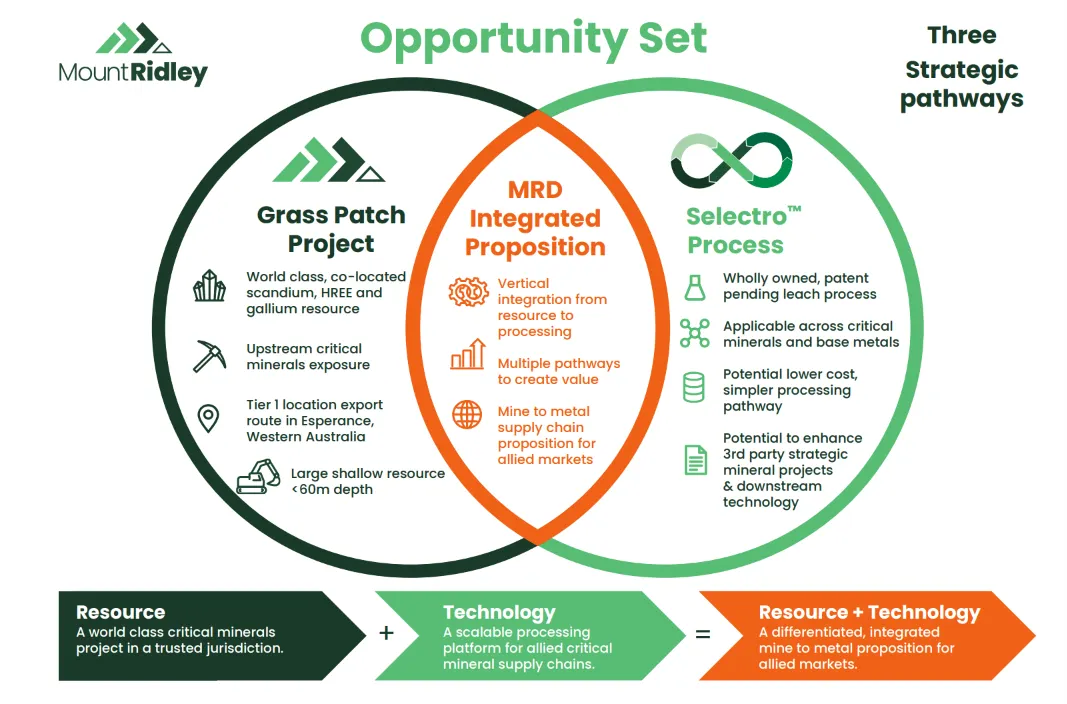
Grass Patch is a big body of soft clay that starts at surface, so an excavator can dig it up with no drilling or blasting. The port at Esperance is half an hour down the road, which keeps the cost of shipping down.
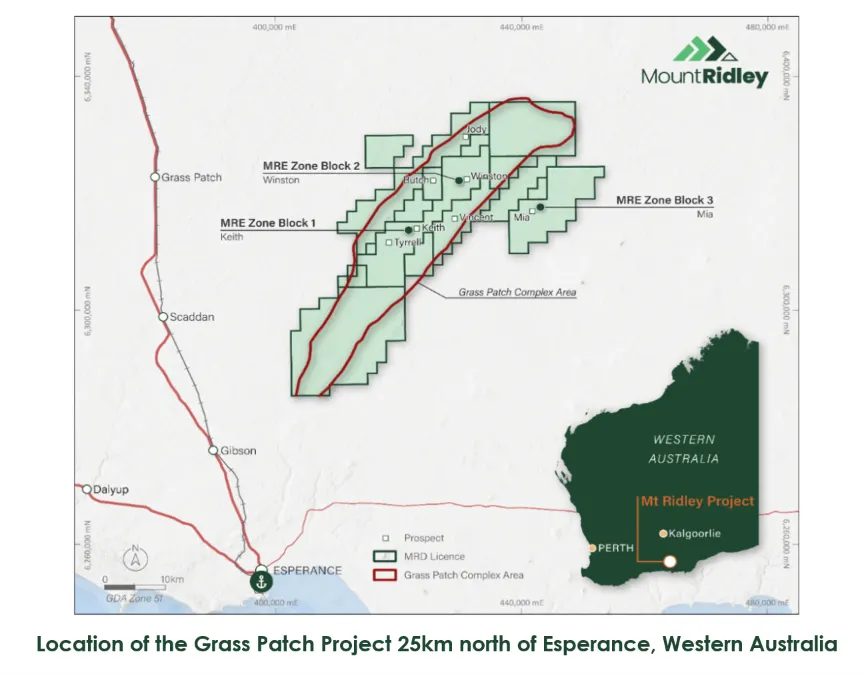
The clay holds scandium, heavy rare earths and gallium. China controls the supply of all three and Western governments are paying to find them somewhere else. Almost anywhere else.
Today’s news is about the scandium, which managing director Allister Caird once told us is “basically a steroid” for aluminium because a pinch of it makes aircraft alloys stronger.
To get a metal out of clay you soak the clay in a chemical bath, which the industry calls a leach. (Caird explains it with a tea bag. The clay is the leaves and the bath is the hot water.)
Grass Patch is low grade at about 50 grams of scandium a tonne, so a mine only pays if most of it comes out.
Most of the industry uses hydrochloric acid for the bath. MRD tried it on Grass Patch clay and got 27.6% of the scandium out, which left nearly three quarters behind.
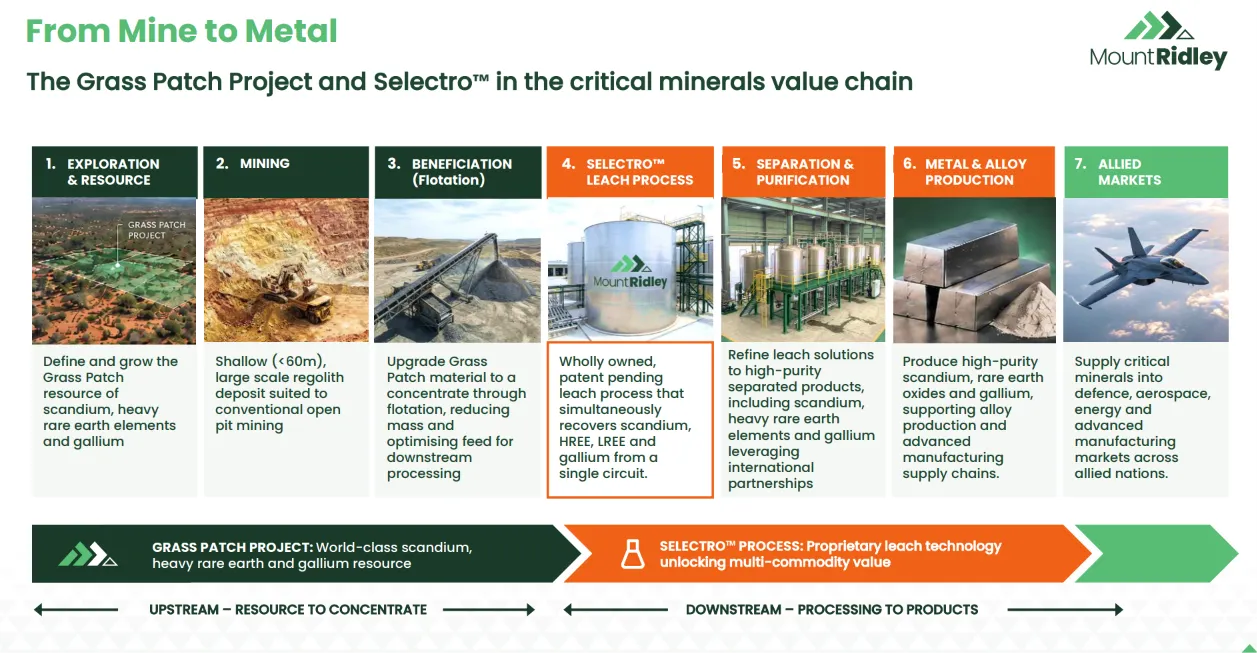
Then metallurgist Chris Larder joined MRD and brought a leach he’d spent more than a decade building. It’s called Selectro, and MRD owns it now.
Selectro got 91.8% of the scandium out of the same clay and used half the chemicals of its earlier tests.
It has since worked on other companies’ ore too, getting 95% of the gallium out of a bauxite and 96% of the vanadium out of an iron ore. MRD plans to license it to other miners.
Read the video transcript
Allister Caird, managing director of Mount Ridley Mines:
This bauxite result, I think we can all agree, is exceptional. 92% recovery of aluminium on a very first test, on a non-optimised basis.
So today we are able to announce that we’ve recovered 92% aluminium as well as 97% iron from a Darling Range bauxite sample, using our Selectro process, or the underlying chemistry of our Selectro process.
This result is obviously exceptional as a first-pass result. This bauxite test was the very first third-party test that we’ve undertaken using our underlying Selectro chemistry, and this just gives us more and more confidence moving into the next round of third-party test work.
As a rule of thumb, for every tonne of aluminium produced, you’re producing 1.5 tonnes of red mud. The red mud is a highly caustic sludge, essentially, which contains a lot of iron. There is up to 4 billion tonnes of red mud contained today, and there’s no really elegant solution to treat that waste stream.
The key with Selectro, and we’ve demonstrated it in this first test, is that we’re recovering the valuable elements from the bauxite, so those are aluminium and iron, and we’re leaving behind the waste, which is primarily the silica. We’re leaving more than 90% of the silica in the waste stream. That’s essentially a very benign, neutral pH residue.
The bauxite samples came from Australian Silica Quartz. Their projects are immediately to the west of South32, which is obviously now part of Alcoa’s bauxite leases or tenements.
We know that our Selectro process works now on Darling Range bauxite, and so we now have in hand some test results that are directly relevant to Alcoa. I think that’s really important because it gives us a lot of opportunity in terms of commercial discussions with a company like Alcoa, which obviously has a tremendous amount of upside.
And again, this is not necessarily the core of our business. We are a critical minerals explorer. Our flagship project is the Grass Patch project, 25km north of the Esperance deepwater port. That is where our focus is.
Having said that, it’s always nice to have that diversification opportunity and create value where other people weren’t looking, and where we’ve demonstrated that we have quite fantastic results.
We’ll admit we had no idea Selectro was coming when we bought in, and we now think it’s worth as much to MRD as the clay.
MRD’s Maiden Indicated Scandium Resource at Grass Patch
This morning a quarter of the Grass Patch scandium resource became solid enough to design a mine around.
Resources come in three grades of confidence called inferred, indicated and measured. The grade depends on how sure the geologist is the metal is really there.
Before today all 946 million tonnes of clay at Grass Patch were inferred.
The nickel crews kept their lab results. The geologist didn’t have enough detail on the checks behind them to be sure the old scandium grades were right.
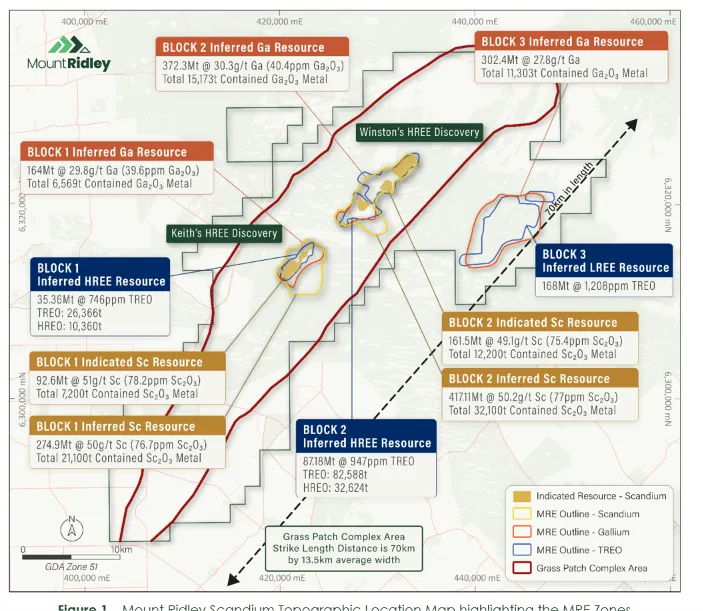
So MRD pulled about one in ten of the bags out of the containers, 224 in all, and sent them to the ALS lab in Perth to be tested again. It could match 77 of them to an old result.
The old and new results lined up. The drill holes were already close enough together in parts of Grass Patch, so the geologist moved 254.1 million tonnes up to indicated. They hold 19,400 tonnes of scandium oxide, which is a bit over a quarter of the total.
MRD got the upgrade for the cost of lab tests on 224 bags. A drill program would’ve cost many times more, and small explorers usually pay for drilling by issuing new shares.
MRD called today a major step towards its economic studies. The first big one is usually a pre-feasibility study, where engineers design the pit and the processing plant and work out what they’d cost to build and run.
Until there’s a study, MRD is valued on how much scandium is in the ground.
A study would tell us what a kilo of Grass Patch scandium costs to produce, which is the number we want most.
Caird was pitching Selectro at a mining conference in Turkey a fortnight ago. This morning he had this to say:
“This is a crucial step towards future economic studies and strengthens our position as we engage with potential strategic and offtake partners.”
Allister Caird, managing director of Mount Ridley Mines
Why the West Wants Mount Ridley’s Grass Patch Scandium
Scandium goes into fuel cells for AI data centres and aluminium alloys for aircraft and defence. It’s all a by-product of other mining.
Caird told us in April even American rare earth miners ship their ore to China to be processed. It’s why he wanted MRD to own a process, and four months later MRD lodged the patent on Selectro.
Canberra and Washington have pledged at least US$1 billion each towards a US$8.5 billion pipeline of critical minerals projects across the two countries.
MRD already has a materials agreement with the US government’s Oak Ridge National Laboratory, which lets the lab test Grass Patch material. An indicated resource puts MRD in a much stronger spot to ask for funding.
In August the Pentagon’s lending office made Sunrise Energy Metals a conditional offer of up to US$400 million to build a scandium mine in NSW. Sunrise was worth about $2.8 billion at the time.
MRD has more scandium in the ground than Sunrise and is worth $54 million.
We wrote in August the gap between the two was the main reason we own MRD.
Sunrise earned the gap with a finished mine study and Lockheed Martin holding an option to buy its scandium.
When we bought in, MRD had none of what Sunrise has. It now has a leach that works in the lab and, as of this morning, tonnes it can put into a study.
What Comes Next for Mount Ridley Mines
Selectro has only ever run in a lab, on samples as small as 90 grams. MRD’s engineers are now designing and costing a demonstration plant, and we want to see it get 90% of the scandium out by the tonne.
MRD is also testing a way to strip the waste out of the clay before the leach, so the plant uses less of the chemicals.
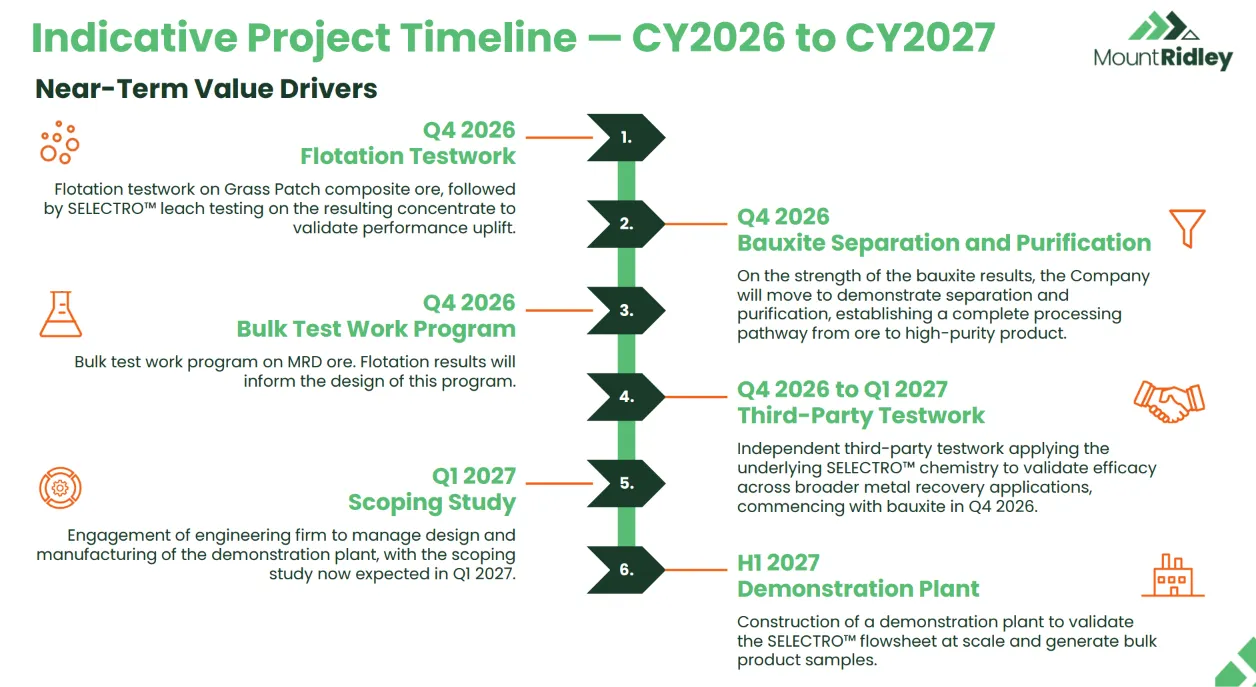
The geologists are working on the same upgrade for the heavy rare earths and gallium. If they get there, one mine study can count three products out of one dig and share the plant’s cost between them.
Selectro already gets all three metals out of the clay in one leach.
About 80% of MRD’s ground has never been tested for scandium. Grass Patch already holds centuries of the world’s supply, so we care more about MRD selling scandium than finding more of it.
The news we’d most like to see is a customer’s name on a contract to buy Grass Patch scandium. A fuel cell maker or an alloy maker signing up would do more for MRD’s valuation than any lab result.
Our Take on MRD’s Indicated Scandium
We bought MRD as a $32 million rare earths explorer.
Eight months on we’re writing about scandium and a leach called Selectro, with the stock up 60%.
Back then we called the metallurgy “the biggest unknown hanging over this stock”. We’d say Selectro has mostly settled it in the lab, and it’s worked on two other companies’ ores as well.
The scandium resource is two-and-a-half times the size it was when we added it to the portfolio.
Today a quarter of it moved up a grade, which gives MRD the footing for a mine study.
It’s all still lab work and paperwork, and Selectro has beaten our expectations on each run so far.
Small-caps have had a rough year and MRD has climbed through it. We thought it was cheap then, and we think the company it’s turned into still is.
General advice warning, disclosure and confidentiality notice
General advice warning
The contents of this document are intended to provide general securities advice only and have been prepared without taking account of your objectives, financial situation or needs. Because of that you should, before taking any action to acquire or deal in, or follow a recommendation (if any) in respect of any of the financial products or information mentioned in this document, consulting your own investment advisor to consider whether that is appropriate having regard to your own objectives, financial situation and needs. If applicable, you should obtain the Product Disclosure Statement relating to the relevant financial product mentioned in this document (which contains full details of the terms and conditions of the relevant financial product) and consider it before making any decision about whether to acquire the financial product. Whilst the Equities Club Pty Ltd (“Equities Club”) believes information contained in this document is based on information which is believed to be reliable, its accuracy and completeness are not guaranteed and no warranty of accuracy or reliability is given or implied and no responsibility for any loss or damage arising in any way for any representation, act or omission is accepted by Equities Club or any officer, agent or employee of Equities Club or any related company.
Neither Equities Club, nor any of its directors, authorised representatives, employees, or agents, makes any representation or warranty as to the reliability, accuracy, or completeness, of this document or any advice. Nor do they accept any liability or responsibility arising in any way (including negligence) for errors in, or omissions from, this document or advice.
Disclosure
The directors, authorised representatives, employees and associated persons of Equities Club may have an interest in the financial products discussed in this document and they may earn brokerage, commissions, fees and advantages, pecuniary or otherwise, in connection with the making of a recommendation or dealing by a client in such financial products. Equities Club owns 2,083,333 MRD performance rights and 303,030 shares at the time of publishing this article. Equities Club has been engaged by MRD at the time of writing.
Confidentiality notice
The information contained in and accompanying this communication is strictly confidential and intended solely for the use of the intended recipient/s. The copyright in this communication belongs to Equities Club. If you are not the intended recipient of this communication please delete and destroy all copies immediately.
Equities Club Ltd (CAR No. 001308139) is a corporate authorised representative of ShareX Pty Ltd, Australian Financial Services License (AFSL) No 519872.