
On the edge of Port Pirie in South Australia, 41 shipping containers sit beside 11,000 solar panels. They house Australia’s first grid-scale vanadium flow battery, soaking up cheap solar power at midday and feeding it back into the grid during the evening peak.
It stores energy in tanks of liquid containing dissolved vanadium. Bigger tanks mean more hours of storage.
ARENA backed the Port Pirie project with $5.7 million and runs the federal government’s $500 million Battery Breakthrough Initiative. Building more vanadium flow batteries means more demand for the liquid, one of their biggest costs.
China makes about three quarters of the world’s vanadium. Most of it is dug up as an iron ore called titanomagnetite, which has vanadium and titanium locked up inside it.
To get the vanadium out, the industry roasts the ore with sodium salts at up to 1,200°C and then washes it with water. The vanadium comes out and gets sold. The titanium and the iron go to the scrapheap.
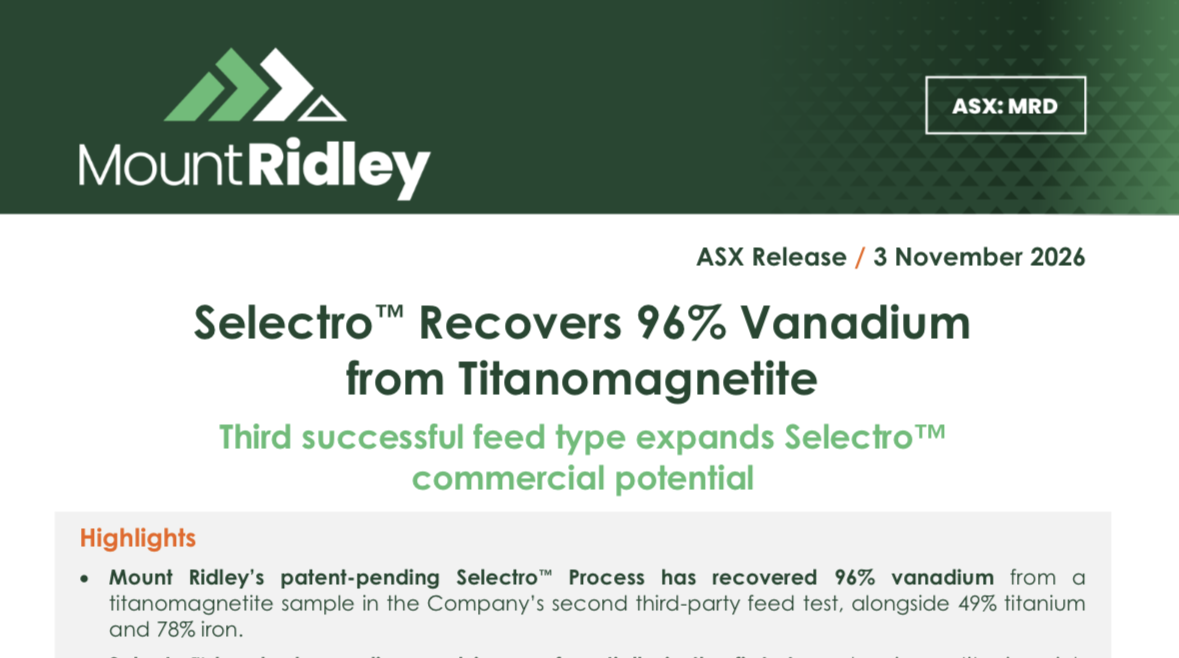
MRD put the 96% in the headline of this morning’s announcement.
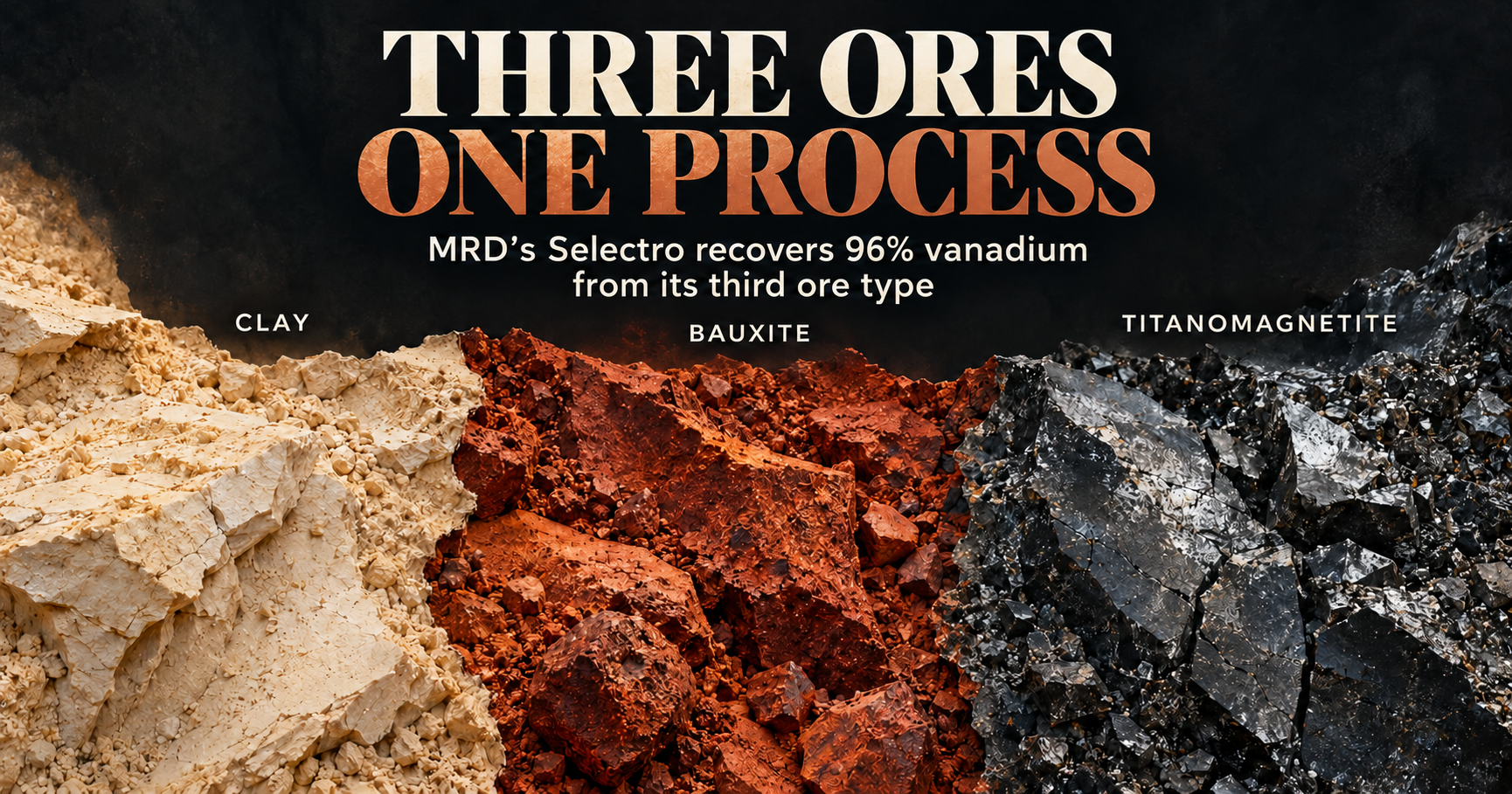
This morning our portfolio company Mount Ridley Mines (ASX: MRD) said Selectro recovered 96% of the vanadium from a titanomagnetite sample without roasting it, and took 49% of the titanium and 78% of the iron along with it.
Selectro has now run on three ores. So far it’s pulled out:
- 92% of the scandium out of MRD’s own clay,
- 92% of the aluminium and 95% of the gallium out of another company’s bauxite, and
- 96% of the vanadium out of this one.
Every new ore Selectro cracks gives MRD another corner of the mining industry to sell its processing tech into.
A process that has worked on three different ores would normally belong to a company a lot bigger than $63 million, and MRD closed yesterday at 4.5c.
The Third Ore Through Mount Ridley’s Selectro Leach
Selectro is a chemical bath MRD built to pull scandium and rare earths out of the clay at Grass Patch, its deposit 25km north of Esperance in WA. The industry calls the bath a leach.
On its own clay it recovered 92% of the scandium against 28% for the industry’s hydrochloric acid.
Then in October MRD borrowed some bauxite from another company and Selectro took 95% of the gallium out of it.
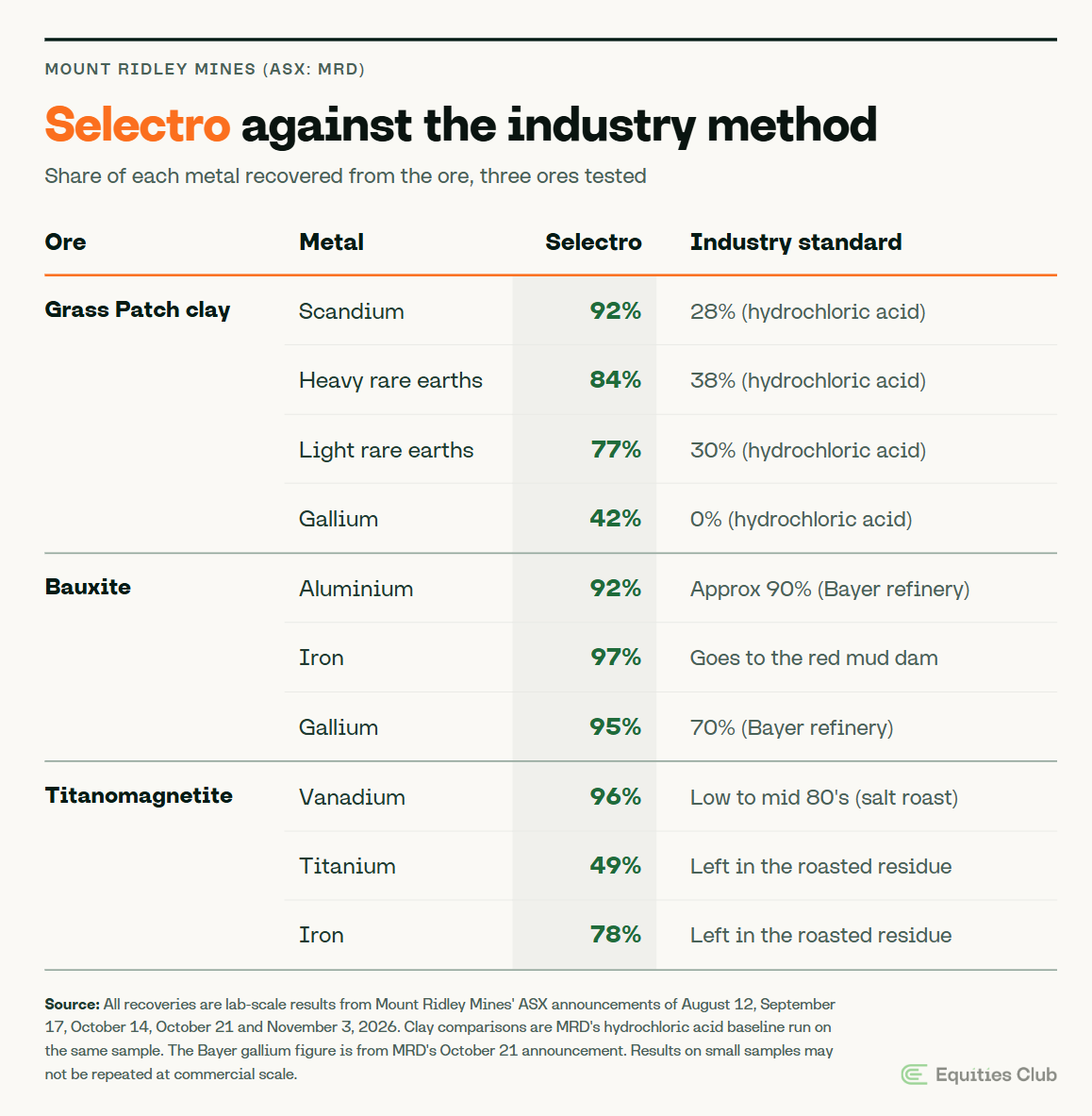
Selectro against the industry method on all three ores, from MRD’s announcements between August and this morning.
An aluminium refinery doing the same job leaves a caustic sludge called red mud, which has no use and sits in a dam forever. Selectro left a small pile of sand.
Titanomagnetite is the third ore and the second from outside the company.
A leach is normally a recipe for one ore. Selectro was built for clay, and in the space of a month it has worked on bauxite and an iron ore at the first attempt, before anyone tuned it for either.
MRD’s whole plan rests on the process working on other people’s ore. Every time it does, a new commodity opens up for the licence, and clay rare earth projects, aluminium refineries and vanadium producers have nothing to do with each other.
In March MRD was a company with one deposit. This morning it’s a company with a process three industries could pay to use, and the deposit is still there.
When we added MRD to our portfolio we were onboard for the scandium potential. The gallium out of bauxite in October was a bonus we never priced in, and vanadium was never on our list at all.
We think the process alone is worth more than $63 million after three ores, and let’s not forget MRD also holds the world’s biggest scandium resource.
How MRD’s Selectro Split the Vanadium From the Titanium
Allister Caird explained a leach to us last month with a tea bag. The ore is the leaves and the bath is the hot water, and the metal ends up in the water where you collect it.
This time MRD needed two cups.
The first cup took almost all the vanadium and most of the iron and barely touched the titanium. Only 9 units of titanium out of every 100 came out. MRD’s view is the water was already full of iron and vanadium and had no room left for the titanium, the way salt stops dissolving once you put too much in a glass of water.
So MRD poured the first cup off, put the leftover solids into fresh water and let it go again. With the iron and vanadium mostly gone, the titanium came out, and by the end of the second cup 48 units out of every 100 had been recovered.
Add the two cups together and Selectro got 96% of the vanadium, 49% of the titanium and 78% of the iron out of the sample. The second cup hasn’t been tuned yet, and MRD expects the titanium number to climb once it is.
The part we like most is what was left in each cup. The first ended up holding mostly vanadium and iron and the second mostly titanium. MRD set out to get the metals out of the ore and got them partly sorted into two cups as well.
Getting each metal back out of the bath as its own product is a separate job from getting it out of the ore, and MRD hasn’t done it on any ore yet. The announcement calls this result a proxy for separation, and MRD thinks it can control the split by adjusting the conditions.
Separation is the expensive part of any processing plant, and Selectro made a start on it without trying. We’d have taken 96% of the vanadium on its own and called it a good day.
“Titanomagnetite is the world’s primary source of vanadium but it has historically been processed for vanadium alone. Recovering 96% of the vanadium from the sample while also bringing titanium and iron into solution shows Selectro has the potential to unlock more value from this feed, which could improve the economics of titanomagnetite projects.”
Allister Caird, managing director of Mount Ridley Mines
What MRD’s Selectro is Worth to a Vanadium Producer
Vanadium is bought and sold as a powder called vanadium pentoxide, priced by the pound. The sample MRD ran graded 1.3%, which is 13kg of the powder in every tonne of ore.
At last year’s Chinese price of about US$5 a pound, a tonne of this ore carries about US$145 of vanadium.
Selectro brought half the titanium and three quarters of the iron out with the vanadium, running in a bath below 100°C.
MRD’s pitch to the owners of this ore is two more products to sell from every tonne, and a far smaller fuel bill because a bath under 100°C burns a lot less than a roast at 1,200°C.
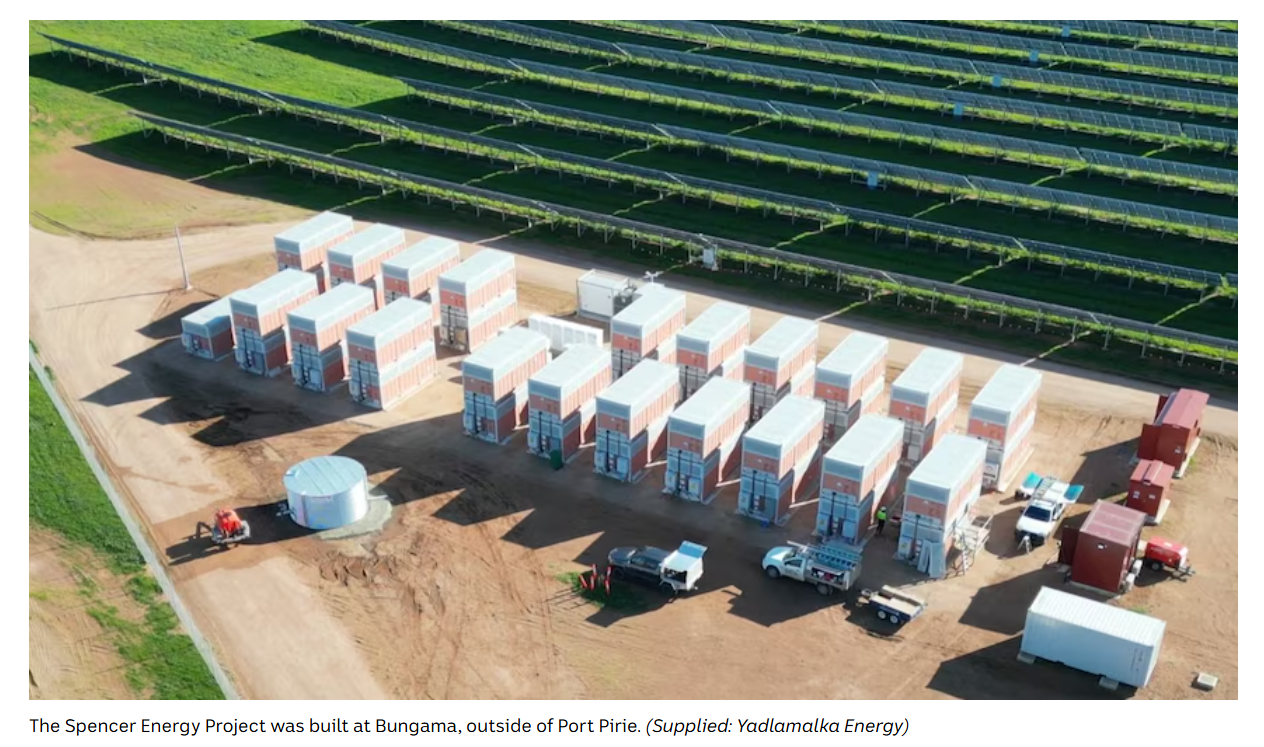
The flow battery outside Port Pirie, 41 containers of vanadium liquid beside the solar farm it charges from. Photo: Yadlamalka Energy.
The vanadium ends up in batteries like the one at Port Pirie. MRD says the vanadium price is high and jumps around because three quarters of the supply sits in China, and the price has made flow batteries hard to finance. A cheaper source outside China is what the battery builders have been waiting on.
Governments here are trying to build one. Queensland has just finished a processing plant in Townsville so a company can prove it can turn Queensland vanadium into flow battery liquid, and Canberra has its $500 million battery fund behind the industry.
MRD’s pitch to the battery crowd is more vanadium out of every tonne, processed here.
Australia, Japan and the US are paying for Alcoa’s gallium plant, which gets 70% of the gallium out of bauxite. MRD got 95% in a lab. We’d say the same governments should be looking at this vanadium number the same way.
What the Titanium Means for MRD’s Scandium
We wrote in August the process might end up worth more to MRD than the ground it sits on. Three ores later we’d drop the might.
The titanium also ties back to Grass Patch. The clay there holds 47,357 tonnes of scandium, the biggest reported scandium resource in the world. Scandium’s main use is making alloys stronger.
Put it in titanium and the metal holds its strength at higher temperatures, which is why aerospace and defence are the first customers in line for titanium-scandium alloys.
MRD’s CSIRO program is already testing them (our article on MRD’s CSIRO scandium program). The alloys are still in the lab everywhere, and MRD thinks a company with its own scandium can get in before they go commercial.
Whoever ends up making titanium-scandium parts for aircraft will need scandium, and MRD holds more of it than anyone.
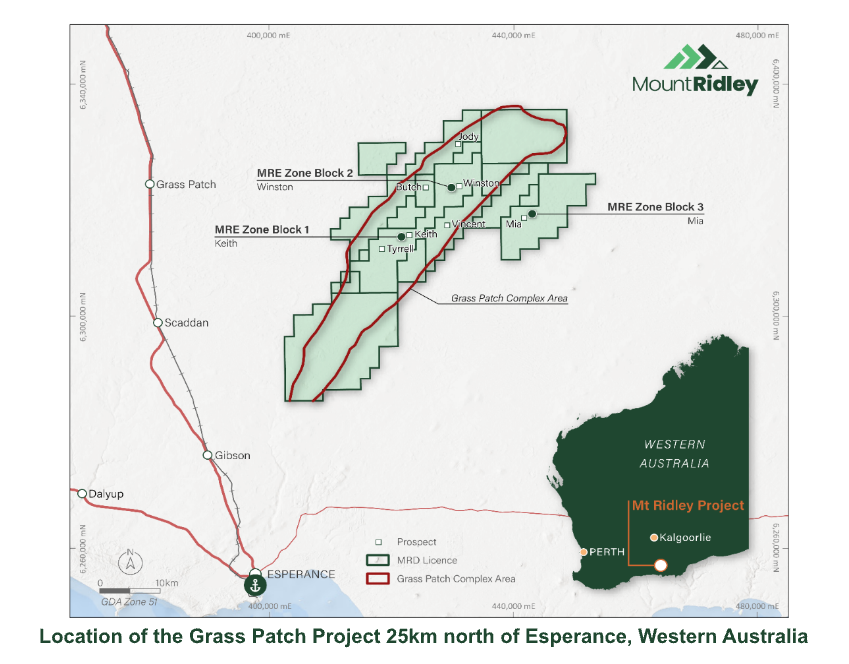
Grass Patch, 25km north of Esperance, the clay Selectro was built for. Map from MRD.
Our Take on Mount Ridley Mines (ASX: MRD)
We bought MRD at 2.4c in March for the scandium in the clay, and at 4.5c the stock is up about 88% on our entry.
Everything so far has happened in a bath. The bigger bauxite test, which MRD calls separation and purification, has to turn the metals in the bath into powders someone will buy.
Until MRD can hand someone a bag of alumina and a bag of gallium, Selectro is a set of lab numbers. Even if they’re the best lab numbers we’ve seen from a company this size.
MRD is talking to engineering groups about its demonstration plant, and with three ores tested the plant can run other companies’ ore for prospective licensees as well as Grass Patch clay.
It is also taking this morning’s result to vanadium and titanium producers, and more outside ores wait for 2027 unless someone makes it worth MRD’s while sooner.
Caird flies to Ankara this week to put Selectro in front of a conference of miners and technology companies from around the world. The organisers are paying his flights, and the vanadium result will be burning a hole in his pocket when he walks in.
MRD wants a royalty on a process running inside other people’s plants. A $63 million company holding the world’s biggest scandium resource and a leach that has now worked on three ores seems cheap in our book, and this morning it added vanadium and titanium to the list.
General advice warning, disclosure and confidentiality notice
General advice warning
The contents of this document are intended to provide general securities advice only and have been prepared without taking account of your objectives, financial situation or needs. Because of that you should, before taking any action to acquire or deal in, or follow a recommendation (if any) in respect of any of the financial products or information mentioned in this document, consulting your own investment advisor to consider whether that is appropriate having regard to your own objectives, financial situation and needs. If applicable, you should obtain the Product Disclosure Statement relating to the relevant financial product mentioned in this document (which contains full details of the terms and conditions of the relevant financial product) and consider it before making any decision about whether to acquire the financial product. Whilst the Equities Club Pty Ltd (“Equities Club”) believes information contained in this document is based on information which is believed to be reliable, its accuracy and completeness are not guaranteed and no warranty of accuracy or reliability is given or implied and no responsibility for any loss or damage arising in any way for any representation, act or omission is accepted by Equities Club or any officer, agent or employee of Equities Club or any related company.
Neither Equities Club, nor any of its directors, authorised representatives, employees, or agents, makes any representation or warranty as to the reliability, accuracy, or completeness, of this document or any advice. Nor do they accept any liability or responsibility arising in any way (including negligence) for errors in, or omissions from, this document or advice.
Disclosure
The directors, authorised representatives, employees and associated persons of Equities Club may have an interest in the financial products discussed in this document and they may earn brokerage, commissions, fees and advantages, pecuniary or otherwise, in connection with the making of a recommendation or dealing by a client in such financial products. Equities Club owns 2,083,333 MRD performance rights and 303,030 shares at the time of publishing this article. Equities Club has been engaged by MRD at the time of writing.
Confidentiality notice
The information contained in and accompanying this communication is strictly confidential and intended solely for the use of the intended recipient/s. The copyright in this communication belongs to Equities Club. If you are not the intended recipient of this communication please delete and destroy all copies immediately.
Equities Club Ltd (CAR No. 001308139) is a corporate authorised representative of ShareX Pty Ltd, Australian Financial Services License (AFSL) No 519872.